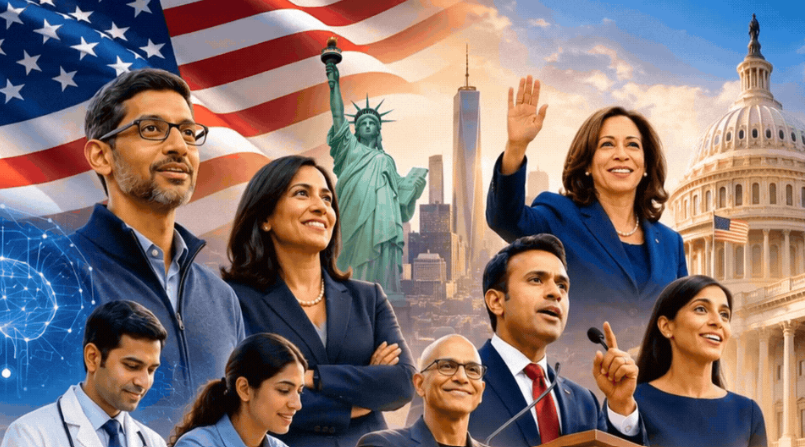
When the United States commemorates the 250th anniversary of the Declaration of Independence on July 4, 2026, it also marks another remarkable milestone in the country’s evolving identity the extraordinary rise of the Indian American community.
Representing just over one percent of the US population, Indian Americans have achieved an influence that extends far beyond their numbers. Today they lead some of the world’s largest Technology companies, occupy prominent positions in government, drive medical innovation, launch billion-dollar startups, and contribute significantly to America’s research, education, and entrepreneurial ecosystem.
Their story is not simply one of Immigration success. It reflects broader themes that have defined modern America: opportunity, education, innovation, diversity, and economic mobility. Over six decades, Indian Americans have transformed from a relatively small immigrant population into one of the nation’s most educated, affluent, and professionally accomplished communities.
As America enters its next quarter millennium, the journey of Indian Americans offers important insights into how immigration and talent have helped shape the country’s global leadership.
The Growth of the Indian American Community
The modern history of Indian immigration to the United States accelerated after the landmark Immigration and Nationality Act of 1965, which eliminated national-origin quotas that had significantly restricted immigration from Asia.
The reform fundamentally changed America’s immigration landscape by opening new opportunities for skilled professionals, students, scientists, engineers, physicians, and entrepreneurs from India.
Over the following decades, successive waves of immigrants contributed to rapid demographic growth.
| Key Demographic Indicator | Overview |
|---|---|
| Estimated Population | Approximately 5.2 million people of Indian origin in the United States. |
| Share of US Population | Just over 1 percent. |
| Position Among Asian Americans | Second-largest Asian-origin community. |
| Major Growth Driver | Post-1965 skilled immigration. |
What began as a relatively small migration has evolved into one of America’s most successful immigrant communities.
Education: The Foundation of Success
One of the defining characteristics of Indian Americans is exceptionally high educational attainment.
A substantial majority possess bachelor’s, master’s, doctoral, or professional degrees, making the community among the most highly educated demographic groups in the United States.
Several factors have contributed to this achievement:
- Strong emphasis on higher education.
- Large numbers of STEM graduates.
- Professional migration through skilled visa programs.
- Continued investment in graduate and postgraduate education.
- High participation in research and innovation.
This educational advantage has opened doors across industries requiring specialized expertise.
A Driving Force Behind America’s Technology Leadership
No industry better illustrates the influence of Indian Americans than technology.
Over the past three decades, Silicon Valley has become home to thousands of Indian engineers, software architects, entrepreneurs, venture capitalists, and executives WHO have helped shape the global digital economy.
Perhaps the most visible examples are the leadership of major multinational technology companies.
Indian-born executives have led globally recognized corporations, demonstrating how immigrant talent has become central to America’s technological competitiveness.
The broader contribution, however, extends well beyond a handful of CEOs. Indian Americans work throughout:
- Artificial Intelligence.
- Cloud computing.
- Cybersecurity.
- Semiconductor design.
- Enterprise software.
- Biotechnology.
- Financial technology.
Their innovations influence billions of users worldwide.
Entrepreneurship and Startup Culture
Indian Americans have also become one of the country’s most entrepreneurial communities.
Thousands of businesses founded by Indian immigrants now operate across sectors ranging from software and healthcare to hospitality, manufacturing, consulting, and retail.
Many entrepreneurs initially arrived as students or skilled professionals before launching companies that created jobs and attracted significant investment.
The startup ecosystem has particularly benefited from this combination of technical expertise, global networks, and entrepreneurial ambition.
Healthcare and Medical Excellence
Another sector where Indian Americans have made a profound contribution is healthcare.
Physicians, surgeons, medical researchers, pharmacists, and healthcare executives of Indian origin serve communities across the United States.
Their contributions include:
- Patient care.
- Medical research.
- Hospital leadership.
- Drug development.
- Public Health initiatives.
- Medical education.
During national health emergencies, healthcare professionals from diverse immigrant backgrounds, including Indian Americans, have played vital roles in strengthening the nation’s healthcare system.
Economic Success and Household Prosperity
Educational achievement has translated into strong economic outcomes.
Indian American households consistently report among the highest median incomes in the United States.
Several factors contribute to this success:
- High participation in professional occupations.
- Strong representation in STEM careers.
- Business ownership.
- Investment in education.
- Multi-generational professional advancement.
Higher household incomes also contribute to increased investment in education, Entrepreneurship, philanthropy, and community development.
The Growing Political Influence of Indian Americans
While early generations of Indian immigrants focused primarily on education and professional careers, recent decades have witnessed remarkable growth in political participation.
Indian Americans now serve across multiple levels of government, including:
- Congress.
- State legislatures.
- Governorships.
- Federal agencies.
- Local government.
- Judicial appointments.
This expanding representation reflects increasing civic engagement and voter participation across the community.
Historic Political Milestones
Several political achievements have marked important moments in the community’s evolution.
Indian Americans have reached some of the highest levels of public office, demonstrating growing acceptance and influence within American politics.
These milestones include:
- Election of governors.
- Representation in Congress.
- Cabinet-level appointments.
- Historic vice-presidential representation.
- Major presidential campaign participation.
Such developments have significantly increased the visibility of Indian Americans in national political discourse.
The Community’s Influence in Swing States
Although relatively small nationally, Indian Americans have become politically influential in several competitive states.
High voter turnout, strong educational engagement, and active participation in public affairs have increased the community’s importance during closely contested Elections.
Political parties increasingly recognize Indian Americans as an important constituency for policy discussions involving immigration, education, technology, healthcare, entrepreneurship, and foreign policy.
The India-US Relationship Benefits From People-to-People Ties
The growth of the Indian American community has also strengthened one of the world’s most significant bilateral Relationships.
People-to-people connections now support cooperation across:
- Technology.
- Education.
- Research.
- Trade.
- Investment.
- Healthcare.
- Defense innovation.
Many professionals maintain strong academic, cultural, and business links between the two countries, contributing to deeper strategic cooperation.
Comparison: Indian Americans Then and Now
| 1960s | 2026 |
|---|---|
| Small immigrant population. | More than five million people of Indian origin. |
| Limited political representation. | Representation across Congress and state governments. |
| Early professional migration. | Leadership across technology, medicine, academia, and finance. |
| Few globally recognized executives. | Leadership of major multinational companies. |
| Growing community institutions. | Well-established cultural, educational, and civic organizations. |
Challenges Alongside Success
Despite remarkable achievements, the community has also faced challenges.
Like many immigrant groups, Indian Americans have navigated issues including:
- Immigration policy changes.
- Visa processing delays.
- Recognition of foreign qualifications.
- Workplace discrimination.
- Balancing cultural identity across generations.
The ability to adapt while preserving cultural heritage has become one of the defining strengths of the community.
A New Generation Is Expanding the Definition of Success
The second and third generations of Indian Americans are entering fields beyond engineering and medicine.
Today they are increasingly visible in:
- Entertainment.
- Journalism.
- Sports.
- Public policy.
- Climate research.
- Creative industries.
- Public service.
This diversification reflects the maturation of a community that is now deeply integrated into nearly every aspect of American society.
The story of Indian Americans is no longer simply an immigration success story. It has become an American success story one demonstrating how education, entrepreneurship, innovation, and civic participation can transform both individuals and the nation they call home.
Future Outlook
As the United States enters its next 250 years, the influence of Indian Americans is expected to continue expanding across business, science, politics, higher education, healthcare, and emerging technologies. Growing representation in public institutions, combined with leadership in artificial intelligence, biotechnology, clean energy, and advanced manufacturing, positions the community to play an even greater role in shaping America’s future.
At the same time, the India-US relationship is likely to benefit further from strong people-to-people connections built through education, research collaboration, entrepreneurship, and investment. Indian Americans increasingly serve as cultural and economic bridges between the world’s oldest democracy and its largest democracy, strengthening cooperation in areas of strategic importance.
The remarkable rise of the Indian American community illustrates one of the enduring strengths of the American experiment: the ability to attract global talent and create opportunities across generations. As America celebrates 250 years of independence, the achievements of Indian Americans stand as a testament to how immigration, education, and innovation continue to shape the country’s economic vitality, democratic institutions, and global leadership.
For breaking news and live news updates, like us on Facebook or follow us on Twitter and Instagram. Read more on Latest World on thefoxdaily.com.






COMMENTS 0