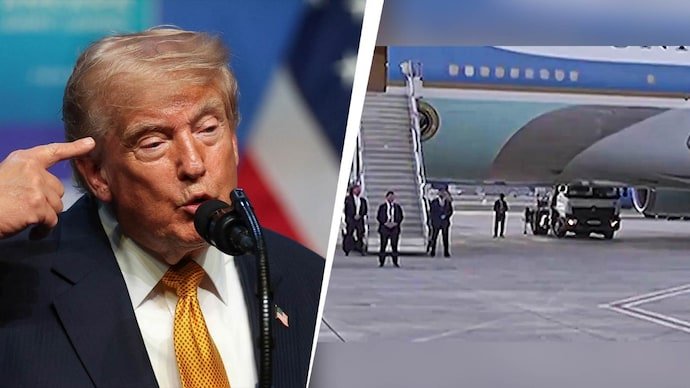
What appeared to be an ordinary departure from Turkey after the NATO summit on July 8 was reportedly a carefully choreographed presidential security operation.
US President Donald Trump was publicly seen boarding the familiar blue-and-white Boeing 747 that has served as Air Force One. Cameras captured the moment, and the White House had indicated that Trump would leave Turkey on the older presidential aircraft. But according to a report by The Washington Post, Trump had already been moved to a much smaller military aircraft after US officials identified a credible threat from Iran.
The extraordinary operation involved a C-32A military jet and, unexpectedly, an airport catering truck. The truck was reportedly used to move Trump and several aides from the larger Boeing 747 without exposing their movement to people watching from the other side of the aircraft.
The larger Air Force One then functioned as a decoy, allowing the public and some members of the travelling operation to believe Trump remained aboard it while the president was already airborne on another aircraft.
The reported operation highlights the extraordinary security measures surrounding a US president facing heightened threats and raises fresh questions about the security capabilities of the newer Boeing 747-8 that Qatar donated to the United States.
Trump appeared to leave Turkey on Air Force One
Trump’s departure initially looked completely routine.
Television cameras showed the president arriving at the airport in a limousine before walking toward the familiar presidential Boeing 747. He climbed the aircraft’s stairs, waved goodbye and appeared to board the plane that would take him out of Turkey.
The White House had previously indicated that Trump would leave Turkey aboard the older Air Force One. Trump himself had said he planned to use the aircraft “for old time’s sake”, while also suggesting that the plane’s presence in Britain would give US troops there an opportunity to see it.
That public plan appears to have been part of a much more complicated security operation.
According to The Washington Post, the newer Qatar-provided Boeing 747-8 had already departed Turkey earlier on July 8. The aircraft therefore was not the plane Trump ultimately used to leave the country.
Instead, a smaller C-32A was brought into the operation.
How the catering truck helped move Trump
The most unusual element of the reported operation was an airport catering truck.
Such trucks are normally used to transport meals and other supplies to aircraft. In this case, however, the vehicle reportedly became an important part of the effort to conceal the president’s movement.
After Trump and several aides boarded the older Air Force One, the catering truck was positioned on the opposite side of the aircraft. Its container was raised hydraulically toward the level of one of the plane’s doors.
The arrangement allowed Trump and his aides to leave the aircraft without being easily observed from the other side of the tarmac.
Footage reviewed by The Washington Post reportedly showed the truck moving across the airport toward a nearby C-32A. The vehicle was briefly outside the main camera view while attention remained focused on the larger presidential aircraft.
A person wearing a suit was subsequently seen leaving the cab and climbing the stairs into the smaller military jet.
The significance of the manoeuvre was not the truck itself, but the concealment it provided. By using a vehicle routinely associated with airport operations, security officials could move the president between aircraft without creating the visual signal that would normally accompany a presidential transfer.
What is the C-32A?
The C-32A is a modified Boeing 757 used by the US government to transport senior officials. It is capable of carrying the president or vice president and is more commonly associated with the Air Force Two call sign when the vice president is aboard.
Its smaller size also gives it a different operational profile from the large Boeing 747s used as Air Force One.
For the Turkey operation, however, the C-32A reportedly served a very different purpose: keeping the president’s actual location uncertain.
The smaller aircraft was sent to Turkey as part of the wider presidential Travel operation, alongside the larger Boeing 747s.
The reported deception was designed to buy time. If observers believed Trump was still aboard Air Force One, they would have little immediate reason to search for another aircraft carrying him.
Why would officials use Air Force One as a decoy?
The basic security principle is simple: protecting a president sometimes requires making it difficult for potential attackers to determine where the president actually is.
A presidential aircraft is highly recognisable. Its movements can be tracked visually, through aviation information and by the presence of large numbers of security and media personnel.
That visibility can become a vulnerability when officials believe a president faces a serious threat.
Using another aircraft while allowing the main presidential aircraft to continue appearing to carry the president can complicate surveillance and targeting efforts.
The reported Turkey operation therefore appears to have relied on deception rather than simply physical protection. Instead of trying only to make the president’s aircraft harder to attack, officials reportedly made it harder for potential attackers to know which aircraft actually contained the president.
The operation was unusual, but not unprecedented
The reported deception has historical precedent.
According to The Washington Post, the approach differed from the security measures adopted after the September 11, 2001, terrorist attacks. In that case, the George W. Bush administration initially concealed the president’s location but did not publicly create the impression that he was somewhere he was not.
A similar aircraft deception was reportedly used during President Bill Clinton’s visit to Pakistan in 2000.
Television cameras recorded Clinton disembarking from a plain white aircraft that had followed Air Force One. Only later did it become clear that Clinton had not travelled on the more visible presidential aircraft.
A former US official also told The Washington Post that other instances occurred over the past several decades in which Air Force One was used as a decoy because of serious security concerns or because the president was travelling to a dangerous location.
The Turkey operation therefore appears to belong to a broader presidential-security playbook in which deception can become an additional layer of protection.
Why Iran was central to the security concern
The reported aircraft switch came against a backdrop of sharply elevated tensions involving Iran and the United States.
A credible assassination threat is an especially serious concern for the US Secret Service and other national-security agencies because the president’s travel schedule is normally a highly visible target.
The reported decision to conceal Trump’s actual aircraft suggests that officials considered the threat significant enough to justify an unusually elaborate operation.
The episode also illustrates why presidential movements can be changed at short notice. Even when a White House itinerary is publicly announced, security officials retain the ability to alter transportation arrangements when intelligence changes.
The fact that journalists and even some White House staff reportedly remained unaware of Trump’s actual location underscores the degree of operational secrecy involved.
The Qatar-provided Air Force One faces renewed scrutiny
The reported incident has also drawn attention to the newer Boeing 747-8 donated by Qatar.
Trump arrived in Turkey aboard the Qatar-provided aircraft, which had recently undergone extensive work costing hundreds of millions of dollars. The plane is intended to serve as a future Air Force One after additional modifications.
Questions have nevertheless been raised about whether the aircraft has all the defensive capabilities found on the legacy presidential planes.
Those concerns are particularly significant in light of the reported decision to move Trump onto a different aircraft during a high-threat situation.
The White House has defended the security of the newer aircraft. Communications Director Steven Cheung said it is equipped with high-level security protocols designed to protect the president and his staff and emphasised the broad range of measures used to protect Trump.
Trump has also said the newer aircraft would undergo additional upgrades.
Why the jet switch matters beyond Turkey
The episode demonstrates that presidential aviation is not simply about choosing the largest or most technologically advanced aircraft.
Security depends on a combination of intelligence, aircraft capabilities, communications, escorts, routing and deception.
In some circumstances, the safest option may be to use a smaller aircraft precisely because its movements attract less attention.
The Turkey operation also shows the value of redundancy. Multiple presidential aircraft were present as part of the broader travel arrangement, giving security officials additional options if circumstances changed.
That flexibility can become crucial when a threat emerges after a president has already arrived in a foreign country.
The unusual role of the airport catering vehicle
The catering truck may be the most memorable detail of the entire operation, but its importance lies in how ordinary it looked.
Airport environments contain a constant flow of service vehicles, including catering trucks, baggage equipment and maintenance vehicles. Such traffic provides natural visual cover because observers are less likely to interpret every vehicle movement as part of a security operation.
According to the reported account, the truck’s hydraulic container created a physical screen between Trump and people positioned on the opposite side of Air Force One.
That gave the security team an opportunity to move the president without the kind of open-air transfer that would normally be visible to cameras.
The episode is a reminder that sophisticated security operations do not always rely on highly conspicuous Technology. Sometimes an ordinary airport vehicle can provide the most useful concealment.
What the operation says about presidential security
The reported jet swap demonstrates three important principles of protecting a president.
- Location secrecy matters: Keeping the president’s precise position uncertain can complicate efforts to target him.
- Deception can supplement physical protection: A decoy aircraft can make it harder for an adversary to identify the president’s actual aircraft.
- Plans can change rapidly: A publicly announced travel plan does not necessarily reflect the final security arrangement.
In Trump’s case, the operation reportedly combined all three.
Why some staff and journalists were reportedly fooled
The success of such an operation depends partly on limiting knowledge of the real plan.
If too many people know that the president is leaving one aircraft for another, the information can quickly spread. Journalists travelling with the president could unintentionally reveal the change through live reports, while staff members could disclose movements through communications or routine activity.
The reported fact that some White House personnel and journalists remained aboard the larger aircraft suggests that the deception extended beyond the general public.
That separation also created a convincing visual narrative: cameras saw Trump board Air Force One, and the aircraft subsequently continued its journey. Meanwhile, the president was already aboard another aircraft.
The bigger lesson from Trump’s Turkey departure
The reported operation is ultimately less about a dramatic plane switch than about how seriously US officials viewed the threat surrounding the president.
A normal presidential departure involves extensive security, but moving Trump secretly from one aircraft to another while leaving a decoy behind represents a substantially higher level of precaution.
The operation also highlights the continuing tension between presidential visibility and presidential security. Trump is one of the world’s most recognisable political figures, and his movements attract enormous media attention. That visibility can be politically useful, but it can also make concealment extraordinarily difficult when a credible threat emerges.
By using a smaller military aircraft, an airport catering truck and a decoy Air Force One, US security officials reportedly turned that visibility into an advantage: the aircraft everyone was watching was not the aircraft carrying the president.
The episode serves as a striking example of how presidential travel can change behind the scenes even when the public sees what appears to be a completely routine departure.
And in this case, the most important clue to what really happened was not the aircraft carrying the president, but the ordinary catering truck that helped him disappear from view.
For breaking news and live news updates, like us on Facebook or follow us on Twitter and Instagram. Read more on Latest World on thefoxdaily.com.


COMMENTS 0