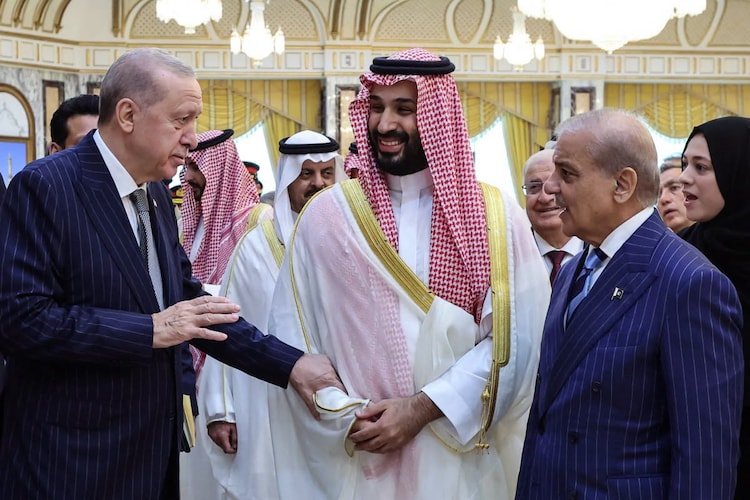
The Pakistan–Saudi Arabia–Türkiye defence pact signed in Mecca on August 7 has immediately raised a much larger question: is this simply a three-country security agreement, or the first step towards a broader Islamic defence bloc?
The Mecca Joint Defence Agreement commits the three countries to treating an armed attack against one member as an attack against all. Turkish Foreign Minister Hakan Fidan has compared the arrangement technically with NATO‘s collective-defence principle, while Turkish President Recep Tayyip Erdogan has backed the idea of expanding the framework beyond its three founding members. Egypt has already emerged as the clearest potential addition.
That has led some commentators to describe the arrangement as an “Islamic NATO” or “Sunni NATO”. The comparison is politically striking, but it needs qualification. The pact is still new, its institutional machinery is only beginning to take shape, and the three countries have not created an organisation comparable to NATO.
What is already clear, however, is that the agreement reflects a significant change in how some regional powers think about security. Saudi Arabia, Türkiye and Pakistan are signalling that they want greater capacity to coordinate their own defence rather than relying exclusively on outside powers.
What exactly does the Mecca Pact do?
The central principle is collective defence: an armed attack on one of the participating countries is to be regarded as an attack on all three.
That language is reminiscent of Article 5 of the North Atlantic Treaty, which is why the agreement has attracted so much attention. Fidan has said the pact is defensive and is not directed specifically against Iran or another named country. The agreement is also intended to complement existing alliances rather than replace them.
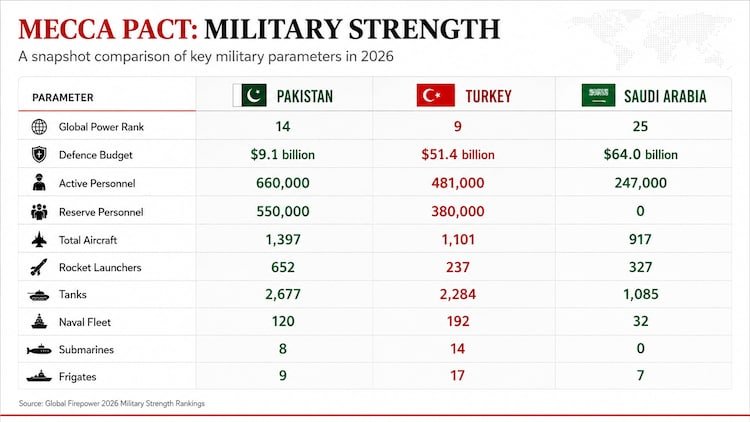
The distinction matters. NATO is supported by decades of institutional development, permanent command structures, military planning arrangements and extensive interoperability. The Mecca agreement does not yet possess that depth.
According to Reuters, the new arrangement is expected to establish a ministerial committee and a secretariat in Saudi Arabia, with operational details to be discussed as the mechanism develops. The pact itself was reportedly under development for nearly three years.
So the more accurate description at this stage is an emerging regional defence framework rather than a fully developed NATO-style military organisation.
Why are more countries being discussed?
The three founding members appear to see value in expanding the arrangement. Fidan has said the framework should not necessarily remain restricted to Pakistan, Saudi Arabia and Türkiye, and Egypt has been identified as the most prominent potential next member.
Egypt would be a particularly important addition. It has one of the largest armed forces in the Arab world, controls the Suez Canal and occupies a strategically important position linking the Mediterranean, Middle East and Africa.
Beyond Egypt, Qatar and Kuwait are frequently mentioned as possible participants, while Jordan and other regional states could potentially become part of a broader framework.
But there is an important difference between being discussed as a possible member and actually joining. Each potential participant has its own relationship with Washington, its own security priorities and its own calculations concerning Iran, Israel and neighbouring states.
Expansion therefore cannot be assumed.
Why Egypt could be the most important test
Egypt is arguably the country that could change the character of the agreement most dramatically.
Saudi Arabia brings financial power and a strategically important geographic position. Türkiye brings a large conventional military, NATO experience and a growing defence industry. Pakistan contributes a large military establishment and nuclear-armed status.
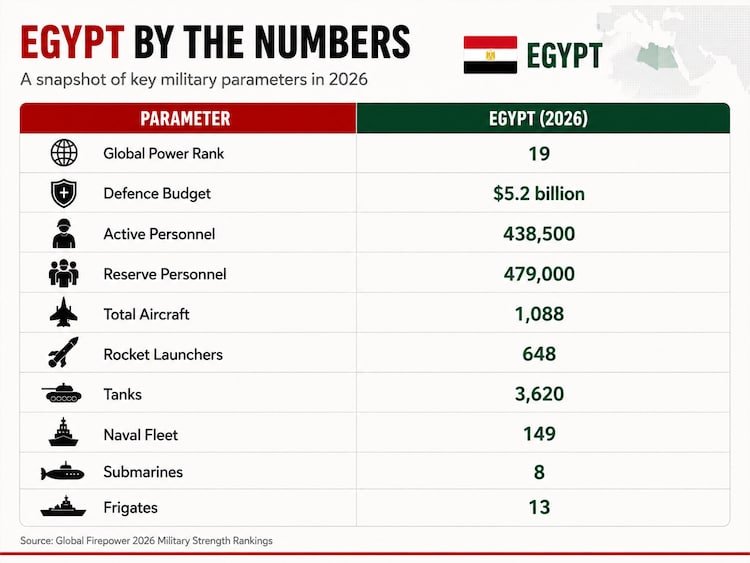
Egypt would add substantial Arab military weight and a country with longstanding influence in regional Diplomacy.
It would also make the agreement harder to portray as simply a Turkish-Pakistani-Saudi arrangement. With Egypt involved, the framework would have a stronger Arab dimension and a wider geographic footprint.
At the same time, Cairo would have to consider the consequences of entering a pact with a collective-defence clause. A commitment that treats an attack on another member as an attack on Egypt could create obligations that extend beyond Cairo’s preferred areas of military engagement.
That is one reason why expansion will be considerably more complicated than simply adding names to a list.
Could Qatar and Kuwait follow?
The Gulf states have a particularly strong reason to watch the development closely. Their economies and strategic infrastructure are deeply exposed to regional conflict, while their security relationships with the United States remain important.
Qatar hosts a major US military presence, while Kuwait has long been a significant American security partner. Joining a new collective-defence structure would therefore require careful balancing rather than an abrupt break with Washington.
Saudi Arabia’s own approach illustrates why this balancing act matters. Riyadh can strengthen relationships with Türkiye and Pakistan while continuing to maintain important ties with the United States.
The same logic could apply to Qatar and Kuwait. Membership in a regional framework would not necessarily mean abandoning America. It could instead provide an additional layer of security and diplomatic leverage.
Is this really about Iran?
Iran is impossible to ignore when examining the pact’s strategic environment, even though the founding members have stressed that the agreement is defensive rather than an anti-Iran alliance.
Saudi Arabia and Iran have historically competed for regional influence, although their relationship has also undergone periods of diplomatic rapprochement. Türkiye has its own complex relationship with Tehran, involving both cooperation and competition. Pakistan, meanwhile, shares a long border and important religious, economic and security interests with Iran.
That makes an overtly anti-Iran alliance difficult for all three.
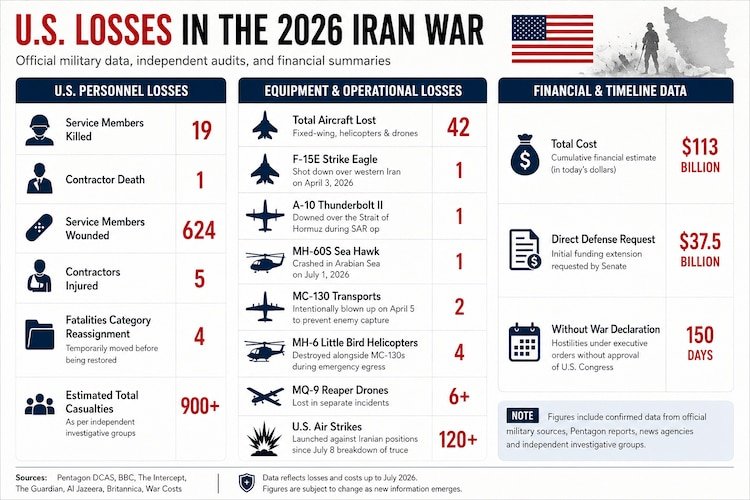
The more plausible interpretation is that the pact is designed to improve collective deterrence and give its members more options during a regional crisis.
In other words, Iran may be an important factor behind the security calculations without being the formal target of the agreement.
Did the United States create the conditions for the pact?
This is where the “US conspiracy” question becomes more complicated.
There is a difference between saying Washington secretly engineered the agreement and saying American policy helped create the circumstances in which regional states decided they needed more independent security arrangements.
The second argument has considerably more evidence behind it.
Saudi Arabia has increasingly pursued a foreign policy that seeks relationships with multiple major powers rather than dependence on one security provider. A previous Saudi-Pakistani Strategic Mutual Defence Agreement, signed in September 2025, already represented a significant strengthening of their security relationship and included language treating aggression against either country as aggression against both.
The addition of Türkiye takes that earlier bilateral relationship into a much broader strategic setting.
From this perspective, the Mecca Pact can be understood as hedging. Regional governments may continue to work with Washington while simultaneously building relationships that give them greater freedom if American priorities change.
But is Washington actually supporting it?
There is also evidence pointing in the opposite direction from the conspiracy theory.
US Representative Joe Wilson publicly welcomed the Pakistan-Saudi-Türkiye defence arrangement and described it as another achievement of President Donald Trump‘s efforts to promote stability, peace and prosperity in the Middle East.
That statement does not prove that Washington designed the agreement. Nor does it establish that the US government negotiated the pact behind the scenes.
It does, however, show why the idea of a simple US-versus-Mecca Pact narrative is inadequate.
Washington could view a greater regional security burden-sharing arrangement as useful if it reduces the need for the United States to carry the entire cost of regional defence. At the same time, regional powers could use the same arrangement to reduce their dependence on Washington.
Those objectives are not necessarily contradictory.
The real driver may be strategic uncertainty
The strongest explanation for the pact is therefore not necessarily an American conspiracy, but uncertainty about the future.
For decades, the United States has been the dominant external security power in the Middle East. American forces, bases, weapons systems and intelligence networks have played a major role in deterring threats and protecting partners.
Yet regional governments have also learned that American protection does not eliminate risk.
Missile and drone attacks can still threaten airports, energy infrastructure, military facilities and shipping routes even when sophisticated air-defence systems are deployed.
The result is a strategic dilemma. If regional states cannot guarantee that an outside power will prevent attacks, they have an incentive to improve their own deterrence and build additional partnerships.
The Mecca agreement fits that logic.
What each founding member brings
| Country | Strategic strength | Potential contribution |
|---|---|---|
| Saudi Arabia | Financial resources, strategic geography and significant defence spending | Funding, regional diplomatic influence and military capabilities |
| Türkiye | Large conventional military, NATO experience and defence industry | Military technology, training, industrial cooperation and operational expertise |
| Pakistan | Large armed forces and nuclear-armed status | Military manpower, defence cooperation and strategic deterrence |
The attraction of the arrangement lies partly in this complementarity. No single member possesses all of these advantages.
Saudi Arabia has money but has historically relied heavily on foreign military Technology and security partnerships. Türkiye has an increasingly capable defence industry but faces its own regional security challenges. Pakistan has substantial military capabilities and nuclear weapons but remains economically constrained.
Working together could allow each country to compensate, at least partially, for the vulnerabilities of the others.
Why the NATO comparison can be misleading
The phrase “Islamic NATO” is powerful because it immediately communicates the idea of collective defence. But it may also create unrealistic expectations.
NATO’s strength comes not simply from Article 5. It comes from the institutions built around that commitment: integrated military commands, common standards, exercises, planning, intelligence cooperation and decades of political coordination.
The Mecca framework has yet to establish comparable mechanisms.
Even the collective-defence principle will eventually face difficult questions. What constitutes an armed attack? How quickly must members respond? Does every member have to provide military forces? What happens if a member is responsible for escalating a conflict? What if another member believes intervention would threaten its own National Security?
These questions are more important than the symbolism of the signing ceremony.
The first real test will come during a crisis
The pact’s credibility will ultimately be measured not by the number of countries that sign it, but by what members do when collective defence becomes costly.
It is relatively easy for governments to agree on broad principles when no immediate military decision is required. It is much harder to decide whether to send aircraft, naval vessels, troops, intelligence or financial resources when another member is under attack.
This is particularly significant because the three founding countries face different strategic priorities.
Pakistan’s central security concerns include India and its own internal security challenges. Saudi Arabia is focused heavily on Gulf security and threats involving Iran and Yemen. Türkiye’s interests span the Middle East, the Black Sea, the Caucasus and its NATO commitments.
A common threat does not automatically create identical national interests.
Could this become a post-American security order?
It is too early to declare the beginning of a post-American Middle East.
The United States remains deeply embedded in the region through military partnerships, economic relationships, intelligence cooperation and longstanding alliances. Türkiye itself is a NATO member, making any claim that the new framework simply replaces the Western security system particularly difficult to sustain.
What may be changing is something subtler: the Middle East is becoming more comfortable with multiple overlapping security arrangements.
Instead of choosing between an American security umbrella and a completely independent regional system, countries may pursue both.
That would be a form of strategic hedging. A state can cooperate with Washington, deepen ties with Türkiye, maintain defence relations with Pakistan, engage China economically and keep diplomatic channels open with Iran at the same time.
The Mecca Pact could become one piece of that increasingly complicated architecture.
What happens if more Islamic countries join?
If Egypt eventually joins, the agreement would gain substantial political and military weight. If Qatar and Kuwait followed, its financial and Gulf dimension would become stronger. The participation of Jordan or other states could extend its geographic reach.
But expansion could also make decision-making harder.
The more countries that join, the more difficult it becomes to reconcile different threat perceptions. Some members may prioritise Iran, others Israel, others domestic security, maritime security or conventional military threats.
A larger alliance could therefore become more influential while simultaneously becoming less cohesive.
That is the central challenge facing the Mecca Pact.
Mecca Pact is more than a three-country deal, but less than NATO
The Mecca Joint Defence Agreement is significant because it formalises an idea that has been developing for years: regional powers want greater control over their own security calculations.
Whether the United States encouraged the arrangement, welcomed it after the fact or simply created conditions that made it attractive remains a separate question. The available evidence does not establish a secret American conspiracy behind the pact.
What can be observed is a convergence of interests. Saudi Arabia wants greater strategic autonomy. Türkiye wants to expand its regional influence and defence partnerships. Pakistan wants stronger international backing and a deeper strategic relationship with two influential Muslim powers.
The next chapter will depend on expansion.
If Egypt joins and other Gulf states follow, the Mecca Pact could evolve into a significant regional security organisation. If potential members remain cautious, it may instead remain a flexible three-country framework whose main value is deterrence and political signalling.
Either way, the agreement is an important sign that the security architecture of the Middle East is becoming more diversified.
The question is no longer simply whether America will remain the region’s security provider. Increasingly, countries in the region are asking what they should build for themselves if American guarantees become less predictable.
That is why the Mecca Pact matters. Its biggest consequence may not be the creation of an “Islamic NATO” overnight, but the gradual emergence of a Middle East in which regional powers are no longer willing to leave their security entirely in someone else’s hands.
For breaking news and live news updates, like us on Facebook or follow us on Twitter and Instagram. Read more on Latest World on thefoxdaily.com.




COMMENTS 0