Israel has entered a crucial phase of government formation after President Isaac Herzog selected opposition leader Gadi Eisenkot to try to assemble a governing coalition, giving Prime Minister Benjamin Netanyahu’s strongest political rival the first opportunity to form the next government.
The decision followed consultations with representatives of all parties elected to the 120-member Knesset. Factions representing 67 lawmakers recommended Eisenkot for the mandate, compared with 46 who backed Netanyahu. The seven-member United Torah Judaism faction did not recommend either candidate.
Although the recommendations gave Eisenkot a clear advantage in the presidential consultations, they did not amount to a confirmed parliamentary majority. He must still negotiate with parties that have different political priorities and, in some cases, sharply conflicting positions on the composition of a future government.
Israel’s October election produces another political deadlock
The October 27 election failed to give either of the two main political camps enough seats to govern independently. Netanyahu’s religious-nationalist bloc secured 53 seats, while the four-party bloc led by Eisenkot won 48. Arab-led parties captured the remaining 19 seats, giving them a potentially decisive role in the coalition negotiations.
Likud, Netanyahu’s party, emerged as the largest individual party with 27 seats. Eisenkot’s Yashar party won 21 seats, making it the second-largest party in the incoming parliament.
Israel’s parliamentary system requires a government to command the support of at least 61 members of the 120-seat Knesset. Neither main bloc reached that threshold, leaving the country dependent on negotiations between parties that disagree over security policy, religious influence, military service and relations with Arab political representatives.
The results also reflected a significant showing by Arab-led parties. The Joint List won 11 seats, while the United Arab List, known as Ra’am, secured eight. Their combined total of 19 seats represented an important shift in parliamentary representation and made their recommendations particularly significant during the presidential consultations.
Netanyahu’s bloc remained the largest grouping after the election, but its position was weakened by the loss of its previous parliamentary majority. Eisenkot, meanwhile, secured the support of more lawmakers during the consultation process, even though his own alliance also fell well short of the number required to govern.
Why President Isaac Herzog selected Eisenkot
Under Israel’s political system, the president consults elected parliamentary factions after an election and then assigns a member of the Knesset the task of forming a government. The process is intended to identify the candidate with the strongest possibility of assembling a parliamentary coalition.
President Isaac Herzog held discussions with representatives of all the factions elected to the new Knesset on November 5. At the conclusion of those consultations, he said that 67 lawmakers had recommended Eisenkot, while 46 had recommended Netanyahu. The remaining seven lawmakers did not endorse either candidate.
Herzog initially said he would conduct further discussions before making his decision, reflecting the difficulty of determining which candidate could overcome the political divisions between the parliamentary groups.
On Saturday evening, November 7, Herzog informed Eisenkot that he intended to assign him the responsibility of forming the next government. The president’s office announced that the formal appointment would take place at the President’s Residence in Jerusalem on Sunday, November 8.
The decision gives Eisenkot the first opportunity to negotiate a coalition. It does not automatically remove Netanyahu from office or make Eisenkot prime minister. Netanyahu remains in charge of the caretaker government until a new administration is formed and approved by the Knesset.
Eisenkot faces three difficult coalition options
Eisenkot’s biggest challenge is converting political endorsements into a functioning government. His existing four-party alliance has 48 seats, meaning he needs support from at least 13 additional lawmakers to reach the 61-seat majority threshold.
His potential partners include Arab-led parties, ultra-Orthodox factions and, theoretically, Netanyahu’s Likud. Each option carries political costs that could divide his own alliance or force him to reconsider campaign commitments.
1. Support from Arab-led parties
The Arab-led parties could provide the parliamentary support needed to bring Eisenkot’s wider political grouping to 67 seats. Both the Joint List and Ra’am recommended him during the presidential consultations, giving him the largest number of endorsements among the candidates considered.
However, support from these parties does not necessarily mean they will join a government. Eisenkot has indicated that he does not intend to bring Arab-led parties into his governing coalition, while some of his political partners have also opposed relying on their support.
Avigdor Liberman’s Yisrael Beiteinu party is particularly resistant to a government dependent on Arab-led factions. The disagreement creates a serious obstacle because the Arab parties’ parliamentary strength could be essential if Eisenkot cannot reach an agreement with other groups.
A minority government supported by Arab lawmakers from outside the coalition has also been discussed as a possible arrangement. Such an approach would allow Arab parties to support the government on confidence votes or other parliamentary matters without holding ministerial positions. However, it would remain politically controversial and could face resistance from members of Eisenkot’s own alliance.
2. Negotiations with ultra-Orthodox parties
Another possible route involves the ultra-Orthodox parties Shas and United Torah Judaism. Together, they hold 13 seats, which would take Eisenkot’s 48-member alliance to the required 61 if both agreed to join.
However, the two sides disagree over one of the most contentious issues in Israeli politics: military service exemptions for ultra-Orthodox men studying in religious institutions.
Eisenkot and his partners made equal military and national service a central part of their election campaign. They have argued that military obligations should be shared more fairly across Israeli society, particularly as the country continues to face security pressures.
Ultra-Orthodox parties have traditionally defended exemptions for members of their communities engaged in full-time religious study. They are likely to seek guarantees protecting religious institutions and their students as part of any coalition agreement.
The dispute has become more significant following legal and political challenges to the longstanding exemption arrangements. A government agreement on the issue could require substantial concessions, potentially undermining one of Eisenkot’s central campaign promises.
3. A national unity arrangement with Netanyahu
Netanyahu has publicly called for a national unity government involving Eisenkot. Such an arrangement could theoretically bring together the two largest political camps and provide a broader parliamentary base.
However, the two leaders have been political rivals, and their differences extend beyond the distribution of ministerial positions. Eisenkot has campaigned on changing the direction of the government and addressing issues that have divided Israeli society.
A unity arrangement would also require decisions about Netanyahu’s existing far-right partners. Eisenkot’s party has indicated that any agreement with Likud would require a different political configuration rather than simply continuing the current coalition with a new partner.
Power-sharing governments have also faced difficulties in Israel because disagreements over budgets, security decisions and leadership arrangements can quickly undermine cooperation. Even if Netanyahu and Eisenkot began negotiations, reaching a durable agreement would remain complicated.
Military service exemptions become a central issue
The question of compulsory service has emerged as one of the biggest obstacles to government formation. Israel maintains compulsory military service for most Jewish citizens, although several exemptions and alternative arrangements exist.
Ultra-Orthodox men studying in religious institutions have historically benefited from arrangements that allowed many to defer or avoid military service. The system has faced growing criticism, particularly during periods of military mobilisation and prolonged security operations.
Eisenkot, a former chief of the Israel Defense Forces (IDF), has argued that national responsibilities should be shared more equally. His political alliance has promoted a framework under which citizens would undertake military, national or civil service according to their circumstances.
For Eisenkot, reaching an agreement with ultra-Orthodox parties without weakening this commitment could prove difficult. For those parties, supporting a government that significantly changes existing exemptions could create political risks among their voters.
The issue also has wider implications for Israel’s military manpower, public finances and social cohesion. Any future coalition agreement addressing the subject could influence the relationship between religious communities, the military and the wider population.
Netanyahu challenges election outcome and calls for unity
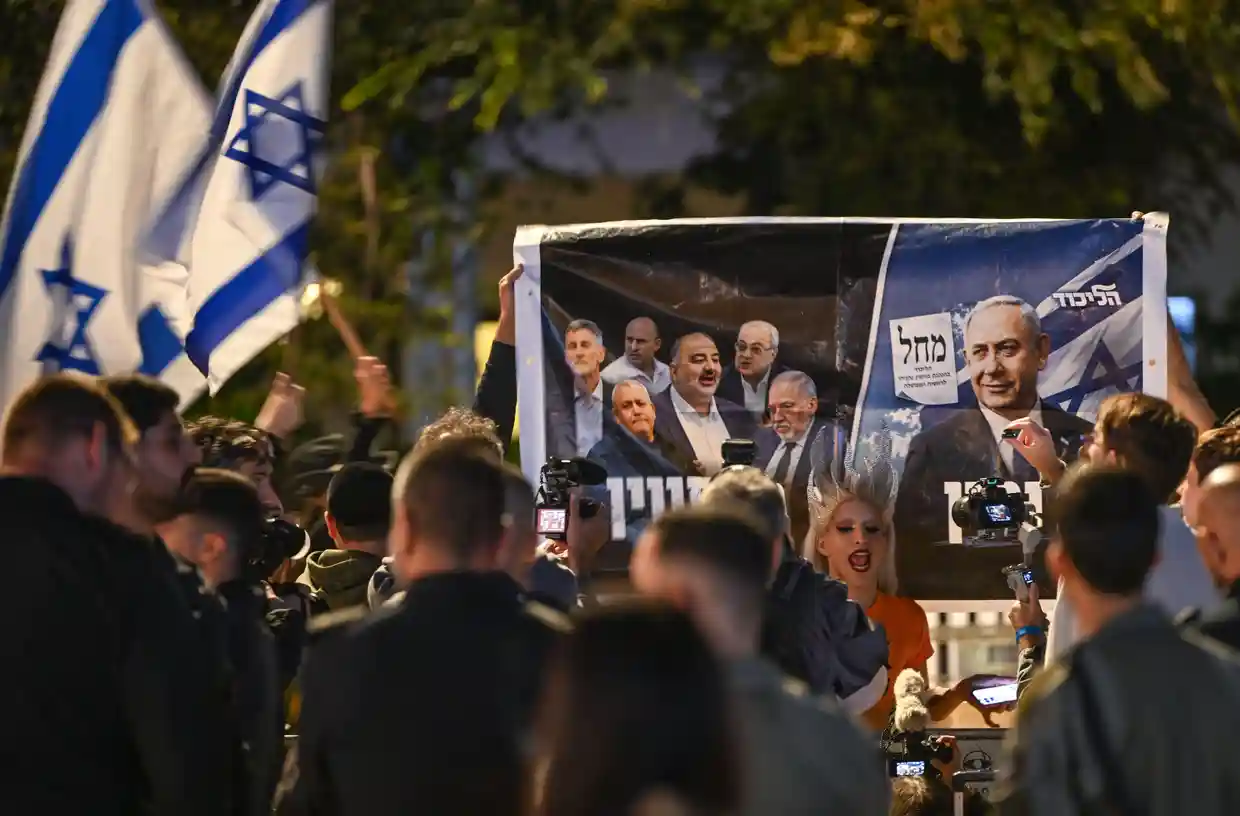
Netanyahu’s political position has weakened following the election, but he has continued to argue that his camp should play a central role in the next government. He called for a national unity arrangement with Eisenkot after Herzog announced his intention to give the opposition leader the mandate.
The prime minister has also repeatedly claimed that Arab parties influenced the election through increased voter mobilisation and described the outcome as having been stolen. However, he has not provided substantiated evidence demonstrating that the vote was invalidated by wrongdoing.
Israel’s election authorities and President Herzog have maintained that the election result was valid. The Central Elections Committee reviewed the outcome and approved the final results after examining complaints and irregularity claims. The official seat distribution remained unchanged.
Israel’s Shin Bet security agency has also been involved in an investigation into possible foreign interference in the election. Such an investigation is separate from establishing whether any alleged activity materially affected the result. The existence of an inquiry does not, by itself, demonstrate that the election was manipulated.
The political dispute over the result adds another layer of tension to coalition negotiations. Netanyahu’s criticism of Arab political participation could make cooperation between his party and Arab-led factions more difficult, while Eisenkot must decide how to approach those parties without alienating his own partners.
Who is Gadi Eisenkot?
Gadi Eisenkot is a former chief of staff of the Israel Defense Forces and one of the country’s most prominent military figures to enter national politics. He served as the IDF chief of staff from 2015 to 2019, overseeing the military during a period of regional tensions and security operations.
During his military career, Eisenkot held several senior positions, including command responsibilities in northern Israel. His experience in the military has shaped his political identity, particularly on questions of national security, defence planning and the responsibilities of the armed forces.
He became more directly involved in politics after leaving the military and entered the national political arena in 2022. His Yashar party has presented itself as a centrist political force seeking institutional reform, stronger public services and a different approach to national leadership.
Eisenkot has also called for efforts to reduce internal divisions and restore public confidence in state institutions. His political message has focused on national responsibility, security and a more equal distribution of civic obligations.
His position on the Israeli-Palestinian conflict, however, remains distinct from that of politicians who support the creation of a Palestinian state. Eisenkot has opposed Palestinian statehood and has advocated ending Hamas’s rule in Gaza and dismantling its military capabilities.
Eisenkot’s military record and the Dahiya doctrine
Eisenkot’s military background is also associated with the Dahiya doctrine, a military concept linked to Israel’s 2006 war with Hezbollah in Lebanon. The doctrine takes its name from the Dahiya neighbourhood in Beirut, which suffered extensive destruction during the conflict.
The concept is associated with the use of overwhelming military force against infrastructure and areas controlled by an armed group in an effort to deter future attacks. It has attracted criticism from human rights organisations and legal observers because of concerns about the destruction of civilian infrastructure and the consequences for non-combatants.
The doctrine remains part of the debate surrounding Eisenkot’s military record and Israel’s approach to conflicts involving armed groups operating from populated areas. His supporters point to his experience in national security, while critics have questioned the humanitarian implications of the military strategy associated with his tenure.
His political leadership would therefore be assessed not only through his domestic coalition negotiations but also through his positions on Gaza, Lebanon, regional security and the future direction of Israeli military policy.
What happens during the 28-day government formation period?
Once formally appointed, Eisenkot has 28 days under Israel’s Basic Law: The Government to assemble a coalition and form a new administration. The president can grant an extension of up to 14 additional days if the initial period is insufficient.
During this period, Eisenkot will need to negotiate with party leaders, agree on policy commitments and determine how ministerial responsibilities would be distributed. He must also secure enough parliamentary support to ensure that his proposed government can obtain the Knesset’s approval.
The process is not simply a matter of collecting endorsements. Parties may recommend a candidate to the president without committing to join that candidate’s government. Coalition agreements must address issues such as military service, religious policy, national security, budgets and the distribution of political power.
If Eisenkot fails to form a government within the permitted period, Herzog may give another member of the Knesset the opportunity to try. Netanyahu could therefore receive a second chance to assemble a coalition if the opposition leader cannot reach an agreement.
If the subsequent attempts also fail under the legal process, Israel could face another election. The country has experienced repeated political deadlocks in recent years, including five national elections between 2019 and 2022.
Why the government formation process matters beyond Israel
The outcome of the negotiations could influence Israel’s domestic policies as well as its approach to the conflicts and diplomatic challenges facing the country. The next government will have to address security concerns involving Gaza and Lebanon, relations with regional partners and the wider international response to the war.
Its domestic agenda could also determine the future of military conscription, the role of religious parties, judicial and institutional reforms, and relations between Jewish and Arab citizens. These issues were central to the election campaign and are likely to shape the negotiations.
For international governments, the political transition matters because Israel’s leadership has a direct role in decisions concerning military operations, ceasefire arrangements, regional diplomacy and relations with the United States and other allies.
However, Eisenkot’s selection should not be interpreted as a change of government already having taken place. He has received the opportunity to attempt coalition formation, but the parliamentary arithmetic remains challenging and several potential partners have conflicting demands.
Israel faces another test of coalition politics
Herzog’s decision gives Gadi Eisenkot the first opportunity to end Netanyahu’s political dominance and assemble a new governing coalition. The election results, however, have left both major camps short of a majority, making the next stage dependent on negotiations with parties that hold sharply different positions.
Eisenkot must find a way to secure parliamentary support without abandoning key campaign commitments on military service and national policy. His choices include seeking backing from Arab-led parties, negotiating with ultra-Orthodox factions or exploring a broader arrangement with Likud.
Netanyahu remains a significant political force despite losing his previous majority, and his call for a unity government indicates that he intends to remain involved in the process. Whether the two rivals can reach an agreement or whether Eisenkot can build an alternative coalition will determine the next chapter of Israeli politics.
The coming weeks will establish whether the opposition leader can turn the presidential mandate into a functioning government or whether Israel will once again face a prolonged political stalemate.
For breaking news and live news updates, like us on Facebook or follow us on Twitter and Instagram. Read more on Latest World on thefoxdaily.com.




COMMENTS 0