Violence has escalated sharply in Pakistan’s Balochistan province after the Balochistan Liberation Army (BLA) claimed responsibility for two attacks that it says killed 25 Pakistani military personnel. The claims were followed by a major Pakistani security operation in which the military said 48 militants were killed across several districts.
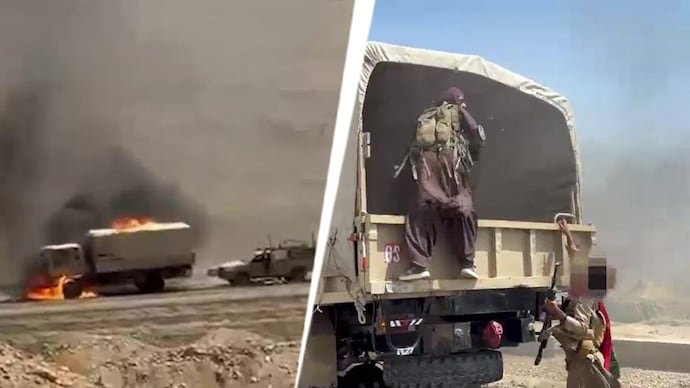
The BLA has also released dramatic footage purporting to show the aftermath of one of its attacks, including burning military vehicles, armed fighters and what the group says are captured weapons. The video, distributed through its media outlet Hakkal, has circulated widely online, but the casualty claims shown or described by the group have not been independently verified.
The latest violence underlines the intensity of the long-running insurgency in Balochistan, Pakistan’s largest province by area. The region has faced separatist violence for decades, with armed Baloch groups demanding greater autonomy or independence and accusing Islamabad of political marginalisation and human-rights abuses.
Pakistan’s military has responded with increasingly extensive counterinsurgency operations, while the BLA and other armed groups have stepped up attacks on security forces, military convoys, Infrastructure and government targets.
The opposing claims of casualties highlight one of the biggest challenges in assessing the conflict: independent access to many affected areas is limited, and both insurgents and the Pakistani military release information from their own perspectives.
What did the BLA claim happened?
The BLA said two separate operations resulted in the deaths of 25 Pakistani military personnel.
In the first attack, the group said its Fateh Squad ambushed a military convoy near Ziarat Cross and destroyed two military vehicles. According to the BLA, 18 personnel were killed while five others were wounded and managed to escape.
The group described the attack as one of its largest recent assaults and said it had successfully targeted a military convoy in a difficult terrain Environment.
In a separate incident in Hajika, near Surab, the BLA said its Special Tactical Operations Squad, known as STOS, carried out a remotely detonated vehicle-borne attack that killed seven Pakistani soldiers.
Pakistan’s military has not publicly confirmed the BLA’s reported figure of 25 military deaths.
Because the incidents occurred in areas affected by an active insurgency and access for independent journalists is limited, the exact number of casualties remains difficult to establish from publicly available information.
What does the BLA video show?
The BLA released footage through its media outlet Hakkal in an attempt to portray the attacks as major battlefield successes.
The video features explosions and gunfire and appears to show fighters near military vehicles that have been set ablaze. Other sequences show armed men examining damaged vehicles and removing weapons and equipment.
The cinematic presentation is part of an increasingly sophisticated information strategy used by militant organisations to amplify the perceived impact of attacks.
Such videos can serve several purposes simultaneously. They can claim responsibility, demonstrate operational capability, encourage supporters and attempt to undermine the morale of opposing forces.
But visual footage alone does not necessarily establish the number of people killed or whether every scene was recorded during the same incident.
The BLA’s casualty claims therefore need to be distinguished from independently established facts.
Who are the BLA’s Fateh Squad and STOS?
The two BLA units named in the attacks are specialised formations within the separatist organisation.
The Fateh Squad is described by the BLA as a combat unit involved in high-risk attacks and guerrilla operations. Its activities have included ambushes against military convoys and other security targets.
The unit gained international attention after the BLA claimed responsibility for the March 2025 hijacking of the Jaffar Express, a passenger train travelling through Balochistan.
The other unit involved in the latest claims is the Special Tactical Operations Squad (STOS). The group has been associated with complex attacks involving explosives and targeted assaults on security installations.
Both units are presented by the BLA as elite components of its armed campaign, although independent information about their size, internal command structure and capabilities is limited.
How Pakistan responded to the BLA claims
Pakistan’s response was swift and significantly larger in terms of reported militant casualties.
The Pakistani military said security forces conducted multiple intelligence-based operations across Mastung, Sibi, Quetta and Kalat over a 72-hour period.
The military said 48 militants were killed during the operations and that weapons and improvised explosive devices were also recovered and destroyed.
The reported total included 36 militants killed during operations in the final 12 to 24 hours of the campaign, according to Pakistan’s Inter-Services Public Relations, the military’s media wing.
The military said those killed belonged to outlawed militant organisations, including the BLA and Tehrik-e-Taliban Pakistan, or TTP.
Pakistan’s military also described the militants using its own terminology associated with outlawed armed groups and alleged Indian sponsorship, although it did not publicly provide evidence supporting the latter claim.
As with the BLA’s claims about Pakistani casualties, the military’s reported militant death toll has not been independently verified.
Why casualty claims are difficult to verify
The conflicting figures are typical of armed conflicts in remote and restricted areas.
Governments often release casualty figures based on information collected from security units involved in operations. Armed groups similarly publish claims intended to demonstrate battlefield effectiveness.
Neither side necessarily provides independent documentation that can immediately establish how many people died.
Journalists may also be unable to reach the affected locations because of security restrictions, active fighting or geographical isolation.
This creates a gap between claims and independently verified information.
The same problem applies to video evidence. Footage can show that an attack or explosion occurred, but without location, date and contextual verification, it may be impossible to determine precisely which incident it depicts.
For that reason, the most reliable assessment of the latest violence will depend on future evidence, including official records, eyewitness accounts, satellite imagery and independent reporting from the affected districts.
Why Balochistan remains a centre of insurgency
Balochistan has experienced separatist unrest for decades.
The province is strategically important because it borders Afghanistan and Iran and provides Pakistan with access to the Arabian Sea. It is also home to significant mineral resources and major infrastructure projects.
Baloch nationalist groups have long accused Islamabad of exploiting the province’s natural resources without providing adequate political representation or economic benefits to local communities.
Insurgent organisations have also accused Pakistani security forces of enforced disappearances, extrajudicial abuses and crackdowns against activists and political opponents.
The Pakistani government rejects separatist violence and considers armed organisations operating in Balochistan to be terrorist groups threatening National Security.
The dispute has therefore developed into a cycle in which armed attacks lead to military operations, which are followed by further insurgent mobilisation.
The BLA’s campaign has become more aggressive
The BLA has increased the frequency and complexity of attacks in recent years.
Its operations have expanded beyond isolated attacks on military personnel to include major transportation infrastructure, security installations and strategically important economic routes.
The group has claimed responsibility for ambushes, attacks on military vehicles, explosions and infrastructure sabotage.
One of the most dramatic examples was the Jaffar Express hijacking in March 2025, when armed BLA fighters seized control of the passenger train and held hundreds of people during a prolonged security crisis.
The incident demonstrated that the organisation could conduct coordinated operations involving planning, communications, explosives and hostage-taking.
The latest convoy ambush claim similarly suggests an effort to target military movements rather than rely solely on small-scale attacks.
Operation Herof remains a major reference point
The recent escalation also recalls the BLA’s Operation Herof, a coordinated campaign that targeted transportation infrastructure and security installations.
During that campaign, the group attacked parts of the Karachi-Quetta highway and targeted railway infrastructure, including a station in Mastung.
The BLA claimed that more than 25 Pakistani military personnel were killed during the operation, while Pakistani authorities issued their own accounts of the fighting.
Operation Herof demonstrated the insurgency’s ability to conduct multiple attacks over a geographically dispersed area rather than relying on a single strike.
The current increase in violence suggests that the BLA is again attempting to maintain a sustained operational tempo.
Why the military convoy attack matters
An ambush against a military convoy is particularly significant in a guerrilla conflict.
Convoys transport soldiers, supplies and equipment between bases and operational areas. They are also vulnerable because multiple vehicles are concentrated along predictable roads.
An insurgent force can attempt to exploit terrain, timing and surprise to strike a convoy before withdrawing into difficult-to-access territory.
Balochistan’s mountainous landscapes can provide favourable conditions for this form of guerrilla warfare.
The alleged destruction of two military vehicles would therefore represent a significant tactical success if the BLA’s account is confirmed.
For Pakistan’s military, protecting supply routes and troop movements across such a large province is a complex logistical challenge.
Why Balochistan’s geography makes the conflict difficult
Balochistan covers a vast area with relatively low population density and large stretches of mountainous and desert terrain.
That geography makes it difficult for security forces to maintain a permanent presence everywhere insurgent groups can operate.
At the same time, the province’s road network and key transport corridors provide strategic targets for militants seeking to disrupt government operations and economic activity.
The combination of remote terrain and critical infrastructure creates a difficult security environment.
Military forces can conduct intelligence-based raids against suspected hideouts, but maintaining lasting control requires intelligence networks, local cooperation and continuous deployment.
Insurgent groups can exploit gaps in surveillance and move between different areas, making the conflict particularly difficult to contain.
Pakistan says 48 militants were killed in raids
The Pakistani military’s reported 48 militant deaths represent a substantial counterinsurgency response.
According to ISPR, operations were conducted across multiple districts over approximately three days and involved intelligence-based raids on militant positions.
In one operation in Mastung, troops reportedly engaged militants after detecting their movement. In Quetta’s Shaban area, the military said several militant hideouts were targeted.
Operations were also reported in Kalat and Sibi.
The military said it recovered ammunition and improvised explosive devices, suggesting that at least some targeted locations were used for weapons storage or preparation.
Pakistan’s security forces said they were continuing searches for other militants in the affected areas after the reported clashes.
Pakistan links some militants to the TTP
The security operations did not target the BLA alone.
Pakistan said the militants killed included members of several outlawed organisations, including the Tehrik-e-Taliban Pakistan (TTP).
The TTP is a separate organisation from the BLA, although both operate against the Pakistani state and have been responsible for attacks in different parts of the country.
The presence of different militant groups in the same province complicates Pakistan’s security challenge because Counterterrorism forces must address multiple networks with different objectives and operational structures.
The TTP’s primary conflict is rooted in its opposition to the Pakistani state and security establishment, while the BLA’s insurgency is centred on Baloch nationalism and demands for greater autonomy or independence.
Pakistan’s decision to describe the latest operations as part of a wider counterterrorism campaign reflects that broader security challenge.
What are the BLA’s political demands?
The BLA and other Baloch separatist organisations have sought either greater autonomy for Balochistan or complete independence from Pakistan.
The groups argue that the central government has exercised excessive control over the province while failing to deliver an equitable share of economic benefits.
Natural resources are an especially important part of the dispute.
Balochistan contains major deposits of minerals and natural resources and hosts economically significant projects. Local nationalist groups argue that revenues and development opportunities have not been distributed fairly.
Islamabad maintains that development and infrastructure projects in the province are intended to benefit the region as well as the country as a whole, and it rejects armed separatism as a legitimate political method.
The disagreement has remained unresolved for decades.
Why China is closely watching Balochistan
The security situation in Balochistan also has international consequences because the province is central to the china-Pakistan Economic Corridor.
Gwadar port, developed with substantial Chinese investment, is located on the Balochistan coast and forms an important part of China’s regional infrastructure strategy.
Chinese workers and projects in Pakistan have previously been targeted by militant groups, adding another layer to security concerns.
Persistent instability can raise insurance costs, complicate construction and affect investor confidence in large infrastructure projects.
For Pakistan, maintaining security in Balochistan is therefore important not only for counterinsurgency but also for economic development and international investment.
The information war is becoming more important
The BLA’s cinematic-style video shows that the conflict is increasingly being fought in the information space as well as on the ground.
Armed groups can now publish high-quality footage quickly through social media and encrypted communication channels, allowing them to reach international audiences without relying on conventional news organisations.
The videos can also be edited to emphasise particular moments and create a perception of military strength.
Pakistan’s military has its own media infrastructure and regularly issues detailed statements about counterterrorism operations.
The result is an information battle in which both sides present competing versions of the same conflict.
For audiences outside the region, distinguishing verified evidence from propaganda requires particular caution.
Could the violence increase further?
The latest cycle of attacks and retaliation suggests that the immediate risk of further violence remains high.
If the BLA can demonstrate that its attacks against military convoys are effective, it could encourage further operations against security forces and infrastructure.
Pakistan’s reported killing of 48 militants indicates that the military intends to respond with sustained counterinsurgency pressure rather than treating the attacks as isolated incidents.
That can produce a cycle of escalation.
Insurgent attacks trigger raids and arrests. Military operations produce militant casualties but can also deepen local grievances if civilians are caught in the fighting or if communities perceive the security response as excessive.
Those grievances can then become part of the insurgents’ recruitment narrative.
Breaking that cycle requires more than military operations alone.
The unresolved political roots of the conflict
Security operations can disrupt insurgent networks, but they do not automatically resolve the political grievances that have sustained the Baloch insurgency.
Questions involving resource distribution, political representation, development, missing persons and the relationship between provincial authorities and Islamabad remain central to the wider dispute.
Successive Pakistani governments have attempted different combinations of development programmes, political negotiations and military action, but the insurgency has repeatedly returned.
The persistence of the conflict suggests that a purely security-based solution is unlikely to eliminate every source of unrest.
At the same time, attacks that kill civilians or security personnel make political dialogue more difficult by increasing public anger and reducing trust between the parties.
What happens next in Balochistan?
The immediate focus will likely remain on Pakistani military operations and whether the BLA conducts additional attacks in retaliation.
Authorities are expected to continue intelligence-based operations in areas where militant activity is suspected. The BLA, meanwhile, is likely to use its media networks to publicise future attacks and highlight what it portrays as military losses.
Independent verification of casualty claims will remain difficult unless authorities allow wider access to affected locations or additional evidence emerges.
The broader security situation will also be influenced by developments involving the TTP and the security environment along Pakistan’s border with Afghanistan.
Any increase in cross-border militant movement could place additional pressure on Pakistan’s security forces, already dealing with separatist violence in Balochistan.
A dangerous new phase in Balochistan’s insurgency
The reported 25 Pakistani military deaths claimed by the BLA and the subsequent Pakistani military announcement of 48 militants killed illustrate the rapidly escalating cycle of violence in Balochistan.
The BLA’s release of a highly produced video reflects the organisation’s effort to turn battlefield attacks into powerful propaganda. Pakistan’s military response shows that Islamabad is prepared to use large-scale intelligence-led operations to suppress the insurgency.
Neither side’s casualty figures have been independently confirmed, making it important to distinguish claims from established facts.
What is not in doubt is that Balochistan remains one of Pakistan’s most difficult security challenges. The province combines a decades-old separatist conflict with strategic infrastructure, natural resources, difficult terrain and the presence of multiple armed groups.
The latest attacks demonstrate that the BLA retains the ability to conduct coordinated and high-impact operations, while Pakistan’s response shows the state’s willingness to intensify counterinsurgency efforts.
The danger is that continued tit-for-tat violence will deepen the conflict without addressing the political grievances that have sustained it.
For now, the immediate battle is being fought through ambushes, raids and competing casualty claims. But the longer-term question remains whether Pakistan can reduce the violence while also addressing the political, economic and human-rights concerns that continue to fuel instability in Balochistan.
For breaking news and live news updates, like us on Facebook or follow us on Twitter and Instagram. Read more on Latest World on thefoxdaily.com.





COMMENTS 0