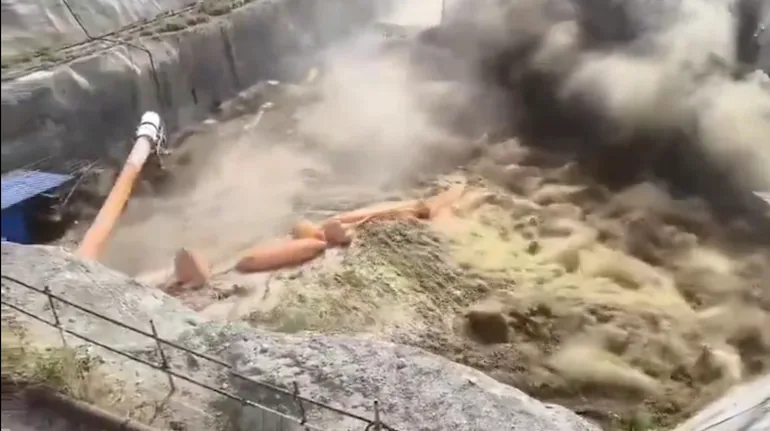
Pakistan’s ambitious Tarbela 5th Extension Hydropower Project has suffered another serious construction setback after a fresh rock collapse caused reservoir water to enter work areas around Tunnel-5 and the powerhouse zone. The incident forced workers to evacuate and prompted an immediate suspension of construction activities at the affected site.
The collapse occurred on Monday, November 9, during excavation work on the second bench of the connecting tunnel at Tunnel-5. A large mass of rock debris gave way, allowing water from the reservoir to enter sections of the construction area.
Pakistan’s Water and Power Development Authority (WAPDA) said workers were moved to safer locations and no casualties had been reported. The authority also said the intake pit had been completely drained, preventing further water from entering downstream work areas.
The latest incident is particularly concerning because the project has already experienced a major cofferdam failure, contractual disagreements and substantial delays. An independent inquiry into the earlier collapse identified shortcomings involving the contractor, project consultant and WAPDA, while the estimated project cost rose from 82.36 billion Pakistani rupees to 317 billion rupees.
What Happened at the Tarbela-5 Construction Site?
According to WAPDA, the latest incident took place during excavation of the second bench of the connecting tunnel. A weak section of rock gave way, allowing water from the intake pit to enter the tunnel and the under-construction powerhouse area.
The sudden water inflow created an emergency at the construction site. Workers were evacuated, and construction activities were suspended while the authorities dealt with the flooding and assessed the affected areas.
WAPDA said the water in the intake pit had been completely drained, stopping further inflow into downstream work areas. Dewatering operations at the powerhouse were also initiated to remove the accumulated water.
Senior WAPDA officials, the project engineer and the contractor began inspecting the site to determine the extent of the disruption and identify the measures required before construction can resume.
WAPDA rejects reports that the main tunnel collapsed
Following reports of the incident, WAPDA clarified that the main Tunnel-5 had not collapsed. The authority said the collapse involved a weak rock formation during excavation work and did not mean that the project’s main tunnel structure had failed.
It also maintained that the main tunnel, the under-construction powerhouse, the tailrace culvert and the switchyard remained intact. The distinction is important because water entering a construction area does not necessarily mean that the entire tunnel or the dam structure has suffered a structural collapse.
The latest incident is nevertheless a significant setback because it has affected work on an already delayed infrastructure project. A detailed technical assessment will be needed to establish the precise cause, the extent of any damage to temporary construction arrangements and the time required to restart activities.
Second Major Setback After Earlier Tarbela-5 Cofferdam Collapse
Monday’s rock collapse is the latest major disruption at the Tarbela 5th Extension project. The construction programme was already under pressure following an earlier cofferdam collapse in August 2025.
A cofferdam is a temporary structure built to keep water away from a construction area. At a hydropower project, it allows engineers and workers to carry out excavation and other activities in relatively dry conditions, even when construction is taking place close to a reservoir or river.
The earlier failure caused flooding and disrupted construction. A government-appointed three-member independent inquiry committee subsequently investigated the incident and published findings that raised serious concerns about project management, contractual compliance and engineering oversight.
Inquiry identifies failures by contractor, consultant and WAPDA
A 15-page inquiry report, reported by Pakistani newspaper Dawn in July 2026, held three key parties responsible for the earlier cofferdam failure: the civil works contractor, the project consultant and WAPDA, which is the project’s employer.
The committee found that Power Construction Corporation of China Limited (PCCCL), the contractor responsible for civil works, had proposed changing the original cofferdam design to a rock-filled structure. The report questioned the contractual and technical basis for the modification.
The project engineer conditionally accepted the proposed change, while WAPDA approved it as construction was approaching completion. According to the inquiry, the approval process did not adequately examine the technical weaknesses or contractual validity of the revised design.
The committee identified inadequate protective layers and filter arrangements as weaknesses that made the modified structure vulnerable to failure. These components are important in structures exposed to water pressure because they help control water movement and prevent the loss of supporting material.
The inquiry also rejected the argument that unusually high flooding had caused the earlier collapse. It said water flows were within Tarbela’s historical levels and below the cofferdam’s designed capacity.
Its findings pointed to failures at multiple levels rather than attributing the incident to a single technical problem. The contractor’s design proposal, the consultant’s conditional acceptance and WAPDA’s approval were all examined as part of the chain of decisions that preceded the collapse.
Irregular payments raised further concerns
The inquiry also flagged irregular payments involving temporary work carried out in place of permanent work. It said these arrangements weakened the government’s ability to seek compensation from the contractor following the earlier failure.
Such findings are significant for a publicly financed infrastructure project because contractual safeguards determine how responsibility is established when construction work fails. They also influence whether the project employer can recover financial losses and enforce the contractor’s obligations.
The report’s findings have raised questions about how design changes were reviewed, how construction quality was monitored and whether the contractual responsibilities of the different parties were properly enforced.
Tarbela-5 Project Cost Rises by More Than 285%
The earlier cofferdam collapse contributed to a major increase in the project’s estimated cost. According to the inquiry findings reported in July, the estimated cost rose from approximately 82.36 billion Pakistani rupees to 317 billion rupees.
This represents an increase of more than 285 per cent compared with the original approved estimate. The scale of the escalation has placed the project under greater financial scrutiny, particularly because it has also experienced substantial construction delays.
The project’s original completion target was 2026. Following the earlier disruption and other construction problems, the deadline was pushed to the end of June 2028.
| Project detail | Reported position |
|---|---|
| Project name | Tarbela 5th Extension Hydropower Project |
| Planned additional capacity | 1,530 MW |
| Original estimated cost | Rs 82.36 billion |
| Revised estimated cost | Rs 317 billion |
| Reported cost escalation | More than 285% |
| Original completion target | 2026 |
| Revised completion target | End of June 2028 |
| International financing | $700 million from the World Bank and AIIB |
The financial implications extend beyond the construction budget. Pakistan’s Planning Commission has estimated that the project’s levelised electricity generation cost over 30 years could reach 27–28 Pakistani rupees per unit.
Levelised cost measures the average cost of producing electricity over a project’s operating life, taking account of construction, financing, operation and other expenses. A higher figure can make electricity from a project less competitive, particularly when compared with alternative generation sources.
The Planning Commission’s assessment raised concerns that the increased cost could make the project economically unviable or difficult to sustain financially. The latest disruption could add further pressure, although its eventual effect on the budget and completion schedule will depend on the technical assessment and recovery plan.
Who Is Financing and Building the Tarbela-5 Project?
The Tarbela 5th Extension is being developed by Pakistan’s Water and Power Development Authority. The project has received international financing, including loans totalling $700 million from the World Bank and the Asian Infrastructure Investment Bank (AIIB).
China’s PCCCL was awarded the civil works contract. Other contractors involved in the project include Harbin Electric International Company Limited and Harbin Electric Machinery Company Limited.
The consultancy arrangements have also faced difficulties. The project consultancy involved a joint venture between Pakistan’s MM Pakistan and China’s BIDR, while WAPDA remained the project employer.
According to the inquiry report, WAPDA subsequently terminated its consultancy agreement with MML-UK, citing its failure to provide a suitably qualified project manager and persistent staffing problems.
Separately, MML had issued a termination notice in May 2025 and withdrawn its staff from the project site. The inquiry report said the withdrawal did not follow the contractual requirement of a 30-day notice period.
These disputes illustrate how large infrastructure projects can be affected by more than construction challenges alone. Design approvals, engineering supervision, staffing, contractor performance and contractual enforcement all influence whether work proceeds on schedule and within budget.
Why the Tarbela 5th Extension Matters for Pakistan’s Electricity Supply
The project is designed to add 1,530 megawatts of hydropower capacity to Pakistan’s electricity system. It comprises three generating units, each with a planned capacity of 510 MW.
Once completed, the extension is expected to increase Tarbela Dam’s installed electricity generation capacity from approximately 4,888 MW to 6,418 MW. This would make the extension an important addition to Pakistan’s existing hydropower infrastructure.
Hydropower is an important part of Pakistan’s electricity mix because it uses flowing or stored water to generate electricity. Unlike power stations that burn imported coal, oil or gas, hydropower does not require continuous fuel purchases to produce electricity. Its generation, however, depends on water availability, reservoir management and operating conditions.
Additional hydropower capacity can help diversify electricity generation and reduce dependence on thermal power plants. It can also support the grid when water conditions allow the generating units to operate.
However, installed capacity should not be confused with actual electricity generation. A 1,530 MW power station will not necessarily produce electricity at its maximum rating throughout the year. Output depends on factors such as reservoir levels, water flows, maintenance and demand from the electricity system.
That makes the completion of the extension important, but it also means that construction costs and delays need to be assessed against the electricity the project is expected to deliver over its operating life.
Will the Fresh Collapse Delay Tarbela-5 Until After June 2028?
The revised completion deadline is already the end of June 2028, following the earlier cofferdam failure and the resulting construction disruption. The latest incident has created another obstacle, but its precise effect on the delivery schedule has not yet been established.
WAPDA’s immediate priorities are to complete dewatering, assess the affected areas and determine what technical measures are needed to make the construction site safe. The authority will also need to establish whether the incident requires changes to excavation methods, temporary water-control arrangements or other construction procedures.
The latest collapse should not be confused with a failure of the entire Tarbela Dam. WAPDA has said the main tunnel and other major project components remain intact. The incident concerns construction activities at the fifth extension site.
Nevertheless, repeated disruptions raise questions about the project’s risk management and the effectiveness of its engineering supervision. The findings from the earlier inquiry make these questions particularly important, although the cause of Monday’s incident must be established separately rather than assumed to be identical to the previous cofferdam failure.
What Happens Next at the Tarbela Hydropower Project?
The immediate next step is a technical assessment involving WAPDA officials, the project engineer and the contractor. Their findings will help determine the extent of the damage, the safety measures required and the conditions under which construction can restart.
Authorities will also need to clarify whether the latest event has affected temporary structures, excavation work or other parts of the construction programme. The status of the main tunnel, powerhouse, tailrace culvert and switchyard will remain important to that assessment.
For Pakistan, the challenge is no longer limited to completing a major hydropower extension. The project must also address the financial and contractual problems highlighted by the earlier inquiry while restoring confidence in the construction process.
The Tarbela 5th Extension is expected to add substantial electricity-generating capacity once operational. But its rising cost, delayed completion and latest construction emergency have increased the pressure on WAPDA and the contractors to demonstrate that the remaining work can be completed safely and with stronger oversight.
Until the technical review is completed and a construction recovery plan is established, the impact of the November 9 incident on the revised June 2028 deadline remains uncertain.
For breaking news and live news updates, like us on Facebook or follow us on Twitter and Instagram. Read more on Latest World on thefoxdaily.com.




COMMENTS 0