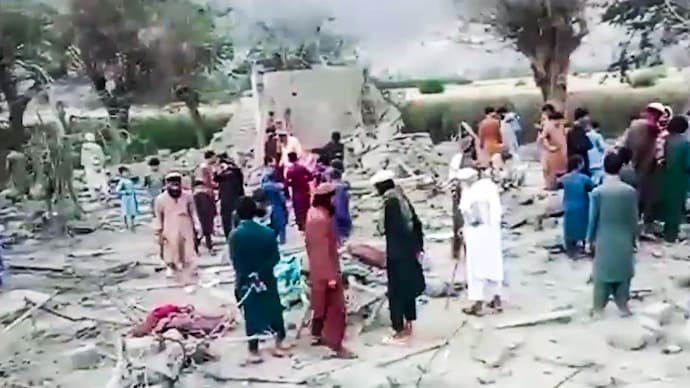
At least three people were killed and six others injured after Pakistani aircraft carried out fresh airstrikes inside Afghanistan early Monday, according to Afghan officials, as fighting between Pakistani forces and the Taliban also intensified along the disputed border. The escalation has raised concerns that months of intermittent violence between the two neighbours could develop into another sustained confrontation.
The strikes reportedly took place between 3 a.m. and 4 a.m. local time in Nurgal district of Kunar province, an area close to the Durand Line separating Afghanistan and Pakistan. Two houses were extensively damaged, and two of those reported killed were women.
Pakistani aircraft also carried out strikes in Paktika province, another area along the countries’ mountainous frontier. At the same time, exchanges of fire were reported between Pakistani forces and Taliban fighters at several points along the border.
The latest violence comes after months of tension over cross-border militancy, the status of the Durand Line and Pakistan’s allegations that the Tehrik-e-Taliban Pakistan, or TTP, operates from Afghan territory. Kabul has repeatedly denied allowing Afghan soil to be used for attacks against Pakistan.
Fresh airstrikes hit Kunar as fighting spreads along border
Afghan officials said the early morning strikes in Kunar targeted areas of Nurgal district, where two homes suffered extensive damage. At least three people were reported killed and six injured.
The civilian toll reported from Kunar has not been independently established by all parties, and details of the targets and circumstances remained under investigation. Pakistani authorities have previously described military operations across the border as actions against militant hideouts and positions linked to groups they accuse of carrying out attacks inside Pakistan.
The strikes were accompanied by reports of ground clashes along several sections of the frontier. Fighting was reported near Spin Shaka in Afghanistan’s Paktia province and Tre Mengal in Pakistan’s Kurram district.
Local reports said the clashes intensified after Taliban forces objected to an attempt by Pakistani troops to establish a tactical position at a former Afghan army location. Artillery fire was also reportedly used during the fighting.
The combination of airstrikes and ground fighting represents a significant escalation because the two countries have struggled to contain border violence through temporary ceasefires and diplomatic contacts.
Pakistan’s latest strikes follow June air operations
The Monday strikes were the first known Pakistani airstrikes inside Afghanistan since June 29, when Pakistani forces conducted attacks in Paktia, Paktika and Kunar provinces.
The United Nations Assistance Mission in Afghanistan said those June strikes killed at least 28 civilians and injured 49 others. UNAMA said women and children were among the casualties and described the figures as preliminary at the time.
Pakistan said its military operations were directed against militant targets along the border. Afghan authorities disputed Pakistan’s account and condemned the strikes as violations of Afghan sovereignty.
The June attacks demonstrated how quickly disputes over militant activity can develop into direct military action between the two countries. The renewed strikes in September suggest that the underlying disagreements remain unresolved.
The latest episode also follows another deadly attack in northwestern Pakistan, which has added pressure on Islamabad to respond to what it considers a continuing militant threat from across the border.
Why Pakistan and Afghanistan are fighting
The central issue behind the latest confrontation is Pakistan’s long-running dispute with the Afghan Taliban government over the Tehrik-e-Taliban Pakistan.
The TTP is a separate organization from Afghanistan’s ruling Taliban, although the two groups have historical, ideological and operational links. The TTP has carried out numerous attacks against Pakistan’s security forces and civilians.
Islamabad has repeatedly accused the Taliban authorities in Kabul of allowing TTP members and leaders to maintain bases and operate from Afghan territory. Pakistan has demanded that the Afghan government take action against the group and prevent attacks from being launched into Pakistan.
The Taliban government rejects the accusation that it provides a safe haven for militants seeking to attack Pakistan. Afghan authorities have also argued that Pakistan should address its security problems without conducting military operations inside Afghanistan.
This disagreement has become one of the most persistent sources of tension between the two governments since the Taliban returned to power in Afghanistan in 2021.
The disputed Durand Line adds another layer of tension
The security dispute is complicated by a separate and longstanding disagreement over the countries’ border.
The Durand Line is roughly 2,600 kilometres long and was drawn during British rule in the region. Pakistan regards it as its international frontier with Afghanistan.
Successive Afghan governments, however, have historically refused to fully recognise the Durand Line as an international border. The Taliban authorities have also maintained objections to Pakistan’s efforts to strengthen border infrastructure and fencing along the line.
The border cuts through areas inhabited by Pashtun communities with longstanding social and family connections on both sides. That has made movement, fencing and the placement of military positions particularly sensitive.
When troops from either side attempt to establish new positions or strengthen existing ones, local disputes can quickly become military confrontations.
Border clashes have repeatedly disrupted attempts at a truce
The latest escalation follows a pattern of intermittent clashes that has intensified since the two countries experienced some of their most serious fighting in years.
A temporary Eid ceasefire in March provided a period of reduced hostilities but failed to produce a lasting settlement. Since then, sporadic attacks, accusations and military responses have continued to undermine attempts to stabilise the border.
The failure of temporary arrangements to address the underlying disagreements has left both sides vulnerable to another cycle of escalation. A militant attack in Pakistan can trigger demands for action against the TTP, while Pakistani military operations inside Afghanistan can prompt retaliation from Taliban forces.
That cycle creates a difficult security environment in which even a localized border incident can rapidly expand into a broader confrontation.
Pakistan faces pressure over attacks blamed on the TTP
For Islamabad, the issue is closely tied to domestic security. Pakistan has suffered repeated attacks in its western provinces, particularly in areas close to the Afghan border.
Pakistani officials have argued that eliminating militant sanctuaries across the border is essential to preventing further attacks. The government has increasingly focused on the TTP as a major security threat and has demanded that Kabul take concrete measures against its leadership and fighters.
Afghanistan’s Taliban authorities have rejected Pakistan’s claims that they are deliberately sheltering the TTP. Kabul has instead called for dialogue and cooperation to address security disputes.
The competing positions leave little room for compromise when a new attack occurs. Pakistan faces domestic pressure to respond, while Afghanistan views cross-border strikes as violations of its sovereignty.
Afghanistan faces the consequences of renewed airstrikes
For communities in Afghanistan’s eastern provinces, renewed airstrikes create an additional security threat in areas already affected by decades of conflict.
Kunar and Paktika are mountainous border provinces where communities have experienced repeated fighting involving militant groups, Afghan forces and foreign military operations. Damage to homes and civilian casualties can further deepen local resentment and complicate security efforts.
The United Nations has previously urged all parties involved in the Pakistan-Afghanistan conflict to protect civilians and comply with international humanitarian law. The June strikes demonstrated the potential civilian cost of cross-border military operations, with UNAMA reporting dozens of civilian deaths and injuries.
Any further expansion of the fighting could increase risks for communities living near military positions and border crossings.
Why the latest escalation matters
The significance of the latest strikes extends beyond the immediate casualties. Pakistan and Afghanistan are neighbours with a long, difficult history, and both countries have limited room for prolonged military confrontation.
Pakistan is dealing with militant violence inside its own territory, while Afghanistan remains economically and politically isolated under Taliban rule. Sustained border fighting could worsen humanitarian pressures and further disrupt Trade and movement between the two countries.
Border crossings are important for commerce, supplies and the movement of people. When fighting intensifies, crossings can be closed or restricted, affecting communities and businesses on both sides.
A prolonged confrontation could also make diplomatic efforts more difficult. Previous mediation attempts have sought to reduce tensions and encourage the two sides to address security concerns through dialogue, but repeated military escalation has continued to undermine those efforts.
What happens next will depend on the next military and diplomatic moves
The immediate concern is whether Monday’s strikes and border clashes remain limited or develop into another sustained period of fighting.
Any further Pakistani airstrikes could prompt a Taliban military response, while additional attacks inside Pakistan could increase pressure on Islamabad to conduct more operations across the border. That creates the possibility of a cycle in which each side describes its actions as defensive responses to the other.
The key unresolved issue remains the TTP and the question of whether Kabul will take measures that satisfy Pakistan’s security demands. At the same time, Afghanistan’s objections to Pakistani military operations and the unresolved status of the Durand Line remain major obstacles to a durable agreement.
For now, the reported deaths in Kunar and the clashes across the frontier show that the fragile calm between Pakistan and Afghanistan is under renewed strain. Without progress on the underlying security and border disputes, the latest confrontation could become another chapter in a cycle of retaliatory strikes, ground clashes and failed ceasefires along one of South Asia‘s most volatile frontiers.
With PTI Inputs
For breaking news and live news updates, like us on Facebook or follow us on Twitter and Instagram. Read more on Latest World on thefoxdaily.com.






COMMENTS 0