Five years after the Taliban returned to power in Afghanistan, the movement has consolidated its control over the country, expanded diplomatic and economic engagement with regional powers and projected an image of political stability. Yet beneath that display of control, Afghanistan continues to face a severe humanitarian and economic crisis.
On August 15, 2021, the Taliban entered Kabul as the United States completed its withdrawal after nearly two decades of military involvement in Afghanistan. The dramatic scenes at Kabul airport, where Afghans who had worked with foreign forces scrambled to leave the country, became one of the defining images of the end of America’s longest war.
Five years later, the contrast is striking. The Taliban is no longer an insurgent movement fighting to capture Kabul. It is the authority governing Afghanistan and has demonstrated an ability to maintain control. But political control has not translated into a broad recovery in living standards.
Afghans continue to face humanitarian needs, economic pressure, natural disasters, displacement and restrictions on basic freedoms. Women and girls have experienced some of the most severe consequences of Taliban policies, particularly in Education, employment and participation in public life.
From the fall of Kabul to five years of Taliban rule
The Taliban’s return to Kabul on August 15, 2021, effectively ended the US military presence in Afghanistan after the intervention that began in 2001. The rapid collapse of the Afghan government and security forces surprised much of the world and produced an evacuation operation involving thousands of people.
The scenes immediately recalled the fall of Saigon in April 1975, when the United States withdrew from South Vietnam shortly before communist forces captured the city. In Afghanistan, however, the consequences of the Taliban takeover extended far beyond the symbolism of an American withdrawal.
The Taliban inherited a country whose institutions, economy and public services had depended heavily on international support. The departure of foreign forces was followed by the loss of much of the international financial assistance that had sustained Afghanistan’s previous government.
That created a difficult starting point for the new authorities. The Taliban had won the war for political control, but governing Afghanistan required dealing with an economy deeply connected to international aid and financial systems.
Five years later, the Taliban projects control
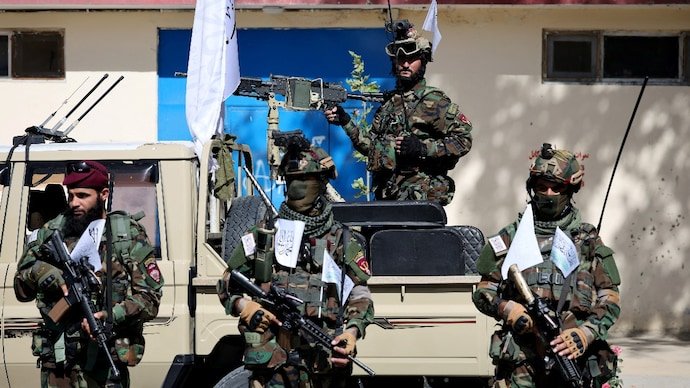
The fifth anniversary of the takeover was marked by a victory parade in Kabul. Armoured Taliban vehicles moved through the capital as fighters carried flags and banners in a public demonstration of the movement’s continuing control.
The location and symbolism of the celebrations were significant. The Taliban was presenting its return to power not as a temporary change in government but as the culmination of its two-decade struggle against Western military forces.
Interior Minister Sirajuddin Haqqani, in a video address, attributed the Taliban’s victory to what he described as “morale, courage” and “divine assistance”. At the same time, he acknowledged that “issues and problems” remained.
That admission captures one of the central realities of Afghanistan five years after the takeover. The Taliban has succeeded in maintaining political control, but it has not resolved the structural problems confronting the country.
Women and girls remain at the centre of Afghanistan’s human rights crisis
The most visible area of concern is the treatment of women and girls. Since taking power, the Taliban has imposed extensive restrictions on education, employment and participation in public life.
According to the figures provided in the source material, around 2.5 million girls have been barred from secondary schools and universities. UN Women data cited in the material also indicates that half of Afghan women now leave their homes only once or twice a month.
These restrictions have fundamentally changed daily life for millions of Afghan women and girls. Education restrictions affect not only current students but also the country’s future workforce, professional sectors and access to trained women in areas where female participation is essential.
The consequences can therefore extend well beyond the classroom. When girls are prevented from continuing their education, Afghanistan loses potential teachers, doctors, administrators, entrepreneurs and other professionals over the longer term.
The restrictions have also remained a major obstacle to broader international recognition of the Taliban authorities. The source material notes that Russia remains the only country to have formally recognised the Taliban government.
Afghanistan is more engaged diplomatically, but recognition remains limited
Although formal recognition remains limited, the Taliban has gradually expanded its diplomatic engagement. Countries including India, Qatar, China, Iran and several Central Asian states have hosted Taliban officials or increased diplomatic and economic contacts with Kabul.
This represents a significant change from the immediate aftermath of the 2021 takeover. The Taliban has increasingly sought to establish working relationships with neighbouring and regional powers even without receiving broad formal recognition.
Afghanistan’s geography is central to that strategy. The country sits between South Asia, Central Asia and the Middle East, giving it potential importance for trade, transport, energy links and regional connectivity.
The Taliban has increasingly presented Afghanistan as a possible bridge between surrounding regions. For neighbouring countries, maintaining communication with Kabul can also serve practical interests, including border management, trade, security and regional connectivity.
But diplomatic engagement should not be confused with international acceptance. The willingness of countries to communicate with the Taliban does not automatically mean that they endorse its domestic policies or have formally recognised its government.
Humanitarian pressure remains severe
Afghanistan’s humanitarian crisis has not disappeared with the Taliban’s consolidation of power. Instead, the country has faced several overlapping pressures, including natural disasters, economic weakness, displacement and reduced international aid.
The source material points to repeated droughts and earthquakes as major shocks affecting communities. Afghanistan has also experienced large-scale deportations of Afghan nationals from neighbouring Iran and Pakistan, adding pressure to communities that already have limited resources.
At the same time, international humanitarian funding has declined sharply. The United States, previously Afghanistan’s largest source of aid, has significantly reduced its assistance.
More than half of Afghanistan’s population of around 45 million is described in the supplied material as requiring humanitarian assistance. That scale illustrates why the country’s economic problems cannot be separated from its humanitarian situation.
When households struggle to find employment and public finances remain constrained, people have fewer ways to absorb shocks caused by drought, earthquakes, displacement or rising living costs. Reduced international assistance can therefore have consequences far beyond the organisations that receive the funding.
Economic isolation remains one of Afghanistan’s biggest challenges
Afghanistan’s economic position is another major contradiction of the Taliban’s fifth year in power. The government has gained greater control over the country, but the economy remains largely disconnected from the global financial system.
According to the figures in the supplied material, imports have increasingly outpaced exports since 2021, while government finances have contracted substantially.
The Taliban’s most recently published budget mentioned in the source, covering the 2023 fiscal year, was approximately $2.44 billion. That was less than half the roughly $6 billion budget cited for 2021.
The comparison illustrates the scale of the financial adjustment Afghanistan has undergone since the Taliban takeover. A government can exercise political control while simultaneously having far fewer financial resources available to operate the state.
That creates a difficult policy environment. The authorities must fund public services and government operations while operating within an economy that remains isolated from much of the international financial system and has limited fiscal capacity.
Trade and Pakistan tensions add another layer of pressure
Afghanistan’s economic difficulties are also affected by its dependence on regional trade routes. The country’s landlocked geography makes access to neighbouring states and transport corridors especially important for imports and exports.
The source material highlights tensions with Pakistan and says border disruptions have affected Afghanistan’s most important trade route.
Repeated interruptions can create wider economic consequences. Businesses may face delays, higher transportation costs and uncertainty, while consumers can be affected when essential goods become more difficult or expensive to move across borders.
For the Taliban government, maintaining stable commercial relationships with neighbours is therefore not simply a diplomatic objective. It is directly connected to the country’s economic survival and its ability to reduce dependence on humanitarian assistance.
The central contradiction after five years
Afghanistan’s situation five years after the Taliban takeover can be understood through a clear contradiction: the government is more firmly established politically, while the country remains deeply vulnerable economically and socially.
The Taliban has achieved something it struggled for throughout its insurgency: sustained control over Afghanistan. There is no longer a large foreign military presence challenging its authority, and the movement has developed relationships with a growing number of regional governments.
Yet control is only one part of governing a country. Afghanistan still needs economic growth, employment, investment, functioning public services and access to international markets. It also faces the consequences of humanitarian emergencies and restrictions that have isolated large parts of the population from education and economic opportunities.
This distinction matters because political stability and economic recovery are not necessarily the same thing. A government can maintain territorial control without immediately solving the structural problems affecting people’s livelihoods.
What the next phase could mean for Afghanistan
The next stage of Afghanistan’s story is likely to depend on several interconnected issues: the country’s ability to strengthen its economy, the future of international aid, relations with neighbouring states and the Taliban’s approach to women and girls.
Regional engagement could create opportunities for trade and connectivity if Afghanistan can maintain stable relationships with neighbouring countries. Its geographical position gives it potential value as a link between several regions, but that potential depends on Infrastructure, security, reliable borders and predictable economic conditions.
International engagement will also remain complicated. Countries may continue working with Kabul on practical issues without granting formal recognition. The gap between diplomatic contact and political recognition is likely to remain important as governments balance strategic interests with concerns about Taliban policies.
For ordinary Afghans, however, the most immediate questions are more basic: whether they can find work, afford essential goods, access education and receive assistance when disaster strikes.
Five years on, the Taliban has won control but not the wider battle
Five years after the dramatic fall of Kabul, the Taliban has transformed itself from an insurgency into Afghanistan’s entrenched ruling authority. Its anniversary celebrations demonstrate the confidence that comes with maintaining power for half a decade.
But the victory parade tells only one part of the story.
Behind the public display of military strength is a country still struggling with humanitarian needs, economic isolation, unemployment, natural disasters and limited international assistance. Women and girls face particularly severe restrictions, while the government continues to seek greater diplomatic and economic engagement without broad international recognition.
The Taliban’s greatest achievement since 2021 has been the consolidation of political control. Its much harder challenge is building a functioning and prosperous Afghanistan that can reduce dependence on humanitarian aid and provide opportunities for its population.
Five years after the last US troops left Kabul, Afghanistan is therefore neither simply the same country it was in 2021 nor a country that has escaped its crisis. The Taliban has secured its hold on power. Rebuilding the country it now governs remains the far more difficult task.
For breaking news and live news updates, like us on Facebook or follow us on Twitter and Instagram. Read more on Latest World on thefoxdaily.com.






COMMENTS 0