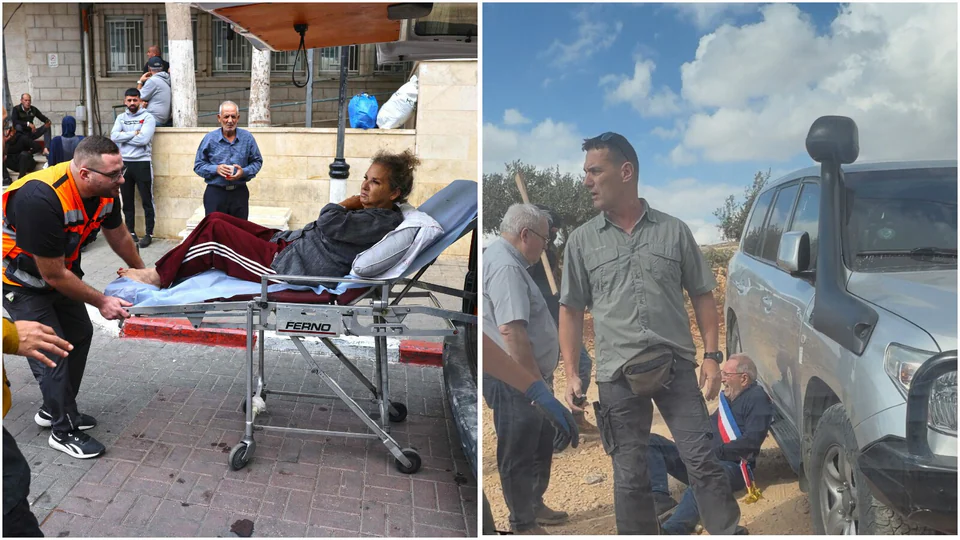
A US photojournalist and several European diplomats have reportedly been attacked by Israeli settlers in the occupied West Bank, intensifying international concerns over rising settler violence during the annual Palestinian olive harvest. The incidents have drawn condemnation from American and European officials, renewed calls for accountability and scrutiny of Israel’s response to attacks on journalists, diplomats and Palestinian civilians.
Washington Post photojournalist Heidi Levine was reportedly assaulted while covering violence in the West Bank, prompting the Trump administration to call for stronger action from Israel. In a separate incident in the Christian village of Taybeh, diplomats from France, Belgium and Poland, along with a visiting French mayor, were targeted by masked settlers.
US Secretary of State Marco Rubio said Washington was disturbed by footage of the reported violence and had urged the Israeli government to crack down on such attacks. Meanwhile, French officials demanded the arrest and prosecution of those responsible, while Israeli authorities condemned the incidents and pledged to investigate them.
The attacks come amid heightened tensions surrounding the olive harvest and ahead of closely contested Israeli elections. They have also intensified a broader debate over settlement expansion, the protection of Palestinian communities and international efforts to hold perpetrators of settler violence accountable.
US photojournalist Heidi Levine attacked in West Bank
Washington Post photojournalist Heidi Levine was reportedly attacked by Israeli settlers on Friday morning while covering violence involving Palestinians harvesting olives in the occupied West Bank. According to Washington Post Executive Editor Matt Murray, Levine was clearly identified as press when the assault occurred.
Murray condemned the incident in a statement posted on X, calling for a thorough investigation and accountability for those responsible. He also rejected the suggestion that reports of the assault were politically motivated or exaggerated.
The Washington Post’s response followed a statement from Israeli Prime Minister Benjamin Netanyahu’s office warning against what it described as the demonisation of law-abiding Jewish residents of Judea and Samaria, the Israeli government’s term for the West Bank.
The dispute highlights a central issue surrounding the recent attacks: the need to establish the facts through investigations while ensuring that journalists and other civilians can carry out their work without facing violence.
Levine’s injuries have added to concerns about the risks faced by journalists covering the Israeli-Palestinian conflict. Reporters and photographers working in the region frequently document confrontations involving security forces, settlers and Palestinian residents, making their safety a significant concern for international media organisations.
Trump administration urges Israel to crack down on settler violence
The Trump administration expressed concern over footage of Levine’s reported assault, with US Secretary of State Marco Rubio publicly calling for stronger action by Israeli authorities.
“We’re very disturbed by those images and what we’re seeing,” Rubio said, adding that the United States had asked the Israeli government to crack down on such incidents.
His remarks signal continued US pressure on Israel to prevent attacks attributed to settlers and respond more effectively when violence occurs. Washington’s position is particularly significant because of the close relationship between the United States and Israel and the role American officials play in diplomatic discussions concerning regional security.
US Ambassador to Israel Mike Huckabee also condemned the reported attack on Levine and called for a full investigation, the arrest of those accused and their prosecution.
“Attacking a female photographer is a despicable act of terror carried out by masked cowards,” Huckabee said, describing the incident as an act of senseless violence.
The calls from Rubio and Huckabee place the focus on whether Israeli authorities will identify those responsible and pursue legal action. While public condemnations communicate diplomatic concern, investigations and prosecutions will be important in determining accountability for the reported assault.
Another AFP photographer injured during olive harvest coverage
Levine’s reported assault comes after another incident involving a journalist covering tensions during the olive harvest. Earlier this month, AFP photographer Jaafar Ashtiyeh was reportedly attacked by settlers while documenting developments in the West Bank.
According to the supplied report, Ashtiyeh’s camera was stolen during the incident, and he suffered several fractured ribs.
The two cases have intensified concerns about the safety of journalists working in areas affected by settler violence. Attacks on media workers can cause physical harm and interfere with the documentation of events that are important to public understanding of the conflict.
Journalists covering the West Bank often work in situations where confrontations can develop quickly. When reporters are attacked or their equipment is taken, it can also make it more difficult to gather and preserve evidence of incidents involving civilians.
The reported assaults on Levine and Ashtiyeh have therefore become part of a wider discussion about protecting press freedom and ensuring that journalists can document violence without intimidation.
European diplomats and French mayor targeted in Taybeh
In a separate incident, masked Israeli settlers reportedly attacked European diplomats and a visiting French mayor in Taybeh, a Christian village in the occupied West Bank. The delegation included representatives from France, Belgium and Poland, according to the supplied report.
The 78-year-old French mayor told AFP that masked attackers shouted defamatory remarks about France and kicked and struck him with iron bars. He said the assault took place as he joined Palestinian olive farmers alongside senior French and Belgian representatives based in Jerusalem and Polish diplomats.
The incident drew attention because the reported targets included diplomatic representatives from several European countries. Attacks on visiting officials can create additional diplomatic tensions, particularly when they occur during an already sensitive period in relations over settlement policy.
The mayor said the situation illustrated the difficulties facing Palestinians who continue to live and work in communities affected by violence.
“I think that if settlers are behaving like this, there is a tolerance on the part of the Israeli government,” he told AFP, adding that the international community needed to understand what was happening.
He also distinguished his own circumstances from those of local residents, saying he would be able to return to France while Palestinians who remained in the area continued to face the consequences of the situation.
The reported attack has prompted European officials to demand action from Israel, with France calling for those responsible to be brought to justice and for civilian populations to be protected.
France demands arrests and protection for civilians
French Foreign Minister Jean-Noël Barrot condemned the reported attack on the European delegation and called on Israeli authorities to take immediate action against the perpetrators.
“The Israeli authorities must arrest those responsible for these revolting acts and bring them to justice,” Barrot said in a statement. He also called for an end to the violence and for civilian populations to be protected in accordance with international law.
France’s response reflects concerns that violence in the West Bank is not limited to confrontations between local residents and settlers. The reported targeting of a French mayor and European diplomatic representatives has given the incidents a wider international dimension.
Belgian Foreign Minister Maxime Prevot also condemned the violence following the incident in Taybeh. He said the delegation had been targeted by masked settlers and called for an end to impunity for violent attacks.
European officials have repeatedly raised concerns about Israeli settlement policy and its consequences for Palestinians. The latest incidents could intensify calls for diplomatic measures, including sanctions targeting individuals considered responsible for violence.
However, the specific diplomatic consequences of the attacks will depend on subsequent investigations and decisions by the governments involved.
Olive harvest becomes a flashpoint for settler violence
The annual olive harvest is an important period for Palestinian communities across the West Bank. Olive trees provide agricultural income for many families and hold longstanding economic and cultural significance.
Harvesting often requires farmers to reach groves located near settlements, outposts or areas where movement is restricted or security tensions are high. Reports of assaults, damaged trees, burned vehicles and intimidation have raised concerns about whether Palestinian farmers can access their land safely.
Activists have accused Israeli authorities of failing to do enough to prevent attacks by settlers during the harvest. The reported assaults on journalists and European visitors have brought additional attention to these allegations.
The consequences of violence during the harvest can extend beyond immediate injuries. Damage to olive trees or equipment can affect farmers’ livelihoods, while threats and physical attacks can make people reluctant to return to agricultural areas.
The latest incidents have also highlighted the risks faced by people documenting or observing events in affected communities. Journalists, international representatives and local residents may all encounter dangerous situations when tensions escalate.
Preventing further violence requires more than condemning individual incidents. The effectiveness of investigations, the enforcement of existing laws and the protection available to civilians will remain central to assessments of the authorities’ response.
Israeli authorities condemn attacks and promise investigation
The Israeli foreign ministry condemned the reported attacks, while Israeli police said an investigation would be opened into the incidents.
These responses indicate that the incidents have drawn official attention within Israel. However, the outcome of the investigations will be important in determining whether those accused of participating in the violence are identified and prosecuted.
Netanyahu’s office has taken a more cautious position, warning against what it described as a coordinated campaign to smear Israel and Jewish residents of Judea and Samaria during the annual olive harvest.
The prime minister’s office argued that reports were appearing before all the facts had been established and warned that premature conclusions could cause reputational damage.
Netanyahu also said the visiting diplomats should have coordinated their movements with the Israeli military. His office further pointed to the French mayor’s political views, describing him as a communist known for supporting the Palestinian cause.
These statements have added a political dimension to the dispute. While the Israeli government has urged caution over the allegations, American and European officials have called for thorough investigations and accountability.
Establishing what happened in each incident will require evidence and formal inquiries. At the same time, the seriousness of the reported assaults has made the protection of journalists, diplomats and civilians a central concern.
Settlement expansion and international tensions
The attacks have renewed attention on the wider dispute over Israeli settlements in the occupied West Bank. Israel captured the West Bank in the 1967 Middle East war, and the territory remains under Israeli military occupation.
Palestinians seek the West Bank, East Jerusalem and the Gaza Strip as parts of a future independent state. Settlement expansion and the establishment of additional outposts have remained major sources of disagreement between Israel and much of the international community.
The United Nations and most countries consider Israeli settlements in the occupied West Bank illegal under international law. Israel disputes aspects of the international legal position and has defended its security and historical claims in the territory.
Critics argue that settlement expansion fragments Palestinian communities and increases tensions over land, movement and access to agricultural areas. Reports of violence by settlers have added another layer to these disputes.
The latest attacks also come amid tensions between Israel and the United Kingdom over British sanctions related to settlement expansion. This broader diplomatic dispute illustrates how developments in the West Bank can influence relations between Israel and its international partners.
Further incidents involving foreign officials or journalists could intensify pressure for additional diplomatic responses. Nevertheless, the nature and timing of any new measures will depend on decisions by individual governments.
Israeli elections add to the political sensitivity
The recent violence comes ahead of closely contested Israeli elections, adding political sensitivity to the government’s response. Netanyahu faces criticism over security failures and the treatment of Palestinians, while settlement policy remains a contentious issue in Israeli politics and International Relations.
The government’s approach to settler violence is particularly significant because some senior Israeli officials are themselves settlers or support settlement expansion. Critics argue that the authorities must demonstrate that allegations of violence are addressed consistently, regardless of the political positions of those involved.
Netanyahu, meanwhile, has warned against what he describes as efforts to discredit Jewish residents of the West Bank. His office’s statements suggest that the government believes some accounts of the violence risk prejudging events before investigations are complete.
The competing positions highlight a wider challenge: ensuring that allegations are assessed through credible investigations while addressing the immediate safety concerns of people affected by violence.
The attacks on Levine and the European delegation have brought these questions into sharper focus because they involve international media workers and officials whose governments can raise the issue directly with Israel.
What happens next after the reported attacks?
The immediate focus will be on the investigations announced by Israeli authorities and whether they lead to arrests, prosecutions and clear findings about the incidents. American and European officials have made accountability a central part of their response.
Diplomatically, the attacks could add to pressure on Israel to strengthen protections for journalists, visiting officials and Palestinian civilians. France and Belgium have condemned the violence, while the United States has urged Israel to take more decisive action against settler attacks.
The olive harvest remains a particular concern because violence can threaten both personal safety and the livelihoods of Palestinian farming communities. Ensuring safe access to agricultural land and preventing further assaults will be important tests of the authorities’ response.
The broader dispute over settlements is likely to remain central to international criticism of Israel’s policies in the occupied West Bank. The latest incidents have reinforced concerns about the consequences of settlement expansion and the difficulty of securing accountability for attacks attributed to settlers.
For now, the reported assaults have widened an already sensitive diplomatic issue. Whether the investigations produce meaningful accountability, and whether authorities can prevent further violence during the olive harvest, will shape the next phase of the response from Israel, the United States and European governments.
For breaking news and live news updates, like us on Facebook or follow us on Twitter and Instagram. Read more on Latest World on thefoxdaily.com.


COMMENTS 0