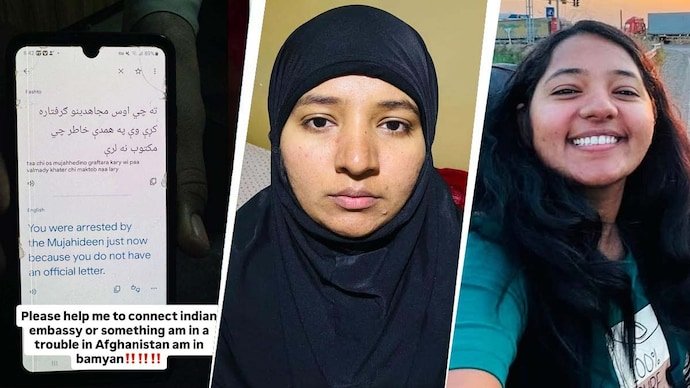
A solo Travel journey through Afghanistan took a frightening turn for Kerala-based travel vlogger Arunima, WHO said she was detained or threatened with arrest by local authorities in Bamyan after travelling alone. She posted an SOS seeking help in contacting the Indian embassy, before later saying she had been allowed to leave following discussions with the authorities.
The episode initially emerged through a Social Media post in which Arunima described herself as having been “arrested” by the “Mujahideen” and shared what she said was a translated official communication. Later, however, her detailed account suggested that the immediate threat was a warning of arrest over her decision to travel without a male companion or guide rather than a confirmed long-term detention.
That distinction matters because the original claim could not be independently verified. Indian officials had also not publicly confirmed an arrest at the time of the initial SOS. Arunima’s subsequent account provides the clearest description so far of what she says happened in Bamyan.
What happened to Backpacker Arunima in Bamyan?
Arunima has been travelling across Afghanistan for several weeks, documenting her experiences on social media. Her journey has included encounters with checkpoints and local authorities, and she has previously described being questioned while travelling through the Taliban-controlled country.
According to her account, she reached Bamyan and was questioned about her travel documents, including her passport, visa and permit. The situation became more serious when authorities allegedly told her that a woman was not permitted to travel alone and that she had violated local rules.
Arunima then posted an urgent message saying she was in trouble in Bamyan and asking people to help her establish contact with the Indian embassy.
She also shared a translated message that she said came from an official communication. The translation stated that she had been arrested by the Mujahideen because she did not have an official letter.
At that stage, there was no independent confirmation of the alleged arrest, and the exact identity of the people who confronted her was unclear.
Why did authorities object to her travelling alone?
The central issue in Arunima’s later account was not her Indian nationality or the fact that she was a travel vlogger. She said the problem was that she was a woman travelling without a male companion or guide.
“According to the law of this country, a woman cannot travel alone,” she said in her account of the incident, adding that authorities told her she had violated the rules and could be arrested.
Arunima said she had previously encountered a similar problem in Jalalabad, where she was allegedly denied a permit because she was travelling alone.
She claimed that permits were required for travel between provinces and that obtaining them was particularly difficult for a woman travelling without a man or guide. In Bamyan, she said authorities again insisted that she obtain the necessary permission and travel with a guide.
These claims should be understood as Arunima’s description of her interaction with local authorities rather than as an independently verified statement of Afghanistan’s entire legal framework. The precise rules applied to her situation were not independently established in the reports surrounding the incident.
How the alleged arrest threat was resolved
After becoming frightened, Arunima said she contacted a man who had previously helped her reach Bamyan. According to her account, he intervened and spoke with the authorities on her behalf.
She said the authorities initially insisted that she obtain a permit and travel with a guide. The confrontation then moved toward the question of how she could leave Afghanistan.
Arunima said she told them she intended to travel onward toward Uzbekistan. The authorities allegedly told her that because she had remained in Afghanistan while violating the rules, she would have to pay a fine and could not continue until the matter was settled.
She said she negotiated with them and eventually reached an agreement. The authorities ultimately allowed her to leave for her next destination without obtaining another permit, according to her account.
That explanation is why later reporting described the episode as an arrest threat rather than a confirmed prolonged arrest. The initial social media post used stronger language, while her later explanation described negotiations that ended with her being permitted to continue travelling.
“I had to go through all of this because I am a woman”
For Arunima, the incident was particularly significant because she has built her online identity around solo travel. She contrasted her experience with that of male travellers she knows who had travelled through Afghanistan without facing the same restrictions.
She said some female travellers she knew had also visited Afghanistan, but they had travelled either with a guide or alongside a man.
“I had to go through all of this simply because I am a woman,” she said.
Her comments underline one of the most important challenges for women travelling independently in Afghanistan: the rules and restrictions governing women’s movement can fundamentally alter the experience of travel compared with that of male visitors.
For a solo traveller, the difference is especially significant. A journey that might otherwise involve choosing transportation, accommodation and destinations independently can instead require interaction with checkpoints, local officials and people who have authority over movement.
Arunima described the experience as terrifying
The vlogger said she became extremely frightened when she was told that she had broken the rules and could be arrested.
She described spending several hours in a state of intense fear and said she did not know what would happen to her. She also said she pleaded with the man who was helping her, believing that the situation could become much worse.
Her description illustrates the psychological pressure involved in dealing with unfamiliar authorities in a country where a foreign traveller may have limited ability to understand local procedures, language or rules.
For Arunima, the uncertainty appears to have been as significant as the immediate confrontation. Her decision to post an SOS seeking help from the Indian embassy indicates that she believed diplomatic assistance might become necessary.
Her earlier encounters with Taliban checkpoints
The Bamyan episode was not the first time Arunima had described being questioned during her Afghanistan journey.
In earlier social media posts, she showed encounters in which she was stopped and questioned at checkpoints. One of the recurring issues was her unusual method of travelling, including moving through parts of the country without conventional transport.
Her social media content has attracted substantial attention because she has continued documenting her journey despite the restrictions and security concerns surrounding travel in Afghanistan.
She has also said that she chose to wear a purdah during much of her journey in an effort to make travelling through the country easier.
That decision illustrates the extent to which she has attempted to adapt her behaviour to local expectations while continuing her solo journey.
Why travelling in Afghanistan carries unusual risks
The incident cannot be viewed only as a disagreement over travel permits. Afghanistan remains a highly sensitive environment for foreign visitors, with security risks, strict local controls and limited consular assistance in many circumstances.
International governments continue to warn their citizens against travelling to Afghanistan because of risks including terrorism, kidnapping, detention and other security threats. Foreign nationals can also attract additional scrutiny from authorities.
Bamyan itself has a complicated recent security history. In May 2024, three Spanish tourists were killed in a shooting while travelling in the Bamyan area. The incident demonstrated that even organised tourism does not eliminate the security risks associated with visiting the region.
For a solo female traveller, those risks can overlap with restrictions on movement and social conduct, creating an additional layer of vulnerability.
The “arrest” wording needs careful interpretation
One of the most important aspects of the Arunima story is the difference between an initial social media description and the later explanation.
Her first post said she had been arrested by the Mujahideen and urgently sought assistance. However, the subsequent account said she was threatened with arrest after authorities concluded that she had violated rules concerning women travelling alone.
She was ultimately allowed to continue her journey after discussions and what she described as a settlement over a fine.
Without independent confirmation from Afghan authorities or Indian officials, it would be premature to describe every detail of the incident as established fact. The most reliable way to understand the episode is therefore to distinguish between what Arunima says happened and what has been independently confirmed.
Her account of being stopped and questioned is consistent with her earlier social media documentation of encounters at checkpoints, but the specific claim of a formal arrest has not been independently established in available reporting.
What the episode says about solo female travel
Arunima’s experience also raises a broader question about the meaning of “solo travel” in countries where women’s movement is subject to restrictions.
For many travellers, travelling alone means being able to decide where to go and how to get there without depending on another person. In a heavily controlled environment, that independence can disappear quickly.
A female traveller may have to consider not only visas and passports but also local expectations regarding clothing, companions, guides and movement between locations. A route that appears straightforward on a map can become complicated when permission is required or when local officials interpret rules differently.
This is particularly relevant for travel creators, whose journeys are often filmed and published in real time. The same social media visibility that attracts an audience can also make a traveller’s location and movements easier to identify.
Arunima says she was eventually allowed to leave
Despite the frightening episode, Arunima said she was eventually permitted to continue towards her next destination. She indicated that she intended to leave Afghanistan and travel onward towards Uzbekistan.
Her account suggests that the immediate confrontation ended without her being held for an extended period or prevented from leaving the country.
That outcome does not erase the seriousness of the incident. Her SOS, the uncertainty surrounding her status and her later description of fearing for her safety demonstrate how quickly a solo journey can become difficult when local rules and the traveller’s plans collide.
For now, the key facts remain based largely on Arunima’s own social media accounts. Her claim that she was threatened with arrest because she was travelling alone is the central element of her later explanation, while the initial claim of a formal arrest remains independently unverified.
Her experience has nevertheless drawn attention to the particular difficulties faced by women attempting to travel independently in Taliban-controlled Afghanistan, where local restrictions and security concerns can turn an ordinary journey into a potentially serious confrontation.
For breaking news and live news updates, like us on Facebook or follow us on Twitter and Instagram. Read more on Latest India on thefoxdaily.com.


COMMENTS 0