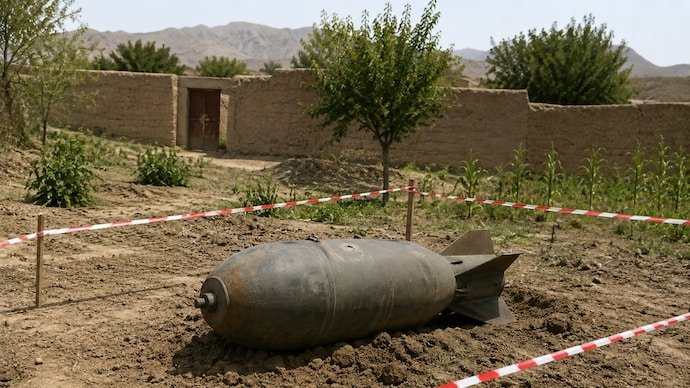
A 500-kilogram Soviet-era bomb has been discovered in the garden of a private home in eastern Afghanistan, providing another stark reminder of the unexploded weapons that remain scattered across the country decades after the Soviet military withdrawal.
The unexploded bomb was found on Wednesday by a resident in Sir village in Ghazni province after the homeowner noticed what was described as a suspicious object in the garden area inside the compound. Police were alerted, and Security forces and a demining team from the Danish Refugee Council went to the property.
Authorities identified the object as a bomb dating from the Soviet era. The weapon was subsequently transferred away from the residential area to a mountainous location, where it was safely detonated, according to Ghazni police.
How the 500-kilogram bomb was discovered
The discovery began with a routine observation by a resident rather than a planned clearance operation. The homeowner found what appeared to be a suspicious object in the garden of the property in Sir village and reported it to authorities.
Khalid Sarhadi, a police spokesperson in Ghazni province, said security forces and a demining team from the Danish Refugee Council responded to the location.
The team determined that the object was a 500-kilogram bomb from the Soviet era. Because of the weapon’s size and the risk associated with an unexploded bomb in a residential setting, it was moved to a mountainous area before being detonated in a controlled manner.
The safe disposal prevented the explosive from remaining in a location where residents could accidentally encounter or disturb it. The incident also illustrates the importance of specialist demining teams when potentially dangerous remnants of past conflicts are uncovered.
Why Soviet-era explosives are still being found in Afghanistan
The bomb was left behind by a conflict that ended decades ago, but Afghanistan’s history of warfare has created a long-lasting explosive hazard.
Soviet troops withdrew from Afghanistan in 1989 following a nearly decade-long occupation. The withdrawal, however, did not mark the end of armed conflict in the country. Successive wars left additional mines, unexploded ordnance and other explosive remnants across large parts of Afghanistan.
As communities expanded and land was reused over the years, some of these hidden weapons have been encountered in places where people now live, work or farm. The discovery of a large bomb inside a private garden demonstrates how remnants of an old conflict can remain relevant to ordinary households generations later.
Explosive remnants can remain buried or partially concealed for many years. Their discovery may occur during construction, farming, digging or routine work around homes. That makes contaminated areas particularly dangerous for communities that may not know exactly where old military activity took place.
More than 45,000 Afghans killed or injured by explosive remnants and mines
The scale of Afghanistan’s explosive-remnant problem is reflected in figures cited by the United Nations Mine Action Service. More than 45,000 Afghans have been killed or injured by explosive remnants of war and mines since Soviet troops withdrew in 1989.
The figure covers decades of exposure to mines and other remnants left by successive conflicts. It demonstrates that the consequences of war can continue long after active fighting has ended.
For affected communities, the danger is not limited to military personnel or former battlefields. Explosive devices can become part of the landscape encountered by civilians in everyday life, particularly in rural areas.
The presence of unexploded ordnance can also restrict how land is used. Areas that might otherwise be available for homes, Agriculture or other activities may require specialist assessment and clearance before they can be considered safe.
Afghanistan’s demining challenge is becoming harder
The discovery in Ghazni comes amid concerns about the resources available to address Afghanistan’s explosive remnants of war.
Nick Pond, head of the Mine Action Section of the United Nations mission in Afghanistan, told AFP in June that the number of teams deployed to tackle the problem had been reduced by 64 percent over the previous two years.
A reduction of that scale matters because identifying and removing explosive remnants is highly specialised work. Demining teams need trained personnel, equipment and sufficient resources to survey contaminated areas, identify hazards and dispose of dangerous weapons safely.
When fewer teams are available, the process of clearing contaminated areas can become more difficult. Communities may therefore continue to live alongside suspected hazards while waiting for specialist teams to assess and remove them.
Why unexploded bombs remain dangerous decades later
The danger posed by an unexploded bomb does not automatically disappear simply because the weapon is old.
An explosive remnant can remain hazardous if it has not been safely neutralised or destroyed. The fact that the bomb found in Sir village weighed 500 kilograms also highlights the potentially serious consequences of discovering large military ordnance close to homes.
For civilians, the greatest danger can come from not recognising what they have found. An object may appear to be old, damaged or harmless while still requiring specialist handling.
That is why suspicious objects discovered in areas affected by past conflict should be treated as potential explosive hazards rather than ordinary debris. The Ghazni incident ended without a reported accident because authorities and a specialist demining team were able to respond and remove the weapon from the residential setting.
The wider impact on communities
Afghanistan’s explosive-remnant problem has consequences beyond the immediate risk of injury or death.
Land contaminated by mines and unexploded ordnance can affect farming, construction and access to basic Infrastructure. Families may also face uncertainty when potentially dangerous objects are discovered near their homes.
For rural communities, where people may depend heavily on surrounding land for their livelihoods, restrictions caused by explosive hazards can have practical consequences. Clearing contaminated land can therefore be an important part of allowing communities to use their surroundings safely.
The challenge is particularly significant in a country that has experienced repeated periods of conflict. Different wars and military campaigns have contributed to a complex legacy of explosive remnants, meaning that the problem cannot be attributed to a single conflict or period.
A decades-old war continues to shape Afghanistan
The Soviet withdrawal in 1989 is an important milestone in Afghanistan’s modern history, but it did not bring lasting peace. Successive conflicts continued to affect the country, leaving behind additional weapons and hazardous remnants.
The discovery of the bomb in Sir village therefore represents more than an isolated incident. It is a physical reminder of how the consequences of war can persist in places far removed from the original fighting.
A private garden might seem an unlikely location for a large military bomb, yet the discovery shows why unexploded ordnance remains a serious concern in areas affected by decades of warfare.
For residents, the most important issue is that potentially dangerous objects can remain hidden until development, farming or ordinary household activity exposes them. Specialist clearance remains necessary to prevent these discoveries from turning into Civilian Casualties.
What happens when a bomb is discovered
The response to the Ghazni discovery demonstrates the role of security and demining personnel in dealing with suspected unexploded ordnance.
After the resident reported the suspicious object, security forces and the Danish Refugee Council’s demining team were brought in. The bomb was identified, moved away from the residential area and destroyed in a mountainous location.
This approach reduced the immediate danger to people living around the property. Rather than attempting to handle or move the object without specialist assistance, authorities used a controlled process designed to remove the threat.
The incident also shows why reports from residents can be crucial. People living in areas with a history of conflict may encounter remnants during ordinary activities, making awareness and rapid reporting an important part of explosive-risk management.
The continuing need for mine action
The 500-kilogram bomb found in Ghazni is likely to attract attention because of its size, but its significance extends beyond the individual weapon.
With more than 45,000 people reported killed or injured by explosive remnants of war and mines since the Soviet withdrawal, Afghanistan’s problem is measured in decades of human impact. At the same time, the reported 64 percent reduction in demining teams over two years raises concerns about how quickly remaining hazards can be addressed.
The discovery also demonstrates that explosive remnants are not necessarily confined to clearly identifiable former battlefields. They can emerge in residential areas and other locations that have become part of civilian life.
For Afghanistan, removing these remnants is therefore not simply a matter of clearing old military equipment. It is part of making land safer for communities and reducing the risk that another family will unexpectedly discover a deadly relic of a conflict long after the fighting has ended.
What the Ghazni discovery tells us
The safe destruction of the Soviet-era bomb prevented a potentially dangerous object from remaining inside a private residential compound. But the incident also underlines the scale and persistence of Afghanistan’s explosive-remnant problem.
Decades after Soviet troops left the country, unexploded weapons continue to surface in civilian areas. The subsequent conflicts that followed added further layers to the challenge, leaving mine-action teams with a vast and complex clearance task.
The discovery in Sir village is a reminder that the legacy of war can remain hidden beneath ordinary landscapes. A garden, road or field may appear completely normal while concealing an explosive remnant from another era.
As Afghanistan continues to deal with the consequences of decades of conflict, the need for specialist mine-action work remains clear. The safe disposal of this 500-kilogram bomb ended one immediate threat, but the broader challenge of finding and clearing the country’s remaining explosive remnants is far from over.
For breaking news and live news updates, like us on Facebook or follow us on Twitter and Instagram. Read more on Latest World on thefoxdaily.com.





COMMENTS 0