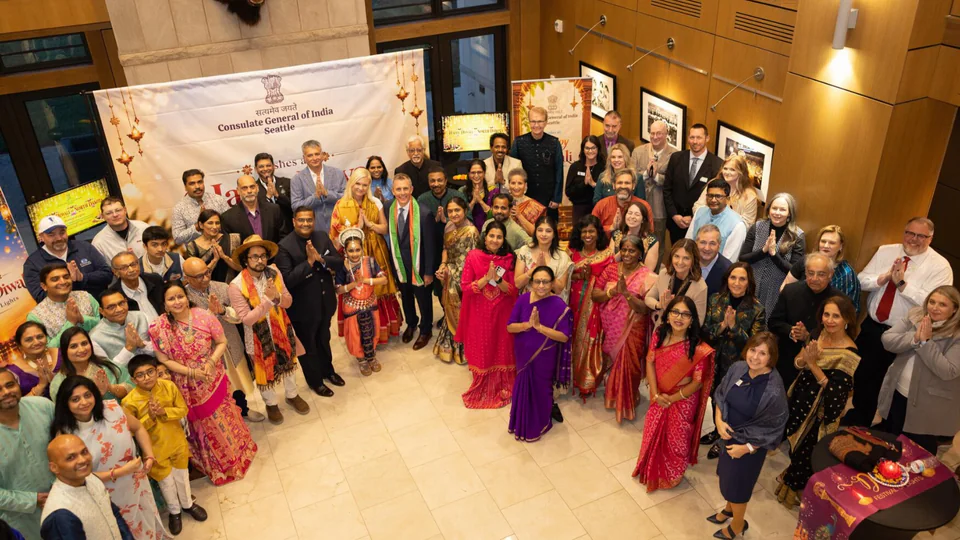
Diwali has received an unusually prominent welcome in the US Pacific Northwest this year, with elected representatives and government officials joining Indian-American communities to celebrate the Festival of Lights. From state capitol buildings and governors’ residences to city halls, the celebrations have highlighted the growing cultural presence and contributions of Indian Americans across the region.
According to the Consulate General of India in Seattle, the celebrations have involved six states and more than 20 cities. Governors, US senators, members of Congress, mayors and other local representatives have participated in ceremonial lamp-lighting events, cultural programmes and community gatherings.
The celebrations began in mid-October and are scheduled to continue until November 10, 2026, when Oregon Governor Tina Kotek is expected to host a concluding ceremony at the State Capitol in Salem. Governors in Idaho, Nebraska, Montana, North Dakota and Washington have already hosted Diwali events at official state venues.
Several city governments have also recognised the festival through public ceremonies and official proclamations. The events reflect the expanding visibility of Diwali in American civic life, as Indian-American communities become increasingly involved in local businesses, public services, education and cultural activities.
Diwali celebrations reach six states and more than 20 cities
The celebrations are part of an initiative coordinated by the Consulate General of India in Seattle in partnership with Indian-American community organisations and local leaders. The diplomatic mission serves several states in the Pacific Northwest and has worked with community representatives to organise events at prominent public institutions.
Idaho, Nebraska, Montana, North Dakota and Washington have hosted governor-level celebrations so far. Oregon is scheduled to host the final state-level event on November 10.
Within Washington state, Diwali celebrations have also taken place in numerous cities, with mayors and city council members participating in lamp-lighting ceremonies. The Consulate’s November 5 announcement referred to celebrations in 22 cities across the Greater Seattle area, where nearly 200,000 Indian Americans reside.
Communities named in the Consulate’s announcement included Auburn, Everett, Marysville, Kirkland, Bellevue, Tukwila, Medina, Bothell, SeaTac, DuPont, Spokane, Issaquah, Edmonds, Lynnwood, Duvall, Tacoma, Mukilteo and Kent. Additional ceremonies were scheduled in Snoqualmie, King County and Seattle on November 10.
Several local governments have also issued proclamations recognising Diwali and its message of the triumph of light over darkness. These recognitions acknowledge the cultural traditions of Indian Americans and their contributions to the economic and social development of their communities.
Washington declares November 8 as Diwali, the Festival of Lights Day
One of the prominent events took place on November 4 at the Washington State Capitol in Olympia. Governor Bob Ferguson hosted a Diwali celebration at the Capitol’s legislative building, bringing together members of the Indian-American community, state officials and representatives of the Consulate General of India.
The event marked the first Diwali celebration at the Washington State Capitol in Olympia. State Senator Manka Dhingra also attended the gathering.
Ferguson praised the Indian-American community for its contribution to Washington’s development, highlighting its growing presence and participation in the state’s economy and public life.
During the event, the governor said Washington was proud to be home to one of the largest shares of Indian Americans in the country. He also referred to the community’s growth over the previous decade and acknowledged the contributions its members have made to the state.
Ferguson further announced that he was proud to sign a proclamation declaring November 8, 2026, as Diwali, the Festival of Lights Day, in Washington state.
The recognition builds on a legislative development earlier in the year. In February 2026, the Washington State Senate passed Senate Bill 6044, recognising Diwali and Bandi Chhor Divas as state observances. These are recognised observances rather than legal public holidays, an important distinction when describing the status of the festivals.
The combination of legislative recognition and a governor-hosted celebration gives Diwali a more visible place in Washington’s public calendar. It also reflects the role of Indian-American residents in the state’s cultural and civic life.
Nebraska Governor welcomes Indian-American community to the Governor’s Mansion
Nebraska Governor Jim Pillen hosted Diwali celebrations at the Governor’s Mansion in Lincoln on October 20. The gathering brought together Indian-American community members and several senior state and local officials.
Pillen described the Indian community as an important part of Nebraska’s identity and welcomed guests with the words, “Welcome to your house”. His remarks emphasised the relationship between Diwali’s values and the state’s sense of community.
The governor drew a connection between the festival’s message and the idea of neighbours helping one another. He also highlighted the importance of family, gratitude and reflection, encouraging Indian-American families to preserve their traditions for future generations.
“Never, ever, ever let the light go out,” Pillen said while extending his Diwali greetings.
First Lady Suzanne Pillen and Lieutenant Governor Joe Kelly attended the celebration, along with Lincoln Mayor Leirion Gaylor Baird, Nebraska Secretary of State Robert Evnen and Congressman Don Bacon.
Bacon also acknowledged the contribution of Indian Americans to the country’s diversity. According to ANI, he said the United States was home to more than 200 ethnic communities and that the Indian community made the country stronger and better.
The gathering demonstrated how cultural celebrations can create opportunities for interaction between elected representatives and communities whose traditions have become part of the wider American social landscape.
North Dakota hosts its first Diwali celebration at the Governor’s Residence
North Dakota marked a milestone on October 29 when Diwali was celebrated for the first time at the Governor’s Residence in Bismarck.
Governor Kelly Armstrong, First Lady Kjersti Armstrong and Agriculture Commissioner Doug Goehring joined the traditional diya-lighting ceremony. Indian-American families and other guests attended the event, which brought the festival’s customs into the state’s official residence.
Armstrong praised the contributions of Indian Americans, particularly professionals such as doctors and entrepreneurs. He highlighted the importance of the relationships connecting North Dakota with India at several levels.
In his remarks, the governor described the gathering as an opportunity to enjoy food, meet old and new friends and strengthen existing relationships. He referred to the connections between North Dakota and India in international relations, trade, state-to-state cooperation and diplomacy.
He also placed particular emphasis on the human connections behind those partnerships, noting that people from India had made important contributions to North Dakota.
The first celebration at the Governor’s Residence gave the Indian-American community an opportunity to share its traditions with state leadership and other residents. It also highlighted the potential for cultural exchanges to support wider educational, professional and economic relationships.
Idaho celebrates Diwali at the State Capitol in Boise
Idaho hosted its Diwali celebration on October 16 at the State Capitol Rotunda in Boise. Governor Brad Little and US Senator Jim Risch, chairman of the Senate Foreign Relations Committee, joined the festivities.
The event recognised the contributions of Indian Americans to Idaho’s economy and communities. Little praised the community’s participation in business, professional services, public service and civic activities.
“Here in Idaho, we’re proud to have a vibrant Indian community that contributes very much to our state,” the governor said.
He added that Indian Americans help strengthen the state’s economy and make its communities better places to live, work and raise families.
The participation of a US senator alongside the governor gave the celebration a wider political dimension. It also reflected the importance of international relationships and cultural engagement in states where Indian-American communities contribute to local economic and professional networks.
For the community, the Capitol Rotunda provided a prominent public setting to celebrate Diwali and introduce its traditions to a wider audience.
Montana Governor hosts Diwali at the Governor’s Mansion
Montana hosted its first Diwali celebration at the Governor’s Mansion in Helena on October 26. Governor Greg Gianforte and First Lady Susan Gianforte welcomed members of the Indian-American community, with Helena Mayor Emily Dean also attending.
The event was organised by the Consulate General of India in Seattle in partnership with the Montana World Affairs Council. It brought together state leadership and community representatives for an evening focused on cultural exchange and strengthening relationships.
Gianforte welcomed the guests and highlighted the importance of bringing people from different backgrounds together. He said the gathering provided an opportunity to begin discussions, continue existing relationships and develop partnerships that could deliver long-term mutual benefits.
The governor’s remarks also connected the celebration with Montana’s broader international engagement. He had recently led a 36-member state delegation on a visit to India, and the Diwali gathering offered an opportunity to build on the relationships established through that visit.
The celebrations also featured a lighter cultural moment. A video shared by the Consulate showed guests dancing to Bollywood music, including a performance to the popular song “London Thumakda”. The footage attracted attention online and offered a glimpse of the informal side of the gathering.
Beyond the ceremonial lamp lighting, the event demonstrated how festivals can create a welcoming environment for people from different cultural backgrounds to meet and participate in shared celebrations.
Oregon to host the concluding Diwali celebration on November 10
Oregon is expected to complete the series of governor-hosted Diwali celebrations on November 10, when Governor Tina Kotek is scheduled to host an event at the State Capitol in Salem.
The ceremony will extend the initiative to another state in the Pacific Northwest and bring the series of official celebrations to six states. The Consulate General of India in Seattle has described the programme as one of the largest coordinated Diwali celebrations hosted across the region.
The scheduled event also means that the series is still underway as of November 7. Additional city-level celebrations are planned in Washington, including events in Snoqualmie, King County and Seattle on the same date.
Why Diwali’s growing recognition matters in the United States
Diwali is celebrated by millions of people around the world, particularly within Hindu, Jain, Sikh and some Buddhist communities. Although traditions differ across regions and religious communities, the festival is widely associated with light, renewal, hope and the victory of good over evil.
In the United States, Diwali celebrations have increasingly moved beyond private homes, religious institutions and community organisations into schools, workplaces, city halls and state government buildings.
Official celebrations and proclamations do not necessarily make Diwali a public holiday. However, they provide public recognition of the communities that celebrate it and create opportunities for people unfamiliar with the festival to understand its traditions.
The Pacific Northwest events are notable because of the level of participation from elected representatives. Governors opened official residences and state capitol venues, while mayors and city council members joined local ceremonies. The involvement of senators and members of Congress also brought national political representatives into the celebrations.
Indian-American communities contribute to the United States in numerous fields, including healthcare, technology, education, entrepreneurship, research and public service. Their economic and civic participation has helped strengthen connections between American states and India.
For state governments, such celebrations can also support cultural diplomacy and people-to-people relationships. Community events create opportunities to discuss trade, education, professional cooperation and international partnerships in a setting that is accessible to residents.
A regional celebration with a wider message
The Diwali celebrations across Idaho, Nebraska, Montana, North Dakota and Washington, with Oregon’s event still scheduled, have brought together political leaders and Indian-American communities around a shared cultural occasion.
From the Capitol Rotunda in Boise to the Governor’s Mansion in Helena and the state capitol in Olympia, the events have given Diwali a visible presence in public institutions. City-level celebrations across Washington have extended that recognition into local communities.
The initiative also highlights the role of the Indian diaspora in strengthening cultural and professional relationships between India and the United States. While official proclamations and ceremonies do not automatically change public-holiday status, they signal growing recognition of the festival’s place in American community life.
As Oregon prepares to host the concluding event on November 10, the message behind the celebrations remains consistent: Diwali is not only an occasion for lighting lamps and sharing traditional food, but also an opportunity to bring people together across cultures and generations.
For breaking news and live news updates, like us on Facebook or follow us on Twitter and Instagram. Read more on Latest World on thefoxdaily.com.




COMMENTS 0