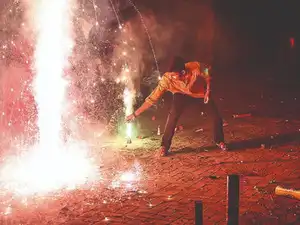
India marked Diwali on Sunday, November 8, with illuminated homes, decorated temples, prayers, fireworks and family gatherings. From Ayodhya’s riverfront to temples in Puri, Kolkata and Madurai, the festival brought together religious traditions and regional celebrations. Political leaders also extended greetings, while several public figures spent the occasion with security personnel, farmers and local communities.
In Chhattisgarh, Prime Minister Narendra Modi celebrated Diwali with security forces at the CoBRA Operations Base in Karanpur, Bastar. He described the occasion as particularly significant, saying it was the first Diwali after every district in the country had become free from naxalism.
However, the celebrations in the national capital came with an environmental concern. Delhi recorded an average Air Quality Index (AQI) of 376 on Sunday, placing it in the ‘very poor’ category. Firecracker emissions, vehicle pollution and seasonal stubble burning were among the factors contributing to the city’s pollution burden. Authorities expected air quality to deteriorate further after the evening celebrations.
Diwali celebrations illuminate cities and temples across India
Homes, markets, religious sites and public landmarks were decorated with rows of diyas and colourful lights as people celebrated the festival. Families gathered for Lakshmi Puja, exchanged sweets and gifts, prepared festive meals and welcomed relatives and friends.
Temples across the country witnessed large gatherings of devotees. In Odisha, thousands of people visited the Shree Jagannath Temple in Puri to attend the early morning Mangal Aarti. In Ayodhya, devotees gathered along the banks of the Saryu River for prayers and a holy dip following the Maha Aarti.
In Delhi, devotees visited the Adya Katyayani Shaktipeeth Temple in Chhatarpur, while the Akshardham Temple was illuminated for the festival. The Red Fort and other prominent locations also featured decorative lighting, adding to the festive atmosphere in the capital.
Kolkata observed Diwali alongside Kali Puja, with the Dakshineswar Kali Temple decorated with lights. In Madurai, people celebrated with traditional prayers and family gatherings, while temples in Mathura and other parts of Uttar Pradesh arranged special decorations and ceremonies.
Regional customs added to the diversity of the celebrations. In Goa, people continued the tradition of burning effigies of Narakasura, the demon associated with the festival’s victory of good over evil. Across other states, communities organised cultural programmes, religious events and neighbourhood celebrations.
Ayodhya’s Deepotsav and regional traditions draw attention
Ayodhya remained one of the major centres of Diwali celebrations. The city’s Deepotsav festivities, held ahead of the main festival, featured large-scale illumination along the Saryu riverfront. The event brought together religious ceremonies, cultural performances and the lighting of traditional earthen lamps.
Vice-President C. P. Radhakrishnan attended the Deepotsav celebrations on November 7, joining other dignitaries and religious representatives. Uttar Pradesh Chief Minister Yogi Adityanath also visited the Ram Temple and participated in the festive observances.
The celebrations in Ayodhya draw on the traditional account of Lord Ram’s return to the city after defeating Ravana. The lighting of lamps is associated with the welcome extended to Ram, Sita and Lakshman after their return from exile.
Other cities marked the occasion through their own customs. Mathura and Vrindavan organised temple illuminations, while Chitrakoot hosted a multi-day fair that attracted devotees. These celebrations demonstrate how the festival combines shared religious themes with local traditions that vary across regions.
PM Modi celebrates Diwali with security personnel in Bastar
Prime Minister Narendra Modi travelled to the CoBRA Operations Base at Karanpur in Bastar, Chhattisgarh, to celebrate Diwali with security personnel involved in operations against Maoist violence. He interacted with the jawans, shared sweets and thanked them for their service.
Modi said he had chosen Bastar to recognise the sacrifices of the personnel who had worked to improve security in an area historically affected by Naxalism. He described the festival as a milestone in India’s long-running effort to address Left-Wing Extremism.
Addressing personnel from the Central Reserve Police Force (CRPF), CoBRA, Border Security Force, Indo-Tibetan Border Police, Sashastra Seema Bal and state police units, the Prime Minister praised their courage and dedication. He also acknowledged the contribution of women personnel and specialised state police teams.
Modi said the country was celebrating its first Diwali after every district had become free from Naxalism. He credited security personnel and government efforts for the change and said the sacrifices made by those involved in the campaign deserved national recognition.
Bastar has been a central area in India’s campaign against Maoist insurgency. The region, which includes several districts of southern Chhattisgarh, has experienced decades of violence involving security forces and armed Maoist groups. The government’s approach has combined security operations with efforts to expand infrastructure and public services.
The Prime Minister’s visit also continued his practice of spending Diwali with members of the security forces. He has previously celebrated the festival with personnel stationed in different parts of the country, including border areas.
Political leaders extend Diwali greetings
President Droupadi Murmu extended greetings to citizens in India and abroad on the eve of Diwali. Her message highlighted the festival’s association with the victory of virtue over negative tendencies and the beginning of a period of happiness and prosperity.
She also urged people to preserve the Environment and maintain harmony while celebrating. Her message referred to the traditional significance of Lord Ganesha and Goddess Lakshmi worship during the festival.
Prime Minister Modi wished people happiness, peace and prosperity. Other political leaders also shared messages focused on goodwill, social harmony and the importance of supporting local communities.
Rajasthan Chief Minister Bhajanlal Sharma encouraged people to purchase goods from local artisans, potters and small traders. Madhya Pradesh Chief Minister Mohan Yadav spoke about the festival’s message of hope and social harmony, while Assam Chief Minister Himanta Biswa Sarma called on people to bring prosperity and positivity into their homes.
Maharashtra Chief Minister Devendra Fadnavis celebrated Diwali with farmers in the Nagpur region, a gesture that was also acknowledged by the Prime Minister. The celebrations offered a reminder of the role of agricultural communities in the country’s economy and festive preparations.
Delhi records ‘very poor’ air quality on Diwali
While much of India celebrated the festival under illuminated skies, Delhi faced worsening air pollution. The national capital’s average AQI settled at 376 on Sunday, according to reported daily readings, compared with 369 on Saturday. The reading placed the city in the ‘very poor’ category, which covers AQI values between 301 and 400.
A separate live reading on Delhi’s air-quality monitoring portal showed an AQI of 372 at 6 pm on November 8. Monitoring stations across the city recorded different pollution levels, with several locations entering the ‘severe’ category.
Jahangirpuri was among the most polluted locations, recording an AQI above 460 in reported station readings. Other areas, including Sonia Vihar, North Campus, Rohini and Burari Crossing, also reported severe pollution levels.
The AQI scale used by the Central Pollution Control Board classifies air quality as good between 0 and 50, satisfactory between 51 and 100, moderate between 101 and 200, poor between 201 and 300, very poor between 301 and 400, and severe between 401 and 500.
The rise in pollution was recorded before the full impact of Diwali-night firecracker emissions could be assessed. Authorities and air-quality forecasts warned that the combination of fireworks, vehicle emissions and unfavourable weather conditions could push the city into the severe category after the celebrations.
Firecrackers, vehicle emissions and stubble burning add to pollution
Firecrackers release particulate matter and gases that can worsen air quality, particularly when large numbers are used over a short period. Fine particles such as PM2.5 are a major concern because they can penetrate deep into the respiratory system.
Delhi’s pollution problem, however, is not caused by a single source. Vehicle exhaust, construction dust, industrial emissions, waste burning and emissions from other activities contribute to the city’s year-round pollution levels. During the post-monsoon and winter period, weather conditions can make the situation worse.
Stubble burning in neighbouring agricultural regions is another seasonal factor. Smoke from crop-residue fires can travel towards the national capital, adding to the pollution already generated within the city. The contribution from farm fires changes according to the number and location of incidents, wind direction and atmospheric conditions.
Weather conditions also influence how quickly pollutants disperse. Low wind speeds and a shallow atmospheric mixing layer can trap emissions close to the ground. When these conditions coincide with firecracker use and other pollution sources, concentrations of harmful particles can rise rapidly.
According to the reported pollution forecast, Delhi was likely to experience severe air quality from November 9 for several days. The expected deterioration highlighted the challenge of managing pollution during the festive period, when emissions from multiple sources can increase at the same time.
Delhi Police deploys special teams to enforce firecracker restrictions
Authorities in Delhi introduced restrictions on firecracker use to limit the impact of festival-related emissions. The Supreme Court had permitted the use of certified green firecrackers in Delhi-NCR during specified hours on November 7 and 8.
The permitted windows were between 6 am and 7 am and between 8 pm and 10 pm on both days. The court also made clear that a complete ban on firecrackers would return from November 9.
Delhi Police deployed more than 250 special teams to monitor compliance with the permitted timings. At least one team was assigned to each police station, while checking was intensified at the city’s borders to prevent the entry of illegal and conventional firecrackers.
The restrictions were intended to allow limited use of approved products while reducing the wider pollution burden. Green firecrackers are designed to produce lower emissions than conventional fireworks, but they do not eliminate pollution entirely. Their use can still release particulate matter and other substances into the air.
Enforcement remained a major challenge because compliance depends on public participation as well as police monitoring. The concentration of fireworks in residential neighbourhoods can make it difficult to identify violations, particularly when celebrations take place across a large urban area.
Why the post-Diwali pollution outlook remains a concern
The expected deterioration in Delhi’s air quality after Diwali reflects the combined effect of short-term and seasonal pollution sources. Firecracker emissions can create sudden increases in particulate matter, while vehicle traffic and other urban activities continue to add pollutants throughout the day.
Stubble burning and unfavourable weather can further limit the atmosphere’s ability to clear the accumulated pollution. This means that even after firecracker use declines, poor dispersion conditions may keep pollution levels elevated.
The impact is particularly important for children, older people and individuals with respiratory or cardiovascular conditions. Exposure to high concentrations of fine particles can aggravate breathing difficulties and increase health risks. Public health advisories during severe pollution episodes generally encourage people to reduce prolonged outdoor activity and follow local authority guidance.
Delhi’s Diwali celebrations therefore highlighted two contrasting realities: the country’s widespread participation in a major cultural festival and the continuing challenge of protecting urban air quality. The festival’s traditional use of lamps and community gatherings can continue, but reducing pollution requires action beyond the festive period.
Diwali celebrations continue with environmental concerns in focus
Diwali remains one of India’s most widely observed festivals, bringing together religious rituals, regional customs and family traditions. This year’s celebrations included temple ceremonies, illuminated public spaces, community events and the Prime Minister’s visit to security personnel in Bastar.
In Delhi, however, the ‘very poor’ AQI served as a reminder of the environmental pressures that accompany the festival. Restrictions on firecrackers and police enforcement were aimed at limiting additional emissions, but the city’s pollution levels were already being influenced by traffic, seasonal smoke and weather conditions.
As the festival period continues with Govardhan Puja and Bhai Dooj, the challenge for authorities and residents will be to balance celebrations with public health and environmental protection. Sustained action on transport emissions, dust, waste burning and crop-residue pollution will remain essential if Delhi is to improve its air quality beyond the Diwali season.
For breaking news and live news updates, like us on Facebook or follow us on Twitter and Instagram. Read more on Latest India on thefoxdaily.com.






COMMENTS 0