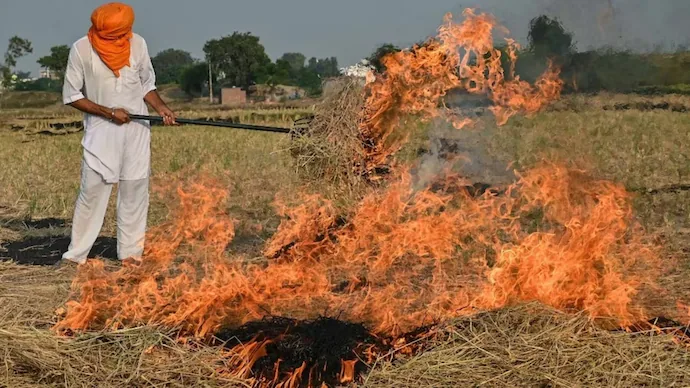
The Aam Aadmi Party (AAP) in Punjab has accused the Bharatiya Janata Party (BJP) and Delhi minister Manjinder Singh Sirsa of targeting the state and its farmers over stubble burning, escalating the political dispute surrounding crop residue management and air pollution in the national capital.
On Saturday, AAP leaders defended the Punjab government’s efforts to curb farm fires, citing investments in agricultural machinery, awareness campaigns and measures to encourage scientific stubble management. They claimed that equipment worth more than Rs 800 crore had been provided to farmers to help manage crop residue without burning it.
Punjab Finance Minister and senior AAP leader Harpal Singh Cheema alleged that BJP leaders were making misleading claims about stubble burning instead of recognising the state’s efforts. AAP Punjab media in-charge Baltej Pannu also questioned the timing of the criticism, arguing that paddy harvesting had not yet gained momentum because of recent rainfall.
The exchange follows a social media post by Sirsa on Friday, in which he accused the AAP government of failing to control stubble burning in Punjab despite previously blaming the problem for Delhi’s pollution while the party was in power in the national capital.
AAP Accuses BJP of Targeting Punjab Farmers
Cheema alleged that the BJP had repeatedly taken positions that harmed farmers’ interests and that its leaders had demanded legal action against farmers rather than acknowledging efforts to address agricultural pollution.
He argued that Punjab’s farming community should not be portrayed as responsible for widespread stubble burning without considering the steps taken by the state government. According to Cheema, the government had been procuring and distributing stubble-management machinery for the past five years, alongside campaigns to educate farmers about alternative methods of handling crop residue.
Cheema claimed these interventions had brought stubble-burning incidents down to negligible levels. He also maintained that isolated cases, if they occurred, should not be used to suggest that the practice remained widespread across Punjab.
“Punjab’s farmers are not burning stubble on the scale being portrayed by BJP leaders. The government has continuously provided machinery and made farmers aware of scientific stubble management practices,” Cheema said.
He added that individual incidents should be assessed in context rather than treated as evidence of a statewide pattern. His remarks formed part of AAP’s broader defence of Punjab’s agricultural policies and its response to criticism linking farm fires to Delhi’s air quality.
What Manjinder Singh Sirsa Said About Stubble Burning
Delhi minister Manjinder Singh Sirsa criticised AAP in a post published in Hindi and Punjabi on X on Friday. He argued that the party had previously blamed others for stubble burning in Punjab when it governed Delhi, but now faced responsibility for the issue because it also governed Punjab.
“When the AAP government was in power in Delhi, everyone was responsible for Punjab’s stubble, except them. Now the AAP government is in Punjab too, and the fires are raging even more than before. This isn’t helplessness… It’s the AAP government’s incompetence. Delhi is still choking today,” Sirsa wrote.
His criticism linked the management of agricultural residue in Punjab to the continuing problem of air pollution in Delhi. It also challenged AAP to demonstrate that its approach had produced a meaningful reduction in farm fires now that the party was responsible for the government in both states at different points in its political history.
In response, Cheema urged Sirsa and other BJP leaders to stop making what he described as false allegations against Punjab. He also asked them to address the situation in neighbouring states governed by the BJP, including Haryana and Uttar Pradesh.
The competing statements highlight a familiar political dispute over the sources of Delhi’s seasonal air pollution, particularly the contribution of agricultural fires in the surrounding region. AAP’s response has focused on its claimed investments and reductions in stubble burning, while Sirsa has questioned the effectiveness of the Punjab government’s efforts.
Rainfall and Harvesting Timing Become Part of the Dispute
Baltej Pannu, AAP Punjab’s media in-charge, challenged BJP leaders over what he described as premature claims about smoke from Punjab reaching Delhi. He said recent rainfall had delayed paddy harvesting and that harvesting activity had not yet gathered significant momentum.
Pannu argued that BJP leaders had begun raising concerns about farm fires before the scale of harvesting could support the picture they were presenting. He questioned how smoke from Punjab could supposedly reach Delhi without passing through Haryana, suggesting that the claims overlooked the geography between the two states.
“Paddy harvesting has not even gathered momentum, yet BJP leaders have started creating a drama about smoke reaching Delhi from Punjab. If fires have not even started on the scale being claimed, how has the smoke bypassed Haryana and reached Delhi directly? Is there some pipeline carrying smoke from Punjab to Delhi?” Pannu said.
His comments were intended to challenge the timing and accuracy of the allegations against Punjab. However, AAP’s statements do not, by themselves, establish the extent of stubble burning during the period in question or determine how much any farm fires contributed to Delhi’s air pollution.
The timing of harvesting is relevant because crop residue burning generally occurs after paddy harvesting, when farmers must manage the remaining straw before preparing fields for the next crop. Weather conditions can affect harvesting schedules, while the timing and number of fires can vary across locations.
The political dispute has therefore developed around two related but distinct questions: whether Punjab’s measures have reduced stubble burning and what role agricultural fires are playing in Delhi’s pollution during the current period. The statements supplied by the two sides reflect their competing positions but do not provide independently verified measurements to settle either question.
AAP Cites Machinery Worth More Than Rs 800 Crore
AAP leaders have pointed to government support for stubble-management machinery as evidence of their approach to the problem. Cheema and Pannu said equipment worth more than Rs 800 crore had been provided to farmers, enabling them to use alternatives to burning crop residue.
Cheema said the state government had continued its machinery procurement and distribution efforts over the past five years. He argued that providing farmers with practical equipment and information about scientific management methods was more constructive than threatening them with punitive action.
Pannu similarly described the investment as evidence that the Punjab government was attempting to address the issue through support rather than intimidation. He accused BJP leaders of continuing to criticise farmers despite what AAP described as substantial investment and progress in reducing farm fires.
Access to suitable machinery is an important part of crop residue management because farmers must handle large quantities of straw within a limited period between harvesting and the next agricultural cycle. Equipment and other residue-management methods can help farmers deal with crop waste, although their effectiveness depends on availability, affordability, timing and local farming conditions.
The Rs 800 crore figure cited by AAP represents the party’s stated account of the government’s investment in machinery. The supplied information does not include a detailed breakdown of the equipment distributed, the number of farmers who received access to it or the independent assessment of its impact.
AAP Claims Stubble Burning Has Fallen Significantly
Pannu also referred to parliamentary discussions in which, according to him, a reduction of up to 80 per cent in stubble burning had been noted last year. He cited the figure to support AAP’s argument that Punjab had made progress and that the state’s farmers should not be portrayed as continuing the practice at the scale alleged by BJP leaders.
However, the supplied account does not identify the specific parliamentary statement, the baseline year used for comparison or the precise period covered by the reported reduction. The figure should therefore be understood as a claim cited by Pannu rather than a fully documented assessment in the material available here.
Evaluating changes in stubble burning requires clarity about the period being compared, the number of detected fires, the area under cultivation and the methods used to measure incidents. A reduction over one period does not automatically establish that farm fires have become negligible in every location or that they no longer contribute to pollution.
AAP maintained that sustained investment in machinery and awareness had helped reduce the practice. Its leaders argued that these efforts deserved recognition instead of what they characterised as political attacks on Punjab and its agricultural community.
Farmers and Punjab’s Contribution to Food Security
The dispute has also taken on a broader political dimension, with AAP leaders arguing that criticism over pollution risks unfairly damaging the reputation of Punjab’s farmers.
Pannu said attempts to portray Punjab as a state of “drug addicts” or “polluters” should stop. He argued that such descriptions insulted the state’s people and ignored the contribution of its farmers to India’s food security.
His remarks broadened the party’s response beyond the immediate question of crop residue burning. AAP presented the controversy as part of what it views as a wider pattern of negative portrayals of Punjab, while insisting that the state government’s measures should be judged on their stated objectives and results.
Punjab’s agricultural sector plays an important role in the country’s food supply, but that contribution does not remove the need to address environmental challenges associated with farming. The central policy issue remains how farmers can manage crop residue effectively while limiting pollution, controlling costs and maintaining agricultural productivity.
For farmers, practical alternatives must be available at the time they are needed. Government support, access to equipment and awareness of residue-management techniques can all form part of a response, but claims about the scale of progress require evidence that can be assessed independently.
Political Dispute Over Delhi’s Air Pollution Continues
The latest exchange adds to the political contest over responsibility for Delhi’s poor air quality and the role of farm fires in the wider region. Sirsa’s criticism focused on AAP’s responsibility for governing Punjab, while the party’s leaders argued that BJP politicians were overlooking the measures they said had already been implemented.
Cheema asked BJP leaders to focus on neighbouring Haryana and Uttar Pradesh as well as Punjab, while Pannu questioned the timing of the allegations in light of rain-delayed harvesting. Both leaders argued that the BJP was using the issue to target Punjab’s farmers rather than acknowledging the government’s claimed progress.
Sirsa, meanwhile, maintained that Delhi continued to face severe pollution and accused AAP of failing to control stubble burning. The supplied material does not include a detailed response from Sirsa to the specific questions raised by Cheema and Pannu, nor does it provide comparative data on farm fires across Punjab, Haryana and Uttar Pradesh for the same period.
Determining the contribution of stubble burning to Delhi’s air pollution requires evidence on fire activity, weather conditions and other pollution sources. The political statements from AAP and the BJP offer competing interpretations of the issue, but the claims cited in the exchange should not be treated as a substitute for comparable, independently verified data.
What Happens Next?
The immediate dispute centres on whether Punjab’s reported investments and claimed reductions in stubble burning are being adequately recognised, and whether the BJP’s criticism accurately reflects conditions during the current harvesting period.
AAP has reiterated that the Punjab government has supplied machinery worth more than Rs 800 crore, conducted awareness campaigns and promoted scientific approaches to crop residue management. Its leaders have also argued that recent rainfall delayed harvesting and made claims about widespread fires premature.
Sirsa’s criticism, by contrast, questions whether AAP has delivered effective results in Punjab and connects the issue to Delhi’s continuing air pollution. Neither side’s statements, as presented in the supplied material, provide enough independently verified evidence to resolve the disagreement over the current scale of farm fires or their precise contribution to pollution.
As harvesting progresses, reliable information on detected fires, crop residue management and regional air quality will be important for assessing the claims. For farmers and residents affected by pollution, the practical priority remains reducing crop-residue burning through workable alternatives and addressing the range of sources that contribute to poor air quality.
For now, the exchange underscores how stubble burning remains both an environmental challenge and a point of political contention between AAP and the BJP, with Punjab’s farmers at the centre of the debate.
For breaking news and live news updates, like us on Facebook or follow us on Twitter and Instagram. Read more on Latest India on thefoxdaily.com.






COMMENTS 0