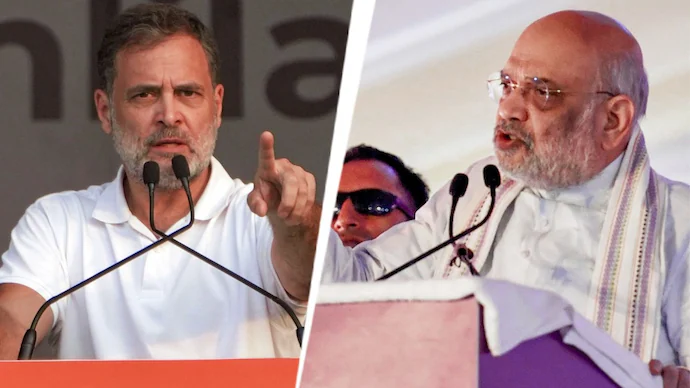
Congress MP and Leader of Opposition in the Lok Sabha Rahul Gandhi on Wednesday launched a sharp attack on Union Home Minister Amit Shah over the growing drug menace in Punjab, questioning his promise to eliminate narcotics by December 31, 2029. Gandhi claimed that Shah would no longer be Home Minister by then and predicted that the Narendra Modi government would not last another year.
Addressing the Congress’ Insaaf Rally in Sangrur, Rahul Gandhi also turned the issue into an early political challenge to the ruling Aam Aadmi Party (AAP), with the Punjab Assembly elections scheduled for next year. He accused the state government of failing to tackle the drug problem and alleged that Punjab was being governed remotely from Delhi rather than by its elected leadership.
The rally marked an important political mobilisation for the Congress as it sought to make Drug Trafficking, unemployment and the functioning of the state government central issues ahead of the next Assembly election.
Referring to Shah’s recent assurance that Punjab and the rest of the country would become drug-free by the end of 2029, Gandhi questioned whether the Union Home Minister would remain in office long enough to fulfil the promise.
“What timeline did they (Union HM Amit Shah) set for the drug issue?… Within three years? In three years, Amit Shah won’t even be the Home Minister anymore… My assessment is that this govt won’t even last a year,” he said.
Shah had made the pledge during his recent visit to Punjab, asserting that the government would eliminate the drug menace across the state and the country by December 31, 2029.
The promise has become politically significant amid public anger over drug trafficking, alleged administrative failures and attacks on individuals who have confronted people suspected of involvement in the illegal narcotics trade.
Rahul Gandhi argued that the scale of the problem had vindicated his earlier warnings about the spread of drugs in Punjab. He also sought to question the credibility of the BJP and AAP’s claims about tackling the crisis.
Rahul Gandhi invokes the ‘chitta’ menace in Punjab
During his address, Rahul Gandhi recalled raising concerns about the spread of drugs in Punjab in the past. He said his warnings had been dismissed by the BJP and the Shiromani Akali Dal at the time, but the situation had since become a major challenge for the state.
He specifically referred to ‘chitta’, a form of adulterated heroin, which has emerged as one of the most politically sensitive aspects of Punjab’s drug problem.
The issue has gained renewed attention following the killing of anti-drug activist Parvinder Singh Jhota. He was shot dead after allegedly confronting a chemist involved in the illegal drug trade.
Jhota’s killing triggered protests and intensified public demands for action against drug networks and those allegedly protecting them. The incident also brought renewed attention to the risks faced by people who publicly challenge suspected narcotics operations.
The controversy prompted Amit Shah to visit Punjab, where he met the families of victims of attacks linked to anti-drug activism. His visit and subsequent drug-free pledge placed the issue back at the centre of the state’s political debate.
For the Congress, the drug crisis offers an opportunity to challenge both the BJP’s claims at the national level and the AAP government’s record in Punjab. By referring to Jhota’s killing and the continuing concerns over ‘chitta’, Gandhi sought to connect the broader drug problem with questions of public safety and government accountability.
‘Punjab is being remote-controlled from Delhi’: Rahul targets AAP
Alongside his criticism of Amit Shah, Rahul Gandhi directly targeted the AAP government led by Chief Minister Bhagwant Mann. He alleged that Punjab’s administration was effectively being controlled from Delhi, with AAP chief Arvind Kejriwal and the BJP leadership exercising influence over the state government.
Gandhi suggested that the state’s elected leadership was not functioning independently and accused Mann of being sidelined in the decision-making process.
He contrasted the AAP government’s functioning with the Congress’ approach, arguing that a government in Punjab should take decisions from within the state and remain accountable to its people.
“People here need a govt that works for Punjab. When the Congress party comes to power, the govt of Punjab cannot be run from Delhi. Our party runs the Punjab government from within Punjab. Our Chief Minister is truly the Chief Minister of Punjab,” he said.
He further alleged that the state’s administration was being controlled jointly by the BJP leadership and Kejriwal, questioning whether the AAP government was acting independently in the interests of Punjab.
The allegation forms part of the Congress’ broader political challenge to AAP ahead of the Assembly elections. By raising the question of who controls the state government, Gandhi attempted to frame the contest around Punjab’s political autonomy and the authority of its elected Chief Minister.
Congress questions AAP’s election promises and governance
Rahul Gandhi also questioned the AAP government’s performance since coming to power in Punjab. He asked the gathering which of the party’s electoral promises had actually been fulfilled and sought to present the Congress as an alternative ahead of the next Assembly election.
Employment and the fight against drugs were central to his appeal. He urged voters to support the Congress, promising a government focused on creating employment opportunities and making Punjab free from drugs.
The approach reflects the Congress’ attempt to combine public concerns about narcotics with wider questions about governance and economic opportunities. Drug trafficking has remained a prominent political issue in Punjab, while employment is another major concern likely to feature in the campaign.
By linking these issues, Gandhi sought to challenge the AAP government on both its administrative record and its ability to deliver on promises made to voters.
The Insaaf Rally also gave the Congress an opportunity to bring its senior state and national leaders together as the party begins building momentum for the upcoming Assembly elections.
Rahul Gandhi remembers Sidhu Moosewala
During the rally, Rahul Gandhi also recalled his interaction with slain Punjabi singer Sidhu Moosewala. The singer’s father, Balkaur Singh, met Gandhi shortly before the Congress event in Sangrur.
Gandhi remembered Moosewala as a talented young man who had the potential to contribute to politics. He recalled that the singer had joined the Congress after meeting him.
The Congress leader also alleged that Moosewala’s security had been withdrawn before he was murdered in broad daylight in May 2022.
Moosewala’s killing remains a sensitive issue in Punjab’s political debate, particularly around questions of public security and the protection provided to prominent individuals. By bringing up the singer during the rally, Gandhi connected the memory of his death with the wider concerns about law and order in the state.
Congress leaders gather in Sangrur ahead of Punjab polls
The Insaaf Rally was attended by Congress president Mallikarjun Kharge, Punjab Congress chief Pargat Singh, party state in-charge Sachin Pilot and several senior leaders.
The presence of the party’s national and state leadership highlighted the importance Congress is attaching to Punjab ahead of next year’s Assembly elections.
With the drug menace, unemployment and allegations of remote control over the state government emerging as key themes, the party is seeking to challenge AAP on its governance record while also questioning the BJP’s role in addressing Punjab’s problems.
Rahul Gandhi’s remarks against Amit Shah added a direct confrontation between the Congress and the Union government to the campaign. His prediction that Shah would not remain Home Minister until the 2029 deadline also turned the drug-free pledge into a political challenge over the government’s ability to deliver on its stated target.
As the Assembly election approaches, the fight over Punjab’s drug crisis is likely to remain a major part of the political contest. The Congress is attempting to use public concerns over narcotics, attacks on anti-drug activists and employment to build its case against the ruling AAP, while Shah’s 2029 deadline has given the BJP another commitment to defend.
For breaking news and live news updates, like us on Facebook or follow us on Twitter and Instagram. Read more on Latest India on thefoxdaily.com.




COMMENTS 0