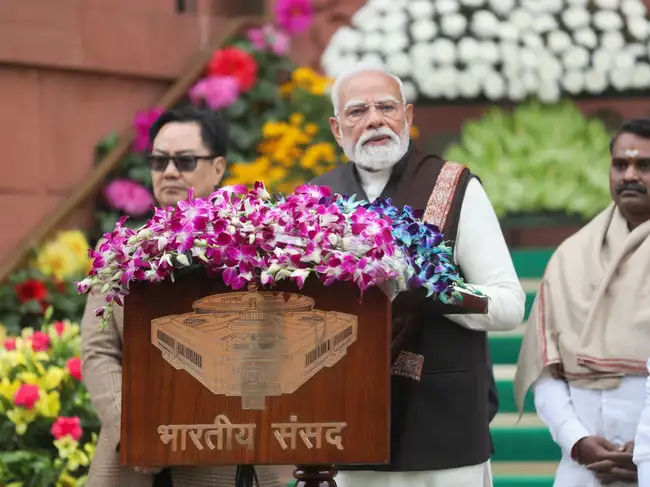
India’s Parliament could reconvene before December 15, with Prime Minister Narendra Modi asking his ministerial colleagues to remain available and ensure their departments are prepared for the next sitting. The issue was discussed during a Cabinet meeting chaired by Modi on Wednesday, November 25, according to reports citing government sources.
The Prime Minister reportedly advised ministers against undertaking foreign travel before the proposed session, signalling that the government wants its ministers ready to participate in legislative business. The Cabinet Committee on Parliamentary Affairs is expected to take the final decision on the commencement date, duration and format of the sitting.
The development comes after more than 100 days of uncertainty following the conclusion of the Monsoon Session on August 13. The delay in announcing the next parliamentary schedule has drawn questions from opposition parties, particularly as speculation continues over the government’s plans for Delimitation and the implementation of the Women’s Reservation law.
Although a special sitting has been discussed in political circles, there is no confirmed announcement that Parliament will meet in a separate special session. The government could instead reconvene the existing Monsoon Session or formally conclude it before calling the Winter Session.
PM Modi asks ministers to remain available for Parliament
The next parliamentary sitting was reportedly discussed at Wednesday’s Cabinet meeting, where Modi asked ministers to complete preparations within their respective ministries. The instruction to avoid foreign travel is intended to ensure that members of the Union Cabinet remain available when Parliament meets.
Ministers are expected to prepare for questions, legislative proposals, departmental updates and other parliamentary responsibilities. Government departments generally need to coordinate with parliamentary affairs officials before a session so that proposed bills, official responses and other business can be scheduled.
However, the Prime Minister’s reported instruction does not itself establish the date on which either House will assemble. The Cabinet Committee on Parliamentary Affairs is responsible for recommending the schedule, after which the formal process for summoning Parliament must be completed.
The distinction matters because the government has not yet publicly confirmed whether the next sitting will be treated as the continuation of the Monsoon Session or as a new Winter Session. The decision could also determine how much time is available for the government to introduce and debate its proposed legislation.
Why the delay in Parliament’s Winter Session has attracted attention
The Monsoon Session of Parliament was adjourned sine die on August 13, meaning that the Houses were adjourned indefinitely without a specific date being fixed for their next sitting. More than 100 days later, the delay in announcing the next parliamentary schedule has become a political issue.
Reports on November 25 put the gap at approximately 103 days. The Monsoon Session had also not been formally prorogued at the time of the latest developments. Prorogation is the formal constitutional process through which the President brings a parliamentary session to an end on the advice of the government.
Adjournment sine die and prorogation are different parliamentary procedures. When a House is adjourned sine die, its sitting ends without a date being announced for the next meeting. The session itself, however, remains formally open until prorogation.
This distinction has become particularly relevant because the government could potentially reconvene the existing session without following the same advance-notice process required for summoning a fresh session after prorogation. It has contributed to speculation that the government may be keeping its options open while deciding how to schedule the next round of parliamentary business.
India does not have a constitutionally fixed calendar requiring the Winter Session to begin on a particular date. Parliament generally meets for three sessions each year: the Budget Session, Monsoon Session and Winter Session. Their timing can vary according to the government’s legislative programme and other considerations.
What the Constitution says about the gap between parliamentary sessions
Article 85 of the Constitution of India gives the President the authority to summon each House of Parliament. It also requires that six months must not intervene between the last sitting in one session and the first sitting of the next session.
This provision establishes the constitutional outer limit for the gap between parliamentary sittings. It does not require the government to convene the Winter Session on a particular date in November or December.
The current delay has therefore generated political questions and procedural discussion, but the number of days since the Monsoon Session was adjourned does not, by itself, establish a constitutional violation. The key constitutional requirement is that Parliament must meet within the prescribed six-month interval.
The government now faces the task of settling the next schedule while preparing for a potentially contentious legislative agenda. The reported December 15 deadline for preparations should not be confused with a formally notified date for the first sitting.
Delimitation and women’s reservation could dominate the agenda
One of the biggest issues surrounding the next parliamentary session is the proposed constitutional amendment connecting delimitation with the implementation of women’s reservation. The legislation could reopen a debate that has already produced a major political confrontation in Parliament.
Delimitation refers to the process of redrawing the boundaries of parliamentary and Assembly constituencies. It can also involve changes to the number of seats allocated to different constituencies. The exercise is important because it determines how voters are represented and how constituencies are organised.
The proposed legislative framework has been linked to the implementation of the 33 per cent reservation for women in the Lok Sabha and state legislative assemblies. Parliament passed the Constitution (106th Amendment) Act in 2023, commonly known as the Women’s Reservation Act. However, the law provides for the reservation to take effect after a census and a subsequent delimitation exercise.
The government is expected to face questions over how the proposed changes would affect the size of the Lok Sabha, the distribution of seats among states and the timeline for implementing women’s reservation. These issues are politically significant because changes to constituency boundaries can influence the relative representation of different regions.
The debate is particularly sensitive for several southern states, where political leaders have raised concerns about the possibility that population-based delimitation could alter their share of representation in Parliament compared with states that have experienced faster population growth.
Why the proposed constitutional amendment faces a numbers test
A constitutional amendment requires more than a simple majority in Parliament. Under Article 368, it must secure a majority of the total membership of each House and at least two-thirds of the members present and voting. The requirement applies separately in the Lok Sabha and the Rajya Sabha.
This makes the proposed delimitation-linked legislation a significant test of the government’s ability to secure support beyond its own parliamentary numbers. Even if the ruling alliance has sufficient support for ordinary legislation, a constitutional amendment requires a higher level of agreement.
The proposed legislation previously faced a setback when a related Constitution amendment bill failed to secure the required support in the Lok Sabha on April 17, 2026. Its defeat demonstrated the difficulty of passing the package without obtaining the necessary numbers.
The government’s next move will therefore depend not only on the timing of Parliament’s return but also on the content of the legislation and the support it can secure from other parties. Any revised proposal could attract scrutiny over the method of delimitation, the proposed expansion of the Lok Sabha and safeguards for the representation of individual states.
For the opposition, the central questions include whether women’s reservation should remain linked to delimitation and how the government intends to address concerns about regional representation. The parties may also seek clarity on the proposed constitutional changes before agreeing to support them.
Opposition questions the government’s parliamentary strategy
The delay in announcing the next parliamentary schedule has prompted criticism from opposition leaders. Congress leaders have questioned why the government has not communicated a clear timetable for the Winter Session or a possible special sitting.
Congress spokesperson Jairam Ramesh has raised questions about the government’s intentions and its proposed approach to delimitation. He has also sought clarity on the formula that could determine the future distribution of parliamentary seats.
The opposition’s concerns extend beyond the timing of the session. Parties have argued that a major constitutional amendment affecting representation should involve consultations and a detailed explanation of its potential consequences for different states.
Congress has also questioned the government’s efforts to secure the parliamentary numbers required for the proposed legislation. Opposition leaders have called for greater transparency about the contents of the proposed bill and the government’s plans for delimitation.
The government, meanwhile, has not publicly announced a final legislative formula or confirmed the exact bills that will be introduced during the next sitting. The possibility of a renewed attempt to advance the delimitation-linked women’s reservation package remains a major subject of political discussion rather than a formally confirmed agenda.
Special session or Winter Session: What could happen next?
Uncertainty over the parliamentary calendar has led to speculation about whether the government could call a short special sitting before holding a regular Winter Session. Such a sitting could provide an opportunity to focus on specific legislative proposals, particularly the constitutional amendment linked to delimitation and women’s reservation.
However, a special session has not been officially confirmed. Reports indicate that the government is considering the next parliamentary sitting before December 15, but the final decision on its structure remains with the appropriate parliamentary authorities.
There are two broad procedural possibilities. The government could reconvene the Monsoon Session, which had been adjourned sine die but not formally prorogued at the time of the reports. Alternatively, it could formally bring that session to an end and summon a fresh Winter Session.
The choice could affect the notice period and the practical timetable for legislative business. It would also clarify whether the government intends to hold a short, focused sitting or a full parliamentary session covering a wider range of issues.
Reports have also suggested that the government could seek to prioritise the delimitation-linked legislation early in the next sitting. However, the precise order of business will become clear only when the official schedule and legislative agenda are announced.
Other issues likely to feature in parliamentary proceedings
Delimitation and women’s reservation are not the only subjects expected to generate debate. Opposition parties have also indicated that they intend to raise concerns about the Special Intensive Revision (SIR) of electoral rolls being conducted in several states.
The revision exercise has become a politically contested issue, with opposition parties questioning its implementation and seeking explanations about the process of verifying and updating voter lists. The government and election authorities may face questions about the procedures followed, safeguards for eligible voters and mechanisms for addressing complaints.
Opposition leaders have also raised demands concerning the Election Commission and Chief Election Commissioner Gyanesh Kumar. These issues could contribute to disagreements between the treasury and opposition benches during the next session.
Other legislative proposals and pending parliamentary business may also feature in the schedule. The government will need to balance its priority bills with questions, discussions and other responsibilities of both Houses.
Whether Parliament can complete substantial legislative work will depend on the number of sittings, the time allocated to individual bills and the ability of political parties to maintain order during proceedings.
Why the next session matters
The next parliamentary sitting will be important for more than its delayed arrival. It could determine whether the government makes another attempt to advance a major constitutional amendment that would affect women’s representation and the structure of India’s electoral constituencies.
For women voters and prospective candidates, the implementation of the reservation law remains a significant issue. The 2023 legislation established the constitutional framework for reserving one-third of seats for women, but its implementation is tied to the census and delimitation process. The next steps will influence how and when that framework becomes operational.
For states, the delimitation debate raises questions about political representation and the balance between population-based seat allocation and the existing distribution of parliamentary seats. Any proposal that changes the number or distribution of constituencies is likely to attract close scrutiny from regional parties.
For Parliament itself, the prolonged gap has renewed attention on the importance of a predictable legislative calendar and adequate opportunities for debate. The next session will provide opposition parties with an opportunity to question the government, while the government will have a chance to explain its legislative priorities and seek support for its proposals.
What happens now?
The immediate next step is a decision by the Cabinet Committee on Parliamentary Affairs on the dates and duration of the next parliamentary sitting. Once the government finalises its recommendation, the formal summons will establish when the Lok Sabha and Rajya Sabha are expected to meet.
Until then, December 15 should be treated as the reported deadline for completing preparations rather than a confirmed opening date. The Prime Minister’s reported instruction to ministers indicates that the government wants departments ready, but it does not settle whether the next sitting will be a continuation of the Monsoon Session, a regular Winter Session or a separate special sitting.
The proposed delimitation and women’s reservation legislation will remain a key point of attention. Its progress will depend on the government’s final proposal, the constitutional majority required for passage and the willingness of other parties to support the changes.
After more than 100 days without a parliamentary sitting, the announcement of the next schedule is expected to bring clarity to the government’s immediate legislative plans. The dates, format and agenda will determine whether the upcoming session becomes primarily a legislative exercise or another major confrontation between the government and opposition.
Frequently Asked Questions
When is Parliament likely to meet again?
Prime Minister Narendra Modi has reportedly asked ministers to complete preparations before December 15, 2026. The exact date of the next sitting has not yet been officially announced.
Why has PM Modi asked ministers to avoid foreign travel?
Ministers have reportedly been advised to remain available so that they can participate in parliamentary proceedings and ensure their departments are prepared for legislative business.
What is the proposed delimitation-linked women’s reservation bill?
It refers to a proposed constitutional amendment connected to redrawing parliamentary constituencies and implementing the 33 per cent reservation for women provided under the 2023 Women’s Reservation Act.
Has the government confirmed a special session of Parliament?
No. A special sitting has been discussed in reports and political circles, but the government has not officially confirmed that it will convene a separate special session.
Why is the opposition questioning the delay?
The Monsoon Session was adjourned on August 13, 2026, and the next parliamentary schedule remained unannounced more than 100 days later. Opposition leaders have questioned the delay and sought clarity on the government’s plans for delimitation and women’s reservation.
What majority is required to pass a constitutional amendment?
Under Article 368, a constitutional amendment must receive a majority of the total membership of each House and at least two-thirds of members present and voting in each House.
Related development: The next parliamentary schedule and the government’s approach to delimitation will be closely watched as political parties prepare for a debate that could shape the future distribution of seats and the implementation of women’s reservation in India.
:chatgpt-content-reference{index=”0″}
For breaking news and live news updates, like us on Facebook or follow us on Twitter and Instagram. Read more on Latest India on thefoxdaily.com.




COMMENTS 0