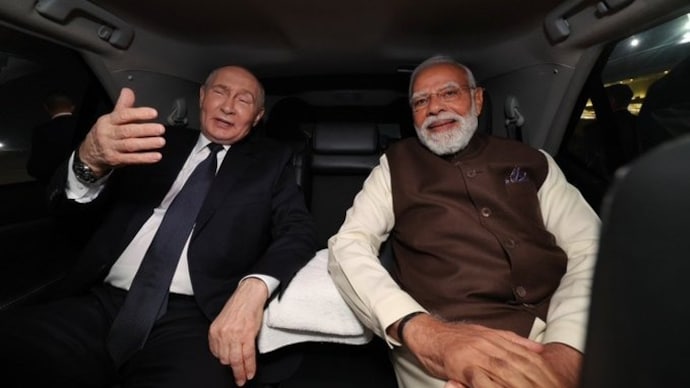
Prime Minister Narendra Modi used his meeting with Russian President Vladimir Putin in Bishkek on Monday to renew India‘s call for an end to the Russia-Ukraine conflict, saying the world must move away from prolonged warfare and towards a peaceful resolution. The message came during a bilateral meeting on the sidelines of the Shanghai Cooperation Organisation (SCO) summit, where the two leaders also discussed the broader India-Russia relationship.
Modi said India continued to support efforts aimed at peace and Diplomacy, framing the conflict not simply as a bilateral dispute but as an issue with consequences for humanity. His remarks came as Russia and Ukraine remain locked in a prolonged war that has affected global energy markets, food supplies, shipping routes and international security.
At the same time, the Bishkek meeting showed that India’s relationship with Russia extends well beyond the Ukraine question. Modi and Putin reviewed cooperation in trade, investment, defence, energy, fertilisers, space, mobility and people-to-people ties. The two sides also discussed regional conflicts and the safety of Indian nationals caught up in the wider security environment.
What Modi told Putin about the Russia-Ukraine conflict
Opening the meeting, Modi said India had consistently discussed the Ukraine issue with Putin and would continue supporting efforts directed towards peace.
“Every day spent on war pushes humanity backwards,” Modi said, arguing that each move towards peace creates new hope. He called for a transition from “endless war towards the end of war” and described a peaceful resolution as a shared priority for humanity.
The message reflects the broad line India has maintained since the Russia-Ukraine War began in February 2022. New Delhi has sought to preserve its longstanding relationship with Moscow while repeatedly stressing dialogue, diplomacy and negotiation as the preferred route to resolving conflicts.
Modi also invoked India’s historical association with Mahatma Gandhi and Gautama Buddha, describing peace as a central message of the country. The formulation allowed him to reinforce India’s diplomatic position without publicly assigning responsibility for the conflict or adopting the language used by either side.
India’s position is based on dialogue and diplomacy
India’s approach to the Russia-Ukraine conflict has involved maintaining communication with both Russia and other major international partners. Modi has previously met Ukrainian President Volodymyr Zelenskyy as well as Putin, while Indian officials have repeatedly said that dialogue and diplomacy are necessary for a sustainable settlement.
That position is strategically important for New Delhi. Russia remains a major partner for India in areas including defence and energy, while India simultaneously maintains extensive economic and strategic relationships with the United States, Europe and other Western countries.
The Bishkek meeting therefore allowed Modi to communicate a clear peace message while avoiding a rupture with Moscow. It also demonstrated that India’s engagement with Russia is continuing despite the geopolitical pressures created by the war.
Modi and Putin discuss wider India-Russia ties
The Ukraine conflict was only one part of the discussion. The two leaders reviewed the progress of the broader India-Russia strategic partnership and discussed ways to expand cooperation in several sectors.
Trade and investment were particularly important areas. Putin said relations between the two countries had continued to strengthen on the basis of their “special and privileged partnership”. Modi, meanwhile, stressed that national interest would remain the guiding principle for both countries.
The two sides also discussed energy and fertiliser security, areas that have become increasingly important for India amid disruptions in global supply chains. Defence cooperation remains another longstanding component of the relationship, although India has also been working to diversify its defence procurement and expand domestic production.
The meeting followed the 27th session of the India-Russia Inter-Governmental Commission on Trade, Economic, Scientific, Technological and Cultural Cooperation, held in Moscow on August 24. Discussions under that mechanism are intended to strengthen the economic side of a relationship traditionally dominated by defence and strategic cooperation.
Trade diversification is becoming a bigger priority
One issue receiving greater attention is the imbalance in bilateral trade. During the Bishkek discussions, Putin spoke about the need to diversify the trade basket and increase opportunities for Indian exports to Russia.
This matters because the rapid expansion of some areas of India-Russia trade has not automatically produced a balanced exchange of goods and services. Increasing Indian exports could help address that imbalance while giving Indian businesses greater access to the Russian market.
Indian officials have also indicated that market access for products including meat, marine goods and dairy has improved in recent months. If that trend continues, agricultural and processed-food exports could become a larger component of bilateral economic ties.
Why the Bishkek meeting matters for India
The timing of the meeting is significant. India is navigating several simultaneous geopolitical pressures, including the Russia-Ukraine war, instability in West Asia and disruptions affecting important maritime routes.
For New Delhi, maintaining working relationships with major powers provides diplomatic flexibility. Russia remains influential in India’s defence and energy landscape, while the United States, European countries and other partners are important to India’s technology, investment and economic ambitions.
That balancing act means India has an interest in keeping channels with Moscow open even while advocating an end to the war.
The Bishkek meeting also demonstrates that the Russia relationship is being managed as a long-term strategic partnership rather than being defined exclusively by the Ukraine conflict. Defence, energy, trade, technology and connectivity remain areas where both governments have reasons to maintain cooperation.
India raises safety of nationals serving in Russian military
Another sensitive issue discussed by Indian and Russian officials concerns Indian nationals who were recruited into the Russian armed forces.
Foreign Secretary Vikram Misri said India had repeatedly raised the matter with Russia and that the Indian embassy in Moscow was monitoring the situation. According to the figures provided by Misri, Indian authorities had information on 227 Indian nationals who had been recruited into the Russian army.
Of those, 139 had been discharged, while Indian authorities had information that 51 had died. The government continues to seek the release and repatriation of nationals whose cases remain unresolved.
The issue is particularly sensitive because it involves Indian citizens becoming connected to a foreign war in which India itself is not a combatant. For New Delhi, securing their release is therefore both a consular responsibility and a diplomatic priority.
A separate humanitarian concern within the strategic relationship
The issue also illustrates the complexity of India’s relationship with Russia. While the two countries continue to describe their partnership in strategic terms, individual cases involving Indian citizens can create difficult diplomatic questions.
India’s effort to secure the discharge of those still serving in Russian forces shows that the relationship includes practical issues affecting citizens directly, not just high-level discussions about defence contracts, oil or international diplomacy.
Modi and Putin also discussed regional conflicts
The two leaders exchanged views on developments beyond Ukraine, including the conflicts in West Asia and the Black Sea region. These issues have implications for India because instability in both areas can affect shipping, energy supplies and the safety of Indian seafarers.
The Strait of Hormuz, in particular, has become an important concern for India because of its role in global energy transportation. Any prolonged disruption to shipping through the waterway can increase transportation costs and put pressure on oil and gas prices.
The Black Sea has also remained strategically important because the wider conflict has disrupted maritime activity and created risks for commercial shipping. For India, which depends heavily on international sea routes for trade, freedom of navigation is not an abstract diplomatic principle. It has direct economic consequences.
Putin’s upcoming India visit adds importance to the talks
The Bishkek meeting also comes ahead of Putin’s planned visit to India for the BRICS summit on September 12 and 13. Modi said he looked forward to welcoming the Russian president in New Delhi.
The upcoming visit provides another opportunity for the two governments to discuss the direction of bilateral ties at a time when the global strategic environment is changing rapidly.
Issues likely to remain important include trade imbalances, energy cooperation, defence supplies, payment mechanisms, technology and opportunities for Indian companies to expand exports to Russia.
The BRICS setting will add another layer to the discussions because the grouping has increasingly become a forum for major developing economies to discuss trade, financial cooperation and global governance.
The symbolism of Modi and Putin travelling together
After their bilateral meeting, Modi and Putin travelled together in the Russian president’s official limousine to the opening ceremony of the World Nomad Games in Bishkek.
The journey attracted attention because the two leaders have previously used similar informal travel arrangements. They also travelled together during the 2025 SCO summit in Tianjin and during Putin’s December 2025 visit to India.
Such moments do not by themselves determine foreign policy, but they can serve as a visible expression of the personal rapport that has developed between the two leaders. In diplomacy, symbolic gestures can complement formal negotiations by signalling that communication channels remain open.
What India’s Russia policy means for the Ukraine war
Modi’s latest remarks should not be interpreted as an announcement of a new Indian policy towards Russia or Ukraine. Instead, they reinforce a position New Delhi has consistently articulated: the conflict should ultimately be addressed through dialogue and diplomacy.
India’s ability to communicate directly with Moscow gives it a channel that some Western governments do not have. At the same time, India’s influence over the course of the war should not be overstated. A durable settlement depends primarily on decisions by Russia and Ukraine and on the broader international diplomatic environment.
India’s role is therefore more accurately understood as that of a major country maintaining relationships with multiple sides while advocating negotiations. Modi’s meeting with Putin illustrates that approach in practice.
Why the peace message matters beyond Russia and Ukraine
The consequences of the conflict extend far beyond the battlefield. Prolonged warfare has affected energy markets, shipping, food security and international diplomatic alignments.
For India, these effects can feed into domestic economic concerns. Higher energy costs can increase import bills, while disruption to shipping can affect businesses dependent on international trade. Fertiliser supplies and agricultural costs can also be influenced by geopolitical disruptions.
That helps explain why Modi’s peace message is framed in terms of global welfare rather than solely as a European security issue. A reduction in hostilities could potentially ease some of the economic and logistical pressures created by years of geopolitical instability.
What happens next in India-Russia relations
The next major test for the relationship will come as the two governments attempt to translate political goodwill into measurable progress on trade, investment and economic diversification.
The upcoming BRICS summit will provide another setting for Modi and Putin to meet. At the same time, the unresolved Russia-Ukraine conflict means India will continue facing pressure to explain how it balances its close relationship with Moscow with its support for a peaceful settlement.
The Bishkek talks suggest that New Delhi intends to maintain that balance rather than abandon it. India is calling for an end to the war while continuing to engage Russia on energy, defence, trade and other national interests.
For now, the clearest message from Modi’s meeting with Putin is that India wants diplomacy to remain central to the international response to the Russia-Ukraine conflict. At the same time, the depth of the India-Russia relationship means that peace diplomacy and strategic cooperation will continue to move alongside each other.
For breaking news and live news updates, like us on Facebook or follow us on Twitter and Instagram. Read more on Latest World on thefoxdaily.com.




COMMENTS 0