
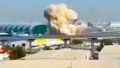
The Ukraine drone strike on St Petersburg marked another significant chapter in Kyiv’s evolving strategy of taking the war deep inside Russian territory. According to Russian officials, Ukrainian drones targeted an oil terminal in St Petersburg’s Kirovsky district while Ukrainian President Volodymyr Zelenskyy said military infrastructure on the strategic island of Kronstadt was also successfully hit. The attacks occurred as the Russia-Ukraine war entered its fifth year, highlighting how both nations are increasingly relying on long-range drone warfare rather than conventional battlefield advances alone.
WHO was involved? Ukrainian armed forces launched the strikes while Russian air defenses responded across the St Petersburg region. What happened? Energy infrastructure and military facilities were reportedly targeted. When? The attacks took place on Saturday amid an escalating exchange of cross-border drone strikes. Where? The operation focused on St Petersburg, Kronstadt, Crimea, Belgorod, and eastern Ukraine. Why? Ukraine aims to weaken Russia’s military logistics and war economy, while Russia continues pursuing territorial gains in eastern Ukraine. How? Through increasingly sophisticated long-range unmanned aerial systems capable of reaching strategic targets hundreds of kilometers from the front line.
Ukraine’s Long-Range Drone Campaign Has Entered a New Phase
During the early stages of the war, Ukrainian military operations were largely concentrated near active front lines. That picture has changed dramatically. Today, long-range drones have become one of Kyiv’s most effective strategic tools for striking military facilities, logistics hubs, ammunition depots, radar installations, air bases, and energy infrastructure far inside Russian territory.
President Volodymyr Zelenskyy has repeatedly described these operations as a form of “long-range sanctions.” Instead of relying solely on international economic restrictions imposed by Western governments, Ukraine seeks to impose direct financial costs on Russia’s military machine by disrupting industries that generate revenue for the Kremlin.
The reported strike on the St Petersburg oil terminal fits squarely within this broader strategy.
Why St Petersburg Matters Beyond Symbolism
St Petersburg is Russia’s second-largest city and one of its most important economic centers. Located on the Baltic Sea, it serves as a major hub for shipping, petroleum exports, industrial production, and naval operations.
Unlike attacks near the front line, strikes reaching St Petersburg demonstrate several important developments:
- Ukraine possesses increasingly capable long-range drone technology.
- Russian air defense systems face growing pressure over large geographic areas.
- Critical economic infrastructure far from active combat zones is becoming increasingly vulnerable.
- The psychological impact extends beyond military targets, reaching Russia’s commercial and industrial sectors.
The reported attack on the Kirovsky district also follows previous drone activity targeting the area before major political and economic events, suggesting that Ukraine carefully selects targets capable of maximizing strategic attention.
Kronstadt: Why This Military Target Is Strategically Important
While the oil terminal attracted significant attention, military analysts may consider the reported strike on Kronstadt even more strategically meaningful.
Kronstadt sits on Kotlin Island in the Gulf of Finland and has historically served as one of Russia’s most important naval strongholds. It protects maritime approaches to St Petersburg and supports operations involving the Baltic Fleet.
Military facilities in Kronstadt include infrastructure supporting naval logistics, maintenance, communications, air defense, and command operations.
A successful strike against assets on the island—even if limited—signals Ukraine’s growing ability to threaten high-value military infrastructure located well beyond the active battlefield.
Russia’s Oil Infrastructure Has Become a Central Target
Energy infrastructure has emerged as one of Ukraine’s highest-priority strategic objectives.
Oil terminals, refineries, fuel depots, and storage facilities are essential for maintaining military operations. Modern armies require enormous quantities of fuel to sustain:
- Tanks
- Armored vehicles
- Aircraft
- Warships
- Supply trucks
- Logistics networks
Disrupting even a small portion of this supply chain can increase transportation costs, complicate military logistics, and require additional spending on repairs and air defense.
Beyond military considerations, Russia’s energy exports remain an important source of government revenue. Although sanctions have reshaped export markets since 2022, petroleum continues to play a major role in financing the Russian economy.
How Drone Warfare Is Changing Modern Conflict
The Russia-Ukraine War has become one of history’s largest demonstrations of drone warfare.
Both countries now employ drones for nearly every military function, including:
- Strategic reconnaissance
- Battlefield surveillance
- Precision strikes
- Electronic warfare support
- Naval attacks
- Infrastructure disruption
- Psychological operations
The rapid evolution of unmanned systems has transformed warfare in ways few military planners anticipated before 2022. Compared with cruise missiles, many drones are significantly less expensive while still capable of reaching targets hundreds or even thousands of kilometers away.
This shift allows countries to maintain pressure on adversaries without exhausting costly missile inventories.
Timeline of Recent Developments
| Period | Key Development | Strategic Significance |
|---|---|---|
| 2022 | Russia launches full-scale invasion of Ukraine. | War expands into Europe’s largest armed conflict in decades. |
| 2023 | Ukraine increases long-range drone production. | Russian infrastructure begins facing more frequent attacks. |
| 2024 | Expanded strikes target refineries, airfields, and logistics hubs. | Economic pressure becomes a central element of Ukraine’s strategy. |
| 2025–2026 | Long-range operations reach strategic cities including St Petersburg. | Russia must defend a much wider area while protecting key infrastructure. |
Conflicting Battlefield Claims Continue
Alongside the long-range strikes, both Russia and Ukraine continued presenting sharply different accounts of developments on the eastern front.
Russian President Vladimir Putin stated that Russian forces had captured Kostyantynivka after weeks of intense fighting, describing the city as strategically important for future operations toward Sloviansk and Kramatorsk.
Ukrainian military officials disputed those claims, maintaining that Russian forces had not established control over the city.
Such competing narratives have become a recurring feature of the conflict. Information warfare now accompanies conventional military operations, with each side attempting to influence domestic audiences, international partners, and global media.
The Expanding Geography of the War
The conflict has steadily expanded beyond traditional front lines.
Recent attacks have affected multiple regions, including:
- St Petersburg
- Kronstadt
- Crimea
- Belgorod
- Zaporizhzhia
- Donetsk region
This wider geographical reach demonstrates that modern conflicts increasingly involve national infrastructure rather than only battlefield positions.
Railways, ports, power stations, fuel depots, telecommunications facilities, and logistics centers have all become important strategic targets.
Economic Pressure Has Become a Second Battlefield
Military victories alone no longer determine the course of prolonged wars. Economic resilience has become equally important.
Ukraine’s strikes on oil infrastructure appear designed to increase the cost of sustaining Russia’s military campaign.
If infrastructure requires repeated repairs or enhanced protection, resources must be diverted toward reconstruction and air defense rather than offensive military operations.
At the same time, Russia continues targeting Ukrainian cities, industrial facilities, and energy infrastructure in an effort to reduce Ukraine’s economic capacity and civilian resilience.
The result is an increasingly complex conflict where economic endurance may prove as decisive as territorial control.
Humanitarian Impact Remains Severe
While military targets dominate headlines, civilians continue bearing much of the conflict’s burden.
Russian authorities reported casualties in Crimea following Ukrainian strikes, while Ukrainian officials reported injuries after attacks on residential areas in the Zaporizhzhia region.
Communities in border regions also continue experiencing disruptions to electricity, transportation, fuel supplies, and public services.
These incidents illustrate how modern warfare extends far beyond military personnel, affecting daily life for millions of civilians across both countries.
Comparison: Traditional Warfare vs. Long-Range Drone Strategy
| Traditional Military Operations | Long-Range Drone Campaigns |
|---|---|
| Require large troop deployments. | Can be launched remotely. |
| Higher operational costs. | Generally lower deployment costs. |
| Focus on territorial control. | Focus on disrupting logistics and infrastructure. |
| Often involve prolonged ground battles. | Enable rapid precision strikes against strategic targets. |
| Front lines define combat zones. | Targets can be located hundreds of kilometers away. |
Why International Observers Are Watching Closely
The conflict continues to reshape military thinking worldwide.
Defense planners across Europe, North America, and Asia are studying how relatively inexpensive drones have challenged traditional assumptions about homeland security, infrastructure protection, and air defense.
Critical energy facilities once considered relatively secure are now viewed as potential targets in future conflicts.
This has accelerated investments in layered air defense systems, electronic warfare capabilities, counter-drone technologies, and improved protection for strategic infrastructure.
A Unique Insight: Infrastructure Is Becoming the New Front Line
One of the most significant developments often overlooked in daily war reporting is the growing importance of infrastructure as a primary battlefield.
Rather than focusing exclusively on capturing territory, both Ukraine and Russia increasingly seek to weaken each other’s ability to sustain prolonged military operations.
Oil terminals, rail networks, naval facilities, electrical grids, communications systems, and industrial centers now represent strategic objectives comparable to traditional military bases.
This evolution reflects a broader shift in modern warfare, where disrupting an opponent’s economic and logistical capacity can be as influential as advancing on the ground.
What Could Happen Next?
Several trends are likely to shape the coming months if current patterns continue.
- Ukraine may continue expanding long-range drone operations against strategic infrastructure.
- Russia is likely to strengthen air defenses around major industrial and military centers.
- Energy facilities could remain among the highest-priority targets for both military planning and infrastructure protection.
- Information warfare and competing battlefield narratives will continue accompanying military operations.
- Both countries are expected to further invest in advanced drone technologies and counter-drone systems.
Although territorial fighting in eastern Ukraine remains intense, strategic competition is increasingly extending into the economic, technological, and logistical domains.
Conclusion
The reported Ukraine drone strike on St Petersburg and the claimed attack on Kronstadt illustrate how the Russia-Ukraine war continues to evolve beyond conventional front-line combat. Long-range drone operations have become central to Ukraine’s effort to pressure Russia’s military infrastructure and energy sector, while Moscow continues pursuing territorial objectives and responding with strikes across Ukraine.
As both sides expand the range and sophistication of their operations, the conflict is increasingly defined not only by control of cities and defensive lines but also by the resilience of economies, the protection of critical infrastructure, and the ability to adapt to rapidly changing military technologies. The growing importance of drones, logistics, and Energy Security suggests that the future trajectory of the war will depend as much on strategic endurance as on battlefield gains, making these developments closely watched by governments, military planners, and global markets alike.
For breaking news and live news updates, like us on Facebook or follow us on Twitter and Instagram. Read more on Latest World on thefoxdaily.com.





COMMENTS 0