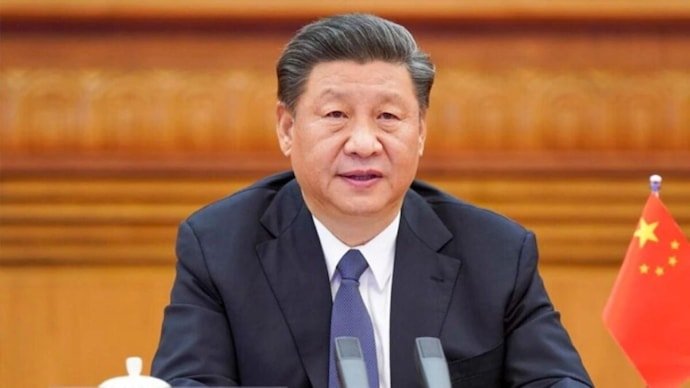
Xi Jinping used a ceremony marking Jiang Zemin’s 100th birth anniversary to stress party unity and centralised leadership as China prepares for another major political transition.
Chinese President Xi Jinping has called on members of the ruling Communist Party of China (CPC) to uphold the party’s overall leadership as he led commemorations marking the centenary of former president Jiang Zemin’s birth.
Speaking at the Great Hall of the People in Beijing on Monday, Xi praised Jiang’s political conviction, communist ideals and ability to handle crises. The ceremony was attended by thousands of party officials, including all seven members of the Politburo Standing Committee and several retired senior leaders.
The event also carried broader political significance, with Xi using his tribute to emphasise the importance of centralised leadership and party unity.
Xi stresses central leadership and party unity
According to state-run Xinhua news agency, Xi said it was “imperative” for the party to uphold its overall leadership and the centralised, unified leadership of the CPC Central Committee.
He called on party members to strengthen party self-Governance and ensure that the Communist Party remains the central leadership force behind China’s socialist system.
Xi urged officials to learn from Jiang’s handling of major challenges, particularly his firmness at important historical moments and his commitment to the party’s political objectives.
The emphasis on unity comes as Xi continues to consolidate his position within the Chinese political system.
Jiang Zemin’s role in modern Chinese history
Jiang served as CPC general secretary from 1989 to 2002 and as China’s president from 1993 to 2003. He died in 2022 at the age of 96.
He became China’s top party leader following the 1989 Tiananmen Square crackdown, when Chinese security forces moved against student-led demonstrations calling for greater democracy and political freedoms.
Jiang subsequently led China through several major international and economic challenges, including Western sanctions following the Tiananmen crackdown, the collapse of the Soviet Union in 1991 and the Asian financial crisis of 1997-98.
His period in power was also marked by continued economic reforms and greater engagement with the global economy.
Xi highlighted Jiang’s ability to respond to difficult circumstances while maintaining China’s reform programme and socialist modernisation.
Jiang oversaw a gradual leadership transition
Jiang stepped down as CPC general secretary in 2002, handing the presidency to Hu Jintao in 2003.
However, Jiang did not immediately relinquish every position of power. He remained chairman of the Central Military Commission, the top command structure of the People’s Liberation Army, until 2004.
His continued presence in that role meant the transition to the next generation of Chinese leadership took place gradually.
Former premier Wen Jiabao and former vice-presidents Wang Qishan and Zeng Qinghong were among the senior figures present at Monday’s ceremony.
Former president Hu Jintao, however, was absent, according to the Hong Kong-based South China Morning Post.
Xi highlights lessons from Jiang’s leadership
In his tribute, Xi praised Jiang for maintaining his communist ideals and making decisive choices during periods of uncertainty.
He said Jiang had remained firm at critical historical moments and responded to risks and challenges while keeping China’s reform and modernisation efforts moving forward.
The remarks placed Jiang’s political legacy within the CPC’s broader historical narrative, presenting his leadership as part of the party’s efforts to navigate major domestic and international changes.
For Xi, the commemoration also provided an opportunity to reinforce the importance of political discipline and cohesion within the party.
Xi’s unprecedented third term
Xi became CPC general secretary in 2012 and president of China in 2013.
He is currently serving an unprecedented third five-year term and is widely expected to seek a fourth term at the party’s national congress next year.
Xi is the only CPC leader after party founder Mao Zedong to remain in power beyond two five-year terms.
He has also been designated the party’s “core” leader, a status previously associated with Mao.
Against this backdrop, Xi’s repeated emphasis on centralised leadership carries particular political significance.
The call for party members to maintain unity and follow the central leadership reinforces the governing structure that has developed during Xi’s tenure.
Why Jiang’s centenary matters politically
The centenary tribute was formally dedicated to Jiang Zemin’s legacy, but Xi’s remarks went beyond historical remembrance.
By emphasising Jiang’s political firmness and loyalty to the party, Xi linked the former leader’s legacy to the CPC’s current priorities.
The message was that political unity, disciplined party governance and strong central leadership are essential as China confronts new economic, geopolitical and domestic challenges.
Jiang’s era also represented a period when leadership transitions occurred more predictably, with power eventually moving from Jiang to Hu and later from Hu to Xi.
Xi’s tenure has departed from that earlier pattern by extending beyond the conventional two-term presidential and Party Leadership cycle.
Zhu Rongji funeral adds to China’s leadership commemorations
China is also preparing to hold the funeral of former premier Zhu Rongji on Tuesday.
Zhu died on August 12 at the age of 98. He served as premier from 1998 to 2003 and was known for his anti-corruption campaign, economic reforms and efforts to restructure China’s state-owned enterprise sector.
Like Jiang, Zhu played an important role during a period of major economic transformation in China.
The two commemorations therefore come at a moment when Beijing is reflecting on leaders WHO helped shape China’s transition from the late 20th century into the modern economic era.
Jiang’s legacy and Xi’s political message
Jiang’s political Career covered a period of profound change for China.
He inherited leadership after the upheaval of 1989 and remained in power through the collapse of the Soviet Union, the Asian financial crisis and China’s continued integration with the global economy.
His administration pursued reforms while maintaining the Communist Party’s political control.
Xi’s tribute highlighted these aspects of Jiang’s career while placing particular emphasis on his commitment to the CPC.
The message was consistent with Xi’s broader focus on strengthening party discipline and ensuring that political authority remains concentrated around the central leadership.
Party unity remains central to Xi’s leadership
Xi’s remarks at the centenary ceremony demonstrated that Jiang’s legacy is being remembered not only as part of China’s political history but also as a source of lessons for the current party leadership.
His call for members to uphold the party’s overall leadership and centralised authority reflects the importance Xi places on maintaining cohesion within the CPC.
With another party congress approaching and Xi widely expected to seek a fourth term, the emphasis on unity provides an important backdrop to China’s political direction.
The Jiang centenary ceremony therefore served two purposes: it commemorated a former Chinese leader who presided over a crucial period of reform and international change, while also allowing Xi to reinforce his own message about party discipline, unity and central leadership.
With PTI Inputs
For breaking news and live news updates, like us on Facebook or follow us on Twitter and Instagram. Read more on Latest World on thefoxdaily.com.






COMMENTS 0