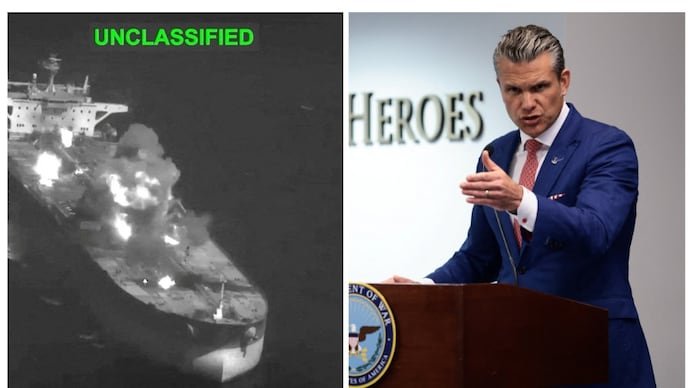
US Defence Secretary Pete Hegseth has warned Iran that American forces will destroy and sink Iranian oil tankers if Tehran attacks US Navy ships, delivering one of Washington’s strongest threats yet as the confrontation between the two countries expands across the Gulf and surrounding waters.
Hegseth’s warning came after US Central Command said American forces struck three Iranian crude oil carriers on Saturday, September 5, following what the US military described as ballistic missile attacks by the Islamic Revolutionary Guard Corps on two US Navy warships.
The US military said the American ships avoided the incoming missiles and that no US personnel were injured. It then targeted three Iranian oil vessels, disabling two and destroying a third. Washington described the tankers as part of an Iranian oil network that helps finance the Islamic Revolutionary Guard Corps and its regional partners.
Hegseth framed the situation in stark terms, saying Iran could avoid further attacks simply by not firing on American naval forces. His comments underline a new phase of the conflict in which energy infrastructure and commercial-style shipping are becoming direct instruments of military pressure.
Iran, meanwhile, has threatened stronger attacks against US military vessels if what it calls American harassment of Iranian ships and a blockade of its maritime trade continues.
Hegseth delivers direct warning to Tehran
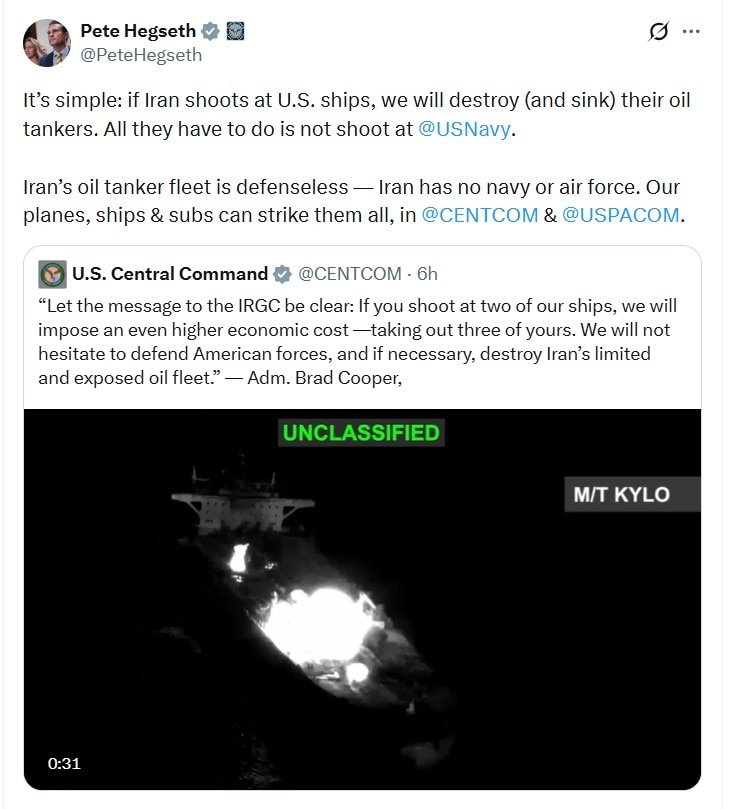
Hegseth issued his warning on social media after quoting US Central Command commander Admiral Brad Cooper.
The defence secretary’s message was blunt: if Iran attacks US ships, American forces will destroy and sink Iranian oil tankers. He presented the threat as a deterrent designed to make Tehran understand the potential consequences of attacking American military assets.
The statement also reflects a broader shift in US military messaging. Rather than limiting retaliation to missile launchers, radar systems or military bases, Washington is openly linking attacks on its naval forces with the destruction of Iranian oil shipping.
That creates a direct connection between battlefield actions and Iran’s economic lifeline. Oil remains central to the Iranian economy, meaning attacks on tankers can impose costs that extend well beyond the immediate military confrontation.
The warning also suggests that tanker strikes could become a recurring feature of the conflict if Iranian attacks on US forces continue.
US says three Iranian tankers were struck
The warning followed a major US military operation involving three Iranian crude carriers.
According to US Central Command, American forces struck M/T Downy near Kharg Island, M/T Stark 1 near Jask and M/T Kylo, also known as the “Noxen,” in the Gulf of Oman.
CENTCOM said the first two vessels were permanently disabled. The third tanker was unladen and was struck at several critical points after its crew had been instructed to abandon ship.
US officials said the operation was carried out after Iran’s Revolutionary Guard launched ballistic missiles toward two US Navy ships. The American military said its vessels successfully evaded the attacks.
The sequence of events is significant because it establishes a pattern of retaliation in which an attack on American naval forces is followed quickly by action against Iranian maritime and economic assets.
It also demonstrates that the conflict is increasingly taking place in areas where military operations overlap with commercial shipping routes.
What Iran says about the naval confrontation
Iran’s Islamic Revolutionary Guard Corps has given a very different account of the latest confrontation.
The IRGC said it had targeted an American aircraft carrier and a destroyer with ballistic missiles. Iranian officials portrayed their actions as a response to what they described as US pressure on Iranian ships and attempts to restrict Iran’s access to maritime trade.
There was no immediate independent confirmation of Iran’s claims about damage to the US vessels.
Iranian forces have also issued warnings to ships operating around the Persian Gulf and the Strait of Hormuz, arguing that certain vessels have been travelling through unauthorised routes.
The competing claims illustrate the growing difficulty of establishing a common factual picture during the conflict. Both sides are using official statements and state-linked media to frame military operations as defensive responses rather than acts of aggression.
For shipping companies, however, the practical issue is less about competing narratives and more about whether the waters remain safe enough for commercial vessels to operate.
Iran threatens harsher attacks on US ships
Iran has responded to the latest strikes by threatening to intensify attacks on American military vessels.
Iran’s military command warned that if the harassment of Iranian ships, hostile acts and the naval blockade continued, attacks against US military vessels could become “more severe than before” and expand in scope.
The warning raises the possibility of a widening cycle of retaliation.
Washington says it is responding to attacks on its personnel and ships. Tehran says it is responding to an American campaign that is targeting Iran’s military and economic infrastructure.
Each side therefore sees its next action as a reaction to what came before, increasing the risk that a single maritime incident could trigger a much larger exchange.
Kharg Island is the centre of the oil dispute
The reported strike near Kharg Island is particularly significant because the island is the centre of Iran’s crude oil export system.
Kharg’s importance means that any military activity in its vicinity is closely watched by energy traders, shipping operators and governments concerned about global oil supplies.
Iran previously sent the overwhelming majority of its crude exports through the island, according to figures cited during the conflict. Disruptions to shipping from Kharg can therefore directly affect Tehran’s ability to move oil into international markets.
US President Donald Trump has repeatedly raised the possibility of military action involving Kharg Island. In late August, he used especially aggressive language in describing the target, while Iranian officials warned that any attack there would trigger a strong response.
Although the latest US operation reportedly targeted a tanker rather than completely shutting down the island’s export facilities, the location makes the strike strategically important.
Why oil tankers are becoming military targets
Oil tankers are attractive targets in an economic war because they connect physical trade with national revenue.
A military strike against a radar station may degrade Iran’s battlefield capabilities. Disabling an oil carrier can simultaneously interfere with exports, insurance arrangements, transportation and access to foreign currency.
That makes tankers a form of economic leverage.
But attacks on oil carriers also create a wider risk. Unlike military bases, tankers operate within international waterways and may carry civilian crews. Repeated attacks can therefore endanger seafarers and create uncertainty for every ship in the region, including vessels with no connection to Iran.
The distinction between Iranian oil shipping and general commercial traffic could become increasingly difficult to maintain if maritime attacks continue.
The Strait of Hormuz is the key pressure point
The escalation cannot be understood without looking at the Strait of Hormuz.
The waterway connects the Persian Gulf to the Gulf of Oman and the wider Arabian Sea. Under normal conditions, roughly one-fifth of global oil supplies move through it, making the strait one of the most important energy chokepoints in the world.
Iran’s geography gives it an unusual degree of influence over the waterway. At the same time, the United States and other naval powers have strong strategic interests in keeping maritime traffic moving.
That creates a dangerous confrontation between military power and geographic leverage.
If Iran threatens to restrict traffic, Washington has an incentive to use naval power to keep the corridor open. If American forces attempt to enforce a maritime blockade or prevent Iranian exports, Tehran has an incentive to retaliate against vessels in the region.
The result can quickly become a self-reinforcing cycle.
US blockade and Iranian counter-pressure
The current confrontation has been accompanied by a broader US effort to restrict Iranian oil exports.
American actions have included measures aimed at limiting Iranian maritime trade, while Iran has sought to challenge what it describes as restrictions on its sovereign right to export oil.
The naval dimension adds another layer to the economic pressure. If tankers cannot safely load, transport or unload crude, then sanctions and military operations can reinforce one another.
For Tehran, that can create severe economic pressure. For Washington, however, enforcing such restrictions requires sustained naval and air operations in a region where miscalculation can have international consequences.
It also increases the possibility that third-country vessels may become involved or face disruption even if they are not directly participating in the conflict.
Iranian media reports tanker attack near Kharg
Iranian semi-official media reported that several US missiles struck a tanker near Kharg Island. The reports said there were no casualties and that the vessel’s crew was being evacuated.
Those accounts were not independently confirmed at the time, illustrating how quickly information from the conflict can diverge depending on the source.
The fact that both US and Iranian channels are reporting maritime attacks is nevertheless significant. It suggests that tanker movements around Iran’s coastline have become central to the military contest.
Even when casualties are avoided, repeated incidents can make crews increasingly reluctant to operate in the area and push shipping companies to demand higher risk premiums.
Oil prices rise as supply risks grow
The escalation has already affected international energy markets.
Brent crude futures closed at about $96.28 a barrel on Friday, their highest level since late July, amid fears that worsening military tensions could disrupt oil supplies.
Oil prices respond not only to barrels actually removed from the market but also to the probability of future disruptions.
That distinction is crucial in the Gulf. Traders may raise prices when they believe shipping lanes are becoming more dangerous, even before a major shortage occurs.
If tanker traffic through Hormuz remains depressed, the market may have to rely increasingly on alternative sources, longer routes and different storage patterns.
That can increase the cost of crude without necessarily causing an immediate physical shortage.
Higher oil prices could affect consumers worldwide
A sustained rise in crude prices would not remain confined to energy traders.
Higher oil costs can increase the price of gasoline, diesel, aviation fuel and petrochemical products. Transportation companies may face larger operating expenses, while manufacturers can see costs rise for energy-intensive processes and materials.
In countries that rely heavily on imported crude, a prolonged oil shock can also weaken trade balances and put pressure on currencies.
India and other major Asian economies would be especially sensitive to sustained Gulf disruptions because they rely heavily on imported energy and maintain extensive commercial ties with Middle Eastern producers.
The consequences of the US-Iran confrontation could therefore spread far beyond the immediate military theatre.
Why shipping companies are increasingly nervous
Commercial shipping depends on predictability. Operators need to know where a vessel can safely travel, whether insurance will remain available and whether ports will accept the cargo when the ship arrives.
The current environment undermines all three assumptions.
A tanker entering the Gulf can now face a range of risks, including missile attacks, naval inspections, mine threats, blockades and rapidly changing security advisories.
Even if a particular vessel is never attacked, its operator may still face higher insurance costs because the surrounding waters have become more dangerous.
That increases freight costs and can make some routes financially unattractive.
The threat of sea mines adds another danger
One of the most serious concerns surrounding the Strait of Hormuz is the potential use of sea mines.
US forces have previously said that Iranian military positions were associated with preparations to deploy mines and interfere with maritime traffic.
Mines are particularly dangerous because they do not need to be actively guided toward a target. Once placed, they can remain a threat until naval forces locate and remove them.
A mined shipping lane could therefore remain effectively unusable even after an immediate military confrontation subsides.
That would greatly increase the economic cost of the conflict and could require a sustained international naval effort to restore normal commercial traffic.
Hegseth’s warning could define the next phase
Hegseth’s message is important because it establishes a simple condition for future escalation from Washington’s perspective.
Do not attack US Navy ships, and the United States says there is no need to destroy Iranian tankers. Attack American vessels, and oil shipping could become a direct target.
That is essentially a deterrence formula.
The problem is that deterrence works only if both sides interpret the warning in the same way. Iran may view American naval activity as an aggressive blockade and believe it has the right to respond. The United States may interpret the same Iranian response as an attack requiring immediate retaliation.
When both sides believe they are acting defensively, escalation can happen even without either side initially seeking a wider war.
Commercial ships may face growing uncertainty
The greatest danger for global trade is that military action increasingly overlaps with commercial shipping.
If Iranian and American forces begin routinely targeting tankers, escorting ships or challenging vessels over their routes, shipping companies will have to make difficult decisions about whether to continue using the Gulf at all.
Some may redirect vessels. Others may wait offshore for clearer security conditions. Still others may seek guarantees from governments or naval forces before attempting a transit.
Each option increases costs and delays.
For oil markets, those disruptions can become nearly as significant as the physical loss of ships because the global energy system depends on the regular movement of huge volumes of crude.
A wider regional confrontation remains possible
The latest exchange also raises the risk that the conflict could pull more regional actors into direct confrontation.
US military assets are deployed across the Middle East, while Iran has ties with armed groups and security networks operating in several countries.
If Iranian forces expand attacks against American positions or commercial shipping, Washington could respond with wider strikes on Iranian military infrastructure.
Likewise, if the US continues attacking Iranian oil vessels or tightening the maritime blockade, Tehran may intensify attacks on naval and commercial targets.
The danger is that each round creates pressure for the next one.
What happens next around Hormuz?
The Strait of Hormuz is likely to remain the immediate focus of international attention.
Shipping companies will watch for changes in naval warnings, tanker movements and insurance conditions. Energy markets will track whether crude exports can continue at significant volumes and whether additional cargoes are disrupted.
Military planners on both sides will be assessing whether the latest attacks have changed the other’s behaviour.
If Iranian attacks on US warships stop, Washington may have an incentive to avoid further strikes on tankers. If attacks continue, Hegseth’s warning suggests the United States could escalate its economic targeting further.
Iran faces a similarly difficult calculation. A stronger retaliation may demonstrate resolve but could also invite more attacks on its oil fleet and infrastructure.
The conflict is becoming an economic and maritime war
The latest US-Iran confrontation shows how quickly a military conflict can spread from conventional battlefield targets into the Global Economy.
The United States says its latest tanker strikes were a response to attacks on its Navy ships. Iran says it is responding to American pressure, harassment and a maritime blockade.
Both sides now have military and economic reasons to continue applying pressure.
For Iran, oil exports remain one of the most important sources of revenue. For the United States, control of maritime routes and protection of American forces are central strategic objectives.
That makes oil tankers and the Strait of Hormuz natural pressure points.
Pete Hegseth’s warning puts oil tankers directly in the crosshairs
Pete Hegseth’s warning that the US will destroy and sink Iranian oil tankers if American Navy ships are attacked represents a significant escalation in the language surrounding the conflict.
The threat follows an actual US operation against three Iranian crude carriers, giving the warning immediate credibility in Tehran’s calculations. At the same time, Iran’s threat to launch harsher attacks against US military vessels indicates that the cycle of retaliation is far from over.
The strategic importance of the situation goes well beyond the fate of individual ships. Every tanker attack raises insurance costs, shipping risks and concerns about global energy supplies. Every threat to the Strait of Hormuz creates the possibility of disruption reaching markets on several continents.
The coming days will therefore be watched closely for any new attacks on US warships, Iranian tankers or commercial vessels. A further escalation around Hormuz could turn an already dangerous regional conflict into a much larger international energy crisis.
For now, the message from Washington is unmistakable: attacking US naval forces could bring direct consequences for Iran’s oil fleet. How Tehran responds to that threat may determine whether the current maritime confrontation remains contained or develops into an even broader conflict involving the world’s most important energy shipping corridor.
For breaking news and live news updates, like us on Facebook or follow us on Twitter and Instagram. Read more on Latest World on thefoxdaily.com.




COMMENTS 0