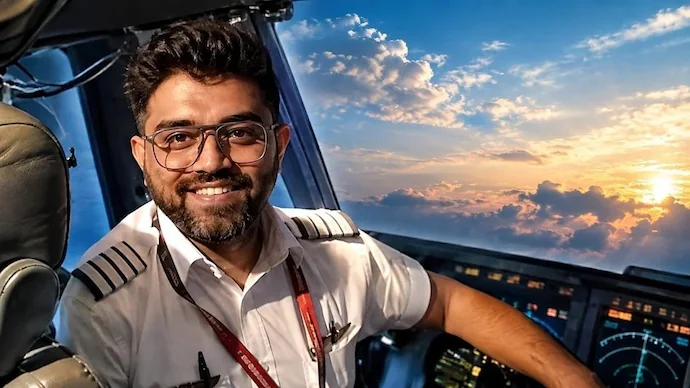
Captain Smit Machchhar, a Flydubai pilot who survived a violent attack inside an aircraft cockpit, has recalled the terrifying moments when he struggled to remain conscious and fight for his life. Despite suffering serious injuries to his head, neck and hands, Machchhar managed to respond during the emergency, helping prevent an already dangerous situation from becoming even worse.
In an interview with Sky News Arabia, Machchhar described how an apparently routine flight turned into a fight for survival after his co-pilot, Hamam al-Hammami, allegedly attacked him with a crash axe. His account highlights the severity of the assault, the confusion inside the cockpit and the role played by crew members, passengers and off-duty pilots in bringing the situation under control.
Recalling the moment he realised that his life was in danger, Machchhar said he could not accept the possibility of dying without trying to save himself.
“I realised I have to do something. You can’t die like this. I can’t accept my death,” he said.
The pilot described his reaction as a survival instinct that emerged under extreme pressure. He also called the outcome a “miracle”, reflecting on how the intervention of people on board helped ensure that all 180 occupants evacuated safely.
How the flydubai cockpit attack unfolded
According to Machchhar’s account in the Sky News Arabia interview, the flight had been proceeding normally before his co-pilot said he wanted to pray. Machchhar said he turned his attention away out of respect for his colleague.
He was then struck on the head.
Describing the suddenness and force of the attack, Machchhar recalled that he had been carrying out his duties when he felt a powerful blow. The assault left him disoriented and struggling to maintain consciousness.
“I was doing my job, there was a hard hit on my head,” he recalled.
The attack was particularly dangerous because it occurred inside the cockpit, where pilots are responsible for operating the aircraft and responding to changing flight conditions. With the captain seriously injured and the situation deteriorating, the immediate priority became containing the threat and preventing further danger to the people on board.
Machchhar said he drifted in and out of consciousness after being struck. His ability to understand what was happening was affected, making it difficult to process the events unfolding around him.
The situation became even more frightening when the cockpit door opened and he heard passengers screaming. The noise and confusion added to the uncertainty as he tried to understand the attack and determine what he could still do.
‘I was in and out of consciousness’: Pilot recalls terrifying moments
Machchhar’s recollection describes a struggle that went beyond the physical injuries he suffered. He had to remain alert enough to respond while dealing with the effects of repeated blows to his head.
He said there were moments when he feared he would not survive. Losing consciousness, even temporarily, made the situation more difficult because he could not fully assess the danger or understand how events were developing.
The pilot also recalled the panic that followed when the cockpit door opened and the sounds of frightened passengers reached him. For someone already injured and disoriented, the scene reinforced the urgency of the situation.
Despite his condition, Machchhar continued trying to respond. His account suggests that he recognised the danger was not limited to his own life: the unfolding emergency also threatened the passengers and crew travelling on the aircraft.
He later reflected on the assistance he received from another colleague who intervened during the crisis. Machchhar said the person’s actions were something he would remember for the rest of his life.
The intervention underscores how the response to an onboard emergency can depend on the coordinated actions of multiple people, particularly when the person initially targeted is unable to manage the situation alone.
How Machchhar fought to regain control during the attack
Machchhar had previously described the incident during a conversation with Israeli Prime Minister Benjamin Netanyahu while recovering in hospital. In that account, he said he had been struck repeatedly on the back of his head.
Initially, he believed something catastrophic might have happened to the aircraft. The force of the blows and the resulting confusion made it difficult for him to understand the cause of the emergency.
He eventually realised that he was being attacked. His vision had become blurred, and he struggled to make sense of what was happening as the aircraft appeared to descend rapidly.
The combination of serious injuries, impaired vision and uncertainty about the aircraft’s condition created an extremely difficult situation. Machchhar was not only trying to survive the assault but also attempting to respond while the aircraft appeared to be in danger.
Despite his injuries, he managed to open the cockpit door. He believed the door was subsequently closed again, leaving him on the cockpit floor as the sounds of frightened passengers continued around him.
At that point, Machchhar said he understood that he had to find the strength to act once more.
“I had that one last fight left in me,” he told Netanyahu.
The statement captures the moment he described as a final effort to respond despite being badly injured. Rather than giving in to the fear that he might die, he tried to use whatever strength remained to help bring the emergency under control.
His accounts to Sky News Arabia and Netanyahu offer different details of the same ordeal, but both emphasise the severity of the attack and his determination to survive. They also draw attention to the role of those who intervened while the pilot was struggling to remain conscious.
Co-pilot Hamam al-Hammami accused of attacking captain with crash axe
The incident involved co-pilot Hamam al-Hammami, who allegedly attacked Machchhar with a crash axe. UAE authorities have been investigating the incident as an attempted hijacking.
The circumstances described by Machchhar point to a serious security emergency inside the cockpit. A violent assault on a pilot can create immediate risks for everyone aboard, particularly when the aircraft is still in flight and the crew must respond to an unfolding threat.
In this case, Machchhar suffered serious injuries to his head, neck and hands. The attack left him struggling to remain conscious, according to his recollections.
The allegations and the authorities’ investigation remain important distinctions when describing the incident. While Machchhar has publicly recounted his experience, the precise circumstances and any legal findings must be established through the relevant investigative and judicial processes.
Cabin crew, passengers and off-duty pilots helped restrain the attacker
Machchhar was not alone in responding to the emergency. Cabin crew, passengers and off-duty pilots intervened and helped restrain the attacker, according to the account of the incident.
Their intervention was crucial in helping contain the immediate threat. With the captain seriously injured, the assistance of other people on board became an important part of the response.
Machchhar’s recollection of a colleague stepping in reflects the lasting impact of that assistance. He said he would carry the memory of the intervention with him for the rest of his life.
Although the available account does not detail every action taken by individual crew members and passengers, it establishes that several people intervened during the crisis. Their efforts helped bring the attack under control and contributed to the safe evacuation of everyone aboard.
The incident also illustrates the importance of emergency preparedness in aviation. Cabin crew members are trained to respond to safety incidents, while pilots and other qualified personnel may be called upon to assist when circumstances demand it. However, an assault inside a cockpit presents unusual challenges because it can involve both a direct threat to the flight crew and a potential risk to the aircraft.
Aircraft diverted to Tabuk as all 180 people evacuate safely
Following the incident, the aircraft was diverted and made an emergency landing in Tabuk, Saudi Arabia. All 180 people on board were evacuated safely, and no deaths were reported.
The safe evacuation marked a critical outcome after an emergency involving a seriously injured captain and an alleged attack inside the cockpit. While Machchhar endured severe injuries, the incident did not result in fatalities among the people aboard the aircraft.
The sequence of events involved several urgent challenges: responding to the alleged attacker, managing the aircraft during the emergency, and ensuring that passengers and crew could leave safely after landing.
The available information does not provide a detailed timeline of every action taken during the flight. However, the reported outcome highlights the combined importance of the crew’s response, intervention by people on board and the emergency landing in bringing the incident to an end without loss of life.
Why the incident raises serious aviation safety concerns
An alleged violent attack inside an aircraft cockpit raises questions about crew safety, cockpit security and the procedures used to manage threats during a flight. The cockpit is a critical area because pilots must be able to operate the aircraft and respond to emergencies without interference.
When a pilot is attacked, the danger can extend beyond the injured individual. Serious injuries may affect the crew’s ability to manage flight operations, while confusion or disruption can complicate an already difficult emergency response.
The reported use of a crash axe makes the allegations particularly serious. Machchhar’s account describes repeated blows to his head, blurred vision and periods of unconsciousness, illustrating how quickly a violent incident can leave a pilot physically incapacitated.
At the same time, the safe evacuation of all 180 people shows that the incident ended without reported fatalities. The actions of cabin crew, passengers and off-duty pilots formed an important part of the response, although the complete sequence of events and the findings of the official investigation remain essential to understanding exactly how the emergency was managed.
The investigation by UAE authorities into the incident as an attempted hijacking is therefore significant not only for establishing individual responsibility but also for clarifying the circumstances surrounding the Cockpit Attack.
‘I can’t accept my death’: A pilot’s account of survival
Machchhar’s account stands out for the way he describes his reaction at the moment he believed he might die. His words, “I can’t accept my death,” reflect the determination he said he felt while struggling to remain conscious after the assault.
His recollections also show that survival during the incident was not a solitary effort. While he tried to respond despite his injuries, another colleague and others on board intervened to help manage the threat.
Calling the outcome a “miracle”, Machchhar reflected on an experience in which a violent cockpit attack could have had devastating consequences. The aircraft ultimately landed in Tabuk, and all 180 people were evacuated safely.
The case remains a serious aviation security incident, with UAE authorities investigating the alleged attack. For Machchhar, however, the experience was also a personal struggle to remain alive when he feared he might not survive. His account highlights both the physical and psychological intensity of that ordeal and the importance of the people who stepped in to help.
For breaking news and live news updates, like us on Facebook or follow us on Twitter and Instagram. Read more on Latest World on thefoxdaily.com.





COMMENTS 0