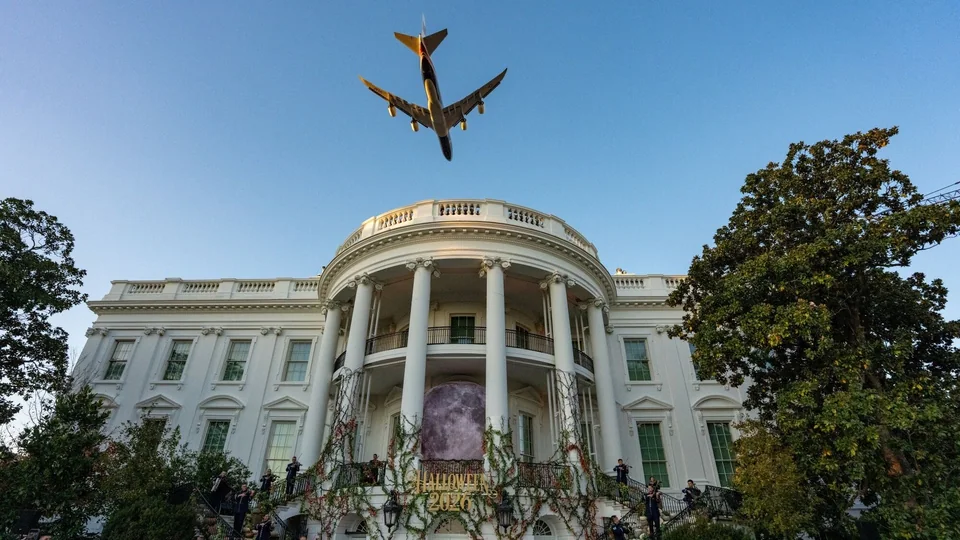
A low-altitude flyover by the US presidential aircraft during a White House Halloween celebration on Thursday evening temporarily disrupted air traffic at Ronald Reagan Washington National Airport, causing delays to more than 200 flights. The unexpected manoeuvre, organised as part of a children’s Halloween event hosted by President Donald Trump, also triggered concerns among local officials and airline representatives over the short notice provided before the aircraft passed over the capital.
The aircraft, known as Air Force One when the president is on board, made two passes around the White House at a lower-than-normal altitude. The Federal Aviation Administration (FAA) temporarily halted air traffic at the nearby airport as the flyover took place, affecting departing and arriving flights.
The disruption prompted criticism from members of the District of Columbia City Council, who said residents, government offices and airport users had received only around 15 minutes’ notice. Airline officials also said they had been informed less than an hour before the operation.
According to flight-tracking website FlightAware, 202 flights were delayed at Reagan National Airport on Thursday. Around 26% of departing flights and 17% of arriving flights experienced delays, with most of the disruption linked to the temporary airport restrictions.
Why Did the Air Force One Flyover Take Place?
The flyover was organised as part of a Halloween celebration at the White House, where President Donald Trump hosted a party for children on Thursday evening. The event included a special appearance by the presidential aircraft, which passed over the White House while guests were attending the festivities.
The White House shared a video of the manoeuvre on one of its social media accounts, describing it as an “epic Air Force One flyover at the White House for the trick-or-treaters!” The footage showed the aircraft making passes over the presidential complex as part of the celebration.
The plane is officially designated Air Force One whenever the US president is aboard. The term does not refer to one specific aircraft model but serves as the radio call sign for any US Air Force aircraft carrying the president.
The flyover involved two passes around the White House at a lower altitude than would normally be expected for commercial aviation. Because of the aircraft’s proximity to Reagan National Airport and the surrounding airspace, the FAA temporarily suspended airport traffic to maintain separation and manage aviation safety.
FAA Temporarily Halts Flights at Reagan National Airport
The Federal Aviation Administration temporarily halted aircraft movements at Ronald Reagan Washington National Airport during the presidential flyover. The airport is located close to central Washington, DC, and operates within some of the most tightly managed airspace in the United States.
Its location near the White House, the Pentagon and other federal government buildings means that aviation activity is subject to strict security and operational requirements. Any unusual aircraft movement near the capital can require coordination between aviation authorities, security agencies and airport operators.
The temporary halt was intended to manage the airspace while the presidential aircraft completed its manoeuvres. However, the restrictions affected the airport’s normal schedule, leaving some aircraft unable to depart or land at their planned times.
Passengers travelling to and from Washington reported delays, while some aircraft approaching the airport were required to circle before receiving permission to land. Other flights experienced disruption to their departure schedules as airport operations adjusted following the temporary suspension.
Although the restrictions were temporary, even a short interruption at a busy airport can create delays that continue after normal operations resume. Aircraft and crews operate on interconnected schedules, meaning that a disruption affecting one flight can influence subsequent services.
More Than 200 Flights Delayed During the Disruption
FlightAware reported that 202 flights at Reagan National Airport were delayed on Thursday. The figures represented approximately 26% of departing flights and 17% of arriving flights.
Most of the delays were attributed to the temporary disruption associated with the presidential flyover. Departing aircraft had to wait for airport operations to resume, while arriving flights faced restrictions on their approach and landing schedules.
Some passengers reported that their aircraft were forced to circle over the Washington area before landing. Others experienced longer waiting times as airlines adjusted their schedules following the FAA’s temporary restrictions.
The disruption illustrates how a relatively short airspace restriction can affect a large number of passengers. Airlines must coordinate aircraft availability, crew schedules, connecting flights and airport slots, making it difficult to immediately restore normal operations after an unexpected interruption.
For travellers with connecting flights, even a delay of several minutes can create additional complications. Missed connections may require passengers to be rebooked, while aircraft arriving late can affect their next scheduled departures.
Washington DC Officials Criticise the Short Notice
The flyover also drew criticism from local officials, particularly over the limited advance warning given to people in the Washington area.
The District of Columbia City Council said in a social media post that only 15 minutes’ notice had been provided to people in downtown Washington, the Pentagon and Reagan National Airport before the manoeuvre took place.
The council said the sudden announcement startled many people, including local officials. Its criticism focused on the lack of sufficient communication before an unusual aircraft movement over a densely populated area and near important government facilities.
The short notice raised questions about how local authorities, airport operators and residents were informed about the operation. Advance communication is particularly important in Washington because the city’s airspace includes sensitive government locations and is subject to strict restrictions.
Airline officials also said they had received less than an hour’s notice before the flyover. The limited warning left carriers with little time to prepare passengers, adjust flight schedules or communicate possible delays.
The criticism was not necessarily directed at the decision to organise a ceremonial flyover itself, but rather at the timing and coordination of the announcement. The incident highlighted the importance of clear communication between federal agencies, aviation authorities, airlines and local government.
Why Air Traffic Around Washington Is Closely Controlled
Washington, DC, has one of the most security-sensitive aviation environments in the United States. The region contains major government institutions, military facilities and the residence and workplace of the US president.
Reagan National Airport is located close to several important sites, including the White House, the US Capitol and the Pentagon. Aircraft operating in the region must comply with specific airspace restrictions and instructions issued by aviation and security authorities.
The Washington metropolitan area includes special flight restrictions designed to protect national security. These rules regulate which aircraft can enter particular areas, what flight paths they can use and when additional authorisation is required.
Temporary restrictions can also be introduced for presidential movements, security operations and other special events. Such measures are intended to prevent unauthorised aircraft activity and ensure that aircraft movements do not create unacceptable risks.
When a presidential aircraft conducts a low-altitude manoeuvre near the White House, aviation authorities must account for its route and coordinate the surrounding airspace. Temporarily pausing commercial traffic can help provide the necessary separation between aircraft and prevent conflicts during the operation.
However, the incident shows that special aviation arrangements can have consequences for ordinary passengers, particularly when an airport is located close to the area where the manoeuvre takes place.
Air Force One and Its Role in Presidential Events
Air Force One is one of the most recognisable symbols of the US presidency. The aircraft serves as the president’s airborne command centre and is equipped with communications, security and operational systems designed to support presidential travel.
The designation Air Force One applies whenever the president is aboard an aircraft operated by the US Air Force. Although the term is commonly associated with the large blue-and-white presidential jets, it is technically a call sign rather than the name of a particular aircraft.
Presidential aircraft movements are carefully coordinated because they involve security arrangements, restricted airspace and specialised ground operations. When the aircraft travels with the president, aviation authorities and security agencies must ensure that its route is protected.
Beyond official travel, the aircraft has also appeared in ceremonial and public settings. Flyovers at sporting events and other major occasions can provide a dramatic display, particularly when the president is attending the event.
Trump has frequently shown interest in Air Force One flyovers, including at major sporting events he attends. The Halloween appearance at the White House followed a similar approach, using the presidential aircraft as part of a public celebration.
Why Presidential Flyovers Can Disrupt Commercial Flights
Military and presidential aircraft demonstrations can require temporary changes to normal air traffic operations, especially when they take place near major airports. Commercial aviation depends on carefully coordinated flight paths, departure times and landing sequences.
When an aircraft is scheduled to make an unusual manoeuvre near a busy airport, air traffic controllers may need to temporarily restrict other aircraft movements. These restrictions can include holding departing planes on the ground, delaying arrivals or directing approaching aircraft to remain in holding patterns.
Such measures are designed to maintain safe separation between aircraft. They can also help ensure that emergency or security-related operations have access to the required airspace.
However, the effects can extend beyond the duration of the original manoeuvre. Flights that are delayed at departure may arrive late at their destinations, while aircraft waiting to land can affect subsequent departures and connecting services.
At a busy airport such as Reagan National, where aircraft operate on tightly coordinated schedules, even a temporary pause can produce a noticeable number of delays.
What the Incident Raises About Aviation Communication
The Halloween flyover has brought attention to the balance between presidential events, aviation security and public communication. While special aircraft movements may require restrictions for safety reasons, local authorities and airlines need sufficient information to prepare for their operational consequences.
The District of Columbia City Council’s complaint about receiving only 15 minutes’ notice highlights the difficulties faced by local officials when unusual aviation activity takes place without adequate advance communication.
Airlines also need time to inform passengers and adjust their schedules. When an airport restriction is announced shortly before it takes effect, passengers may receive limited warning about delays, while airline staff have less time to make alternative arrangements.
The incident also demonstrates why coordination between the FAA, federal security agencies, airport authorities and local government is important. A presidential flyover may last only a short time, but its effects can extend across airport operations and passenger travel schedules.
What Happened After the Air Force One Flyover?
The FAA’s temporary restrictions affected traffic at Reagan National Airport while the presidential aircraft completed its two passes around the White House. Once the manoeuvre was completed and the relevant airspace restrictions were lifted, normal airport operations could resume.
Nevertheless, the disruption had already affected hundreds of scheduled movements, with FlightAware recording 202 delayed flights. Passengers reported waiting on the ground or circling before landing, while airlines dealt with the effects on their schedules.
The White House presented the flyover as a special Halloween moment for children attending the event. Local officials and airline representatives, however, focused on the limited notice and the disruption caused to airport users.
The episode has highlighted the operational challenges of organising presidential aircraft displays in one of the country’s busiest and most security-sensitive aviation regions. While Air Force One flyovers can form part of major public events, the Washington disruption has renewed attention on the need for advance coordination and clear communication when such manoeuvres affect commercial air traffic.
For breaking news and live news updates, like us on Facebook or follow us on Twitter and Instagram. Read more on Latest World on thefoxdaily.com.




COMMENTS 0