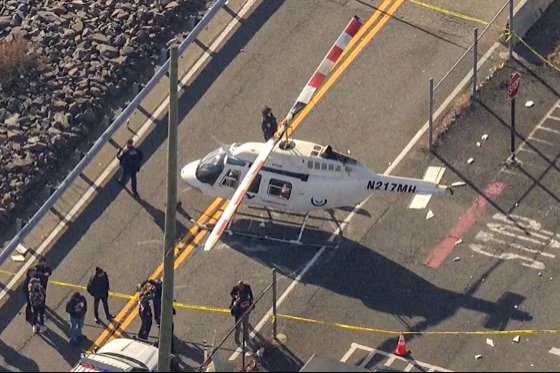
A helicopter made an emergency landing at a cruise ship terminal in Bayonne, New Jersey, on Tuesday after its pilot declared a mayday and reported an engine problem to air traffic control. The aircraft came down on a pier, with video from the scene showing significant visible damage, including what appeared to be a severed tail section.
The pilot and co-pilot were the only two people aboard the helicopter, and both were reported to be safe following the incident. Radio communications between the flight crew and air traffic controllers captured the emergency as the pilot requested help finding a suitable place to land immediately.
The Federal Aviation Administration (FAA) confirmed the incident. However, the precise cause of the emergency and the circumstances surrounding the helicopter’s visible damage have not been established.
Helicopter Pilot Declares Mayday After Reporting Engine Failure
The emergency unfolded when the helicopter’s pilot contacted air traffic control and issued a mayday call, the internationally recognised distress signal used by pilots facing serious emergencies.
During the radio exchange, the pilot reported that the aircraft had lost an engine and asked controllers for assistance in identifying an immediate landing location.
The communication captured the urgency of the situation as the pilot and controllers discussed the helicopter’s stability and possible places where it could be brought down safely.
Bayonne was selected as the location for the emergency landing. The helicopter subsequently came down at a cruise ship terminal in the New Jersey city.
Engine problems can create serious challenges for helicopter pilots, depending on the aircraft’s design, operating conditions and the nature of the mechanical failure. In an emergency, pilots must assess the aircraft’s condition while identifying a suitable landing area and communicating with air traffic control.
In this case, the pilot’s request for an immediate landing location allowed controllers to assist in selecting a place for the aircraft to come down.
Both Pilot and Co-Pilot Reported Safe
Despite the emergency landing and the visible damage to the helicopter, both people aboard were reported to be safe.
The pilot and co-pilot were the only occupants of the aircraft. Radio communications indicated that neither had been injured during the incident.
Their safety was the most significant immediate outcome of the emergency. The available information did not identify any passengers or other people aboard the helicopter.
Details about whether either crew member required medical attention were not provided in the initial account. Authorities also had not released further information about their condition beyond the indication that both were OK.
Video Shows Helicopter With Apparent Tail Damage on Bayonne Pier
Footage from the scene showed the helicopter on the pier at the cruise ship terminal. The aircraft appeared to have suffered substantial damage, with its tail section visibly sheared off.
However, it remained unclear whether the tail separated before the helicopter struck the landing surface or whether the damage occurred during impact.
That distinction could be important in determining how the emergency developed. A mechanical problem affecting the aircraft before landing would need to be assessed separately from damage caused by the landing itself.
The footage also drew attention to the helicopter’s possible association with a tourism company. However, its operator had not been definitively identified in the information available about the incident.
Without an official assessment of the wreckage and the aircraft’s condition, the visible damage alone cannot establish what caused the emergency or how the helicopter lost its tail section.
FAA Confirms New Jersey Helicopter Incident
The Federal Aviation Administration confirmed that a helicopter was involved in the emergency landing at the Bayonne cruise ship terminal.
The FAA is the US federal agency responsible for regulating civil aviation, including aircraft operations and aviation safety. Its confirmation establishes that the incident occurred, but the available information does not provide a final explanation of the mechanical problem or the damage.
Further examination of the helicopter may be needed to establish the sequence of events. Investigators would generally consider the pilot’s account, aircraft condition, available flight information and any relevant maintenance records when assessing an aviation incident.
No detailed findings about the cause of the engine problem or the apparent tail separation had been released in the initial report.
Why Emergency Landings Are Critical During Helicopter Engine Problems
Helicopters operate differently from conventional fixed-wing aircraft, and an engine-related emergency can require pilots to make rapid decisions about how and where to land.
The response depends on several factors, including the type of helicopter, the number of engines, the aircraft’s speed and altitude, and the nature of the failure. Some helicopters are designed with systems and procedures that allow pilots to manage certain engine emergencies, but the available options vary by aircraft.
When a pilot reports a serious mechanical problem, air traffic controllers can help by providing information about nearby landing locations and coordinating with other aircraft. The pilot remains responsible for controlling the helicopter and carrying out the landing.
The radio exchange in the Bayonne incident shows how communication between the flight crew and controllers can become important during an emergency. The pilot reported the engine issue, requested immediate assistance and worked with controllers to identify a landing location.
In this case, the aircraft reached a pier at the cruise ship terminal, and both crew members were reported safe.
What Is Known About the Bayonne Helicopter Emergency?
The confirmed details indicate that the helicopter experienced an emergency after the pilot reported losing an engine. The pilot declared a mayday, requested help finding an immediate landing location and brought the aircraft down at a cruise ship terminal in Bayonne.
Both occupants, the pilot and co-pilot, were reported to be safe. Video from the scene showed the helicopter on the pier with apparent damage to its tail section, although the timing and cause of that damage remained unclear.
The FAA confirmed the incident, but further details about the helicopter’s operator, the exact mechanical failure and the sequence of damage were not available in the initial report.
The incident highlights the importance of emergency communication and rapid decision-making when an aircraft develops a serious mechanical problem. While the helicopter sustained visible damage, the reported safety of both crew members meant the emergency landing did not result in a reported loss of life or injury among those aboard.
For breaking news and live news updates, like us on Facebook or follow us on Twitter and Instagram. Read more on Latest World on thefoxdaily.com.






COMMENTS 0