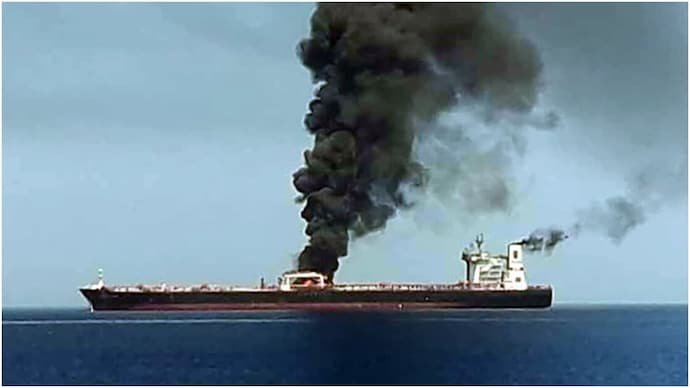
The Strait of Hormuz, one of the world’s most strategically important maritime chokepoints, has once again become the focus of international attention after reports that Iranian missiles struck commercial vessels transiting the waterway. The attacks, which reportedly damaged multiple ships and left at least one tanker on fire near the coast of Oman, have intensified fears that the fragile understanding between Iran and the United States may be rapidly unraveling.
The reported strikes come only weeks after Washington and Tehran had signaled a willingness to reduce hostilities through an interim understanding intended to prevent attacks on commercial shipping. However, with missiles once again flying over one of the world’s busiest energy corridors, questions are growing about the future of Gulf security, international trade, and global oil markets.
Adding further political drama, US President Donald Trump remarked that America had given Iran “a week off for a funeral,” referring to the temporary pause following the funeral ceremonies of former Iranian Supreme Leader Ali Khamenei. His comments, combined with renewed military activity, have once again pushed the region toward a period of uncertainty.
What Happened in the Strait of Hormuz?
According to multiple reports, at least two commercial vessels sustained damage after missiles were reportedly launched toward ships navigating the Strait of Hormuz. While there were no immediate reports of casualties, one tanker reportedly caught fire after being struck by a projectile while sailing south toward the Gulf of Oman.
Maritime authorities issued urgent navigational warnings advising commercial vessels to exercise maximum caution while transiting the region.
The incident has renewed concerns because attacks on civilian shipping threaten not only regional stability but also the uninterrupted movement of Global energy supplies.
Why the Strait of Hormuz Is So Important
The Strait of Hormuz is one of the world’s most strategically valuable waterways. Located between Iran and Oman, it connects the Persian Gulf with the Gulf of Oman and the Arabian Sea.
Although relatively narrow, it serves as the primary export route for oil and liquefied natural gas produced by Gulf countries.
| Feature | Importance |
|---|---|
| Location | Connects the Persian Gulf to the Arabian Sea |
| Strategic Role | Main maritime gateway for Gulf energy exports |
| Primary Cargo | Crude oil, LNG, refined petroleum products and commercial goods |
| Global Significance | One of the world’s busiest and most closely monitored shipping lanes |
Any disruption in this narrow waterway has immediate implications for international shipping, insurance costs, freight rates and global commodity markets.
Understanding the Recent Iran-US Maritime Understanding
The latest attacks are particularly significant because they appear to challenge the spirit of a recently negotiated understanding between Iran and the United States aimed at reducing tensions in the Gulf.
Following weeks of military confrontation, diplomatic efforts involving regional mediators sought to prevent further attacks on merchant vessels.
The temporary arrangement focused on several objectives:
- Reducing attacks on commercial shipping.
- Preventing escalation into a wider regional conflict.
- Protecting international maritime trade.
- Creating space for broader diplomatic negotiations.
The reported missile strikes now cast uncertainty over whether that understanding can survive amid rising political tensions.
Trump’s ‘Week Off for Funeral’ Comment Explained
President Donald Trump’s remark that the United States had given Iran “a week off for a funeral” referred to the temporary reduction in hostilities during the funeral ceremonies for former Iranian Supreme Leader Ali Khamenei.
The comment reflected Washington’s view that restraint had been exercised despite ongoing tensions.
However, political statements of this nature often carry diplomatic consequences, particularly during sensitive negotiations. Analysts note that public rhetoric can influence perceptions on both sides, making future diplomatic engagement more complicated.
How Maritime Security Works in the Gulf
The Strait of Hormuz is continuously monitored by several international maritime organizations and naval forces.
Commercial vessels navigating the region follow established shipping corridors while remaining in close contact with Maritime Security agencies.
These organizations provide:
- Threat assessments.
- Navigation advisories.
- Emergency response coordination.
- Incident reporting.
- Maritime surveillance.
Whenever an attack occurs, shipping companies often revise routes, increase security measures and reassess operational risks.
Why Commercial Ships Become Strategic Targets
Merchant vessels themselves are rarely involved in political disputes. However, they often become symbolic targets because disrupting international shipping immediately attracts global attention.
Attacks on commercial shipping can:
- Increase shipping insurance premiums.
- Delay international cargo movement.
- Create uncertainty in commodity markets.
- Pressure governments to respond diplomatically or militarily.
- Disrupt global supply chains.
This explains why even limited attacks can generate worldwide economic and political consequences.
Potential Impact on Global Energy Markets
The Strait of Hormuz remains indispensable for international energy trade.
Even temporary security concerns can influence Oil Prices because traders anticipate possible disruptions in future supply.
Potential consequences include:
- Higher crude oil prices.
- Increased transportation costs.
- Higher marine insurance rates.
- Greater volatility in financial markets.
- Pressure on fuel-importing economies.
Countries heavily dependent on imported energy—including many Asian economies—closely monitor developments in the Gulf because prolonged instability can directly affect domestic fuel prices.
How Shipping Companies Respond During Maritime Crises
Commercial shipping firms generally activate enhanced security protocols whenever military tensions rise.
Common responses include:
- Adjusting sailing schedules.
- Increasing onboard security measures.
- Maintaining continuous communication with maritime authorities.
- Purchasing additional war-risk insurance.
- Considering alternative routes where economically feasible.
Although rerouting is sometimes possible, the Strait of Hormuz has very few practical alternatives for Gulf energy exports, making complete avoidance extremely difficult.
Regional Diplomacy Faces a New Test
Recent months have demonstrated that regional diplomacy remains active despite repeated crises.
Several Gulf countries have attempted to reduce tensions through mediation, encouraging dialogue between Iran, the United States and regional stakeholders.
The latest attacks, however, illustrate how quickly security conditions can deteriorate even after temporary understandings are reached.
This underlines the challenge facing diplomats: preventing isolated incidents from escalating into prolonged military confrontations.
Global Trade Depends on Stable Sea Lanes
Modern international trade depends heavily on predictable maritime transportation.
Beyond oil exports, the Strait of Hormuz also supports movement of:
- Petrochemicals.
- Industrial equipment.
- Food supplies.
- Manufactured goods.
- Container cargo.
Shipping disruptions therefore affect industries far beyond the energy sector.
Manufacturers, logistics providers, commodity traders and financial institutions all closely monitor maritime security developments in the Gulf.
Comparison: Previous Hormuz Shipping Crises
| Period | Primary Concern | Global Impact |
|---|---|---|
| 1980s Tanker War | Attacks on oil tankers during the Iran-Iraq conflict | International naval escorts and higher insurance costs |
| 2019 Gulf Tensions | Multiple tanker incidents near Hormuz | Heightened military deployments and market volatility |
| Current Crisis | Reported missile strikes following diplomatic engagement | Renewed concerns over energy security and regional stability |
History demonstrates that while individual incidents may be contained, repeated attacks increase uncertainty and complicate diplomatic efforts.
What This Means for India and Asia
Asian economies are among the largest consumers of Gulf energy exports.
Countries such as India, Japan, South Korea and china import significant volumes of crude oil and liquefied natural gas transported through the Strait of Hormuz.
Any prolonged disruption could lead to:
- Higher import costs.
- Inflationary pressure.
- Greater shipping expenses.
- Supply chain adjustments.
- Strategic reviews of energy security policies.
For India, ensuring uninterrupted maritime trade through the Arabian Sea and Gulf region remains an important component of national energy security.
The Role of International Maritime Law
Freedom of navigation is a fundamental principle of international maritime law.
Commercial vessels operating through international waterways are generally expected to move safely without interference.
When attacks occur, governments often coordinate investigations through maritime agencies while working diplomatically to prevent further escalation.
The protection of civilian shipping remains a shared interest for both regional and global powers because disruptions affect the international economy as a whole.
Future Outlook: Diplomacy or Escalation?
The reported missile strikes represent another reminder of how fragile stability remains in the Gulf region.
Although diplomatic channels remain open, repeated attacks on commercial shipping risk undermining confidence-building measures established after recent negotiations.
Much will depend on whether regional powers can prevent isolated military incidents from expanding into a broader confrontation. Continued dialogue, maritime security cooperation and effective crisis management will be essential for maintaining stability in one of the world’s most strategically important waterways.
For global markets, the Strait of Hormuz will continue to serve as both a critical trade corridor and a geopolitical barometer. Every development in the region is likely to be watched closely by governments, investors, shipping companies and energy markets, as the balance between diplomacy and confrontation remains delicate.
For breaking news and live news updates, like us on Facebook or follow us on Twitter and Instagram. Read more on Latest World on thefoxdaily.com.






COMMENTS 0