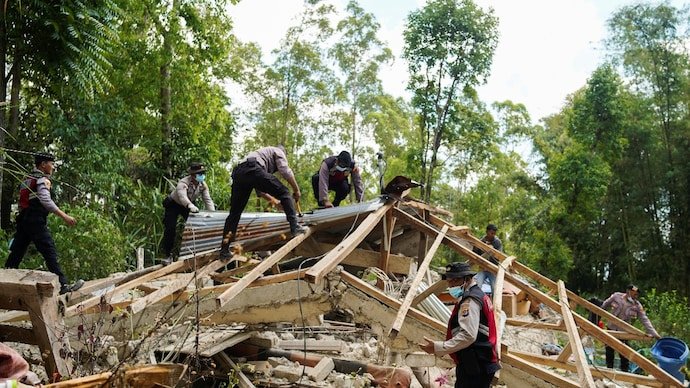
A powerful magnitude-7.7 earthquake struck eastern Indonesia on Saturday, killing at least 51 people and forcing around 5,000 residents to evacuate as rescuers worked to reach areas cut off by landslides and damaged roads.
The earthquake hit East Nusa Tenggara province on Flores Island and was followed by about 341 aftershocks, adding to fears among residents already displaced by collapsed buildings and unstable ground. Officials said 36 people suffered serious injuries and another 77 sustained minor injuries.
The disaster has created a complex emergency in which rescue teams are dealing with collapsed homes, blocked transport routes, power failures and residents WHO are reluctant to return indoors because of continuing seismic activity.
According to Indonesia’s National Disaster Mitigation Agency, BNPB, more than 1,300 homes were damaged. Rescue teams have reached parts of Maumere that were initially isolated by landslides, while authorities continue assessing the full scale of destruction and searching areas where people may remain trapped under rubble.
What happened in the Indonesia earthquake?
The earthquake struck eastern Indonesia on Saturday morning, with the strongest impacts reported across parts of East Nusa Tenggara. The shaking damaged residential buildings and public Infrastructure and triggered landslides that blocked important roads.
Maumere and surrounding parts of the province were among the areas affected. Some roads became inaccessible, complicating the movement of rescue personnel and emergency supplies. In several locations, people were forced to remain outside because damaged homes were considered unsafe.
The situation was particularly difficult in Sikka, where thousands of residents either evacuated on their own or gathered at a sports arena. BNPB said more than 3,300 people in the region were among those seeking shelter or staying away from their homes.
The scale of the evacuation reflects an important feature of earthquake disasters: the immediate shaking is often only the beginning of the emergency. Aftershocks can destabilise already damaged structures, while landslides and debris can cut off communities and make it harder for rescuers to reach people in need.
341 aftershocks keep residents out of their homes
The large number of aftershocks has become a major concern for survivors. Authorities reported around 341 aftershocks following the main earthquake, creating continued uncertainty for communities already affected by structural damage.
For residents whose houses have collapsed or developed serious damage, staying outside is a necessity. For others, the fear of another strong tremor has made returning home difficult even when their buildings remain standing.
Residents in Sikka described sleeping on porches, under makeshift shelters and in open areas. The combination of damaged buildings and repeated tremors has left many people relying on temporary arrangements while authorities assess whether homes are safe.
That response is particularly important after a major earthquake because buildings weakened by the initial shock can become more vulnerable during subsequent tremors. The continuing aftershock sequence therefore complicates both humanitarian assistance and the assessment of structural damage.
Residents flee as roads are blocked by landslides
One of the biggest challenges facing emergency crews is access. Landslides triggered by the earthquake blocked roads in parts of the affected region, isolating communities and slowing Rescue Operations.
Indonesia’s search and rescue agency said rescuers had reached parts of Maumere after some areas were cut off. But the lack of an immediate count of missing people means the final human cost could take time to establish.
BNPB reported that more than 1,300 homes were damaged, while other reports indicated significant destruction to public facilities and infrastructure. Rescue workers have had to combine debris removal with searches for people who may be trapped beneath collapsed structures.
More than 3,500 military and police personnel have been deployed to the region, according to Cabinet Secretary Teddy Indra Wijaya. Their role includes supporting rescue efforts, securing affected areas and helping authorities respond to communities that remain difficult to reach.
Medical services move outside damaged facilities
The earthquake has also put pressure on local Healthcare services. Some injured residents were treated in temporary medical areas outside hospitals, including tents set up in Maumere.
Outdoor treatment areas can provide an important safety measure when medical buildings have themselves been damaged or when aftershocks make indoor treatment areas unsafe. They also allow emergency teams to continue treating patients while structural inspections take place.
The reported casualty figures included 36 people with serious injuries and 77 with minor injuries. As rescue teams reach additional locations, authorities are expected to continue updating casualty and damage assessments.
The medical response is also complicated by infrastructure disruption. Power outages caused 20 petrol stations to stop operating, according to state energy company Pertamina. Fuel availability can become critical during a disaster because ambulances, rescue vehicles, generators and supply trucks all depend on functioning fuel distribution.
Why thousands of people are staying outside
In Sikka, residents described leaving their homes after the earthquake and remaining outdoors. Some slept beneath makeshift tarpaulin shelters, while others gathered in public spaces.
One resident, 63-year-old Abdul Mutas, told Reuters that he and his family slept on a tarp surrounded by trees after fleeing. He described seeing tides rise and said the family ran in response to the danger.
Sikka’s deputy regent, Simon Subandi, said many residents were unwilling to stay indoors and instead slept on porches or in tents outside.
These accounts show the psychological and practical consequences of a major earthquake. Even when a home has not collapsed, visible cracks, falling objects and repeated aftershocks can make residents reluctant to sleep indoors. Temporary shelters therefore become essential not only for people who have lost homes but also for those who cannot yet safely return.
Authorities consider an emergency declaration
The East Nusa Tenggara government is considering declaring an emergency for the province, BNPB said. Such a designation could help authorities mobilise additional resources and funding as the response expands.
The decision is significant because the needs created by a major earthquake extend well beyond search and rescue. Authorities must also provide temporary shelter, medical treatment, Food, water, transportation, fuel and other essential services while repairing damaged infrastructure.
The scale of the evacuation means that local governments may need support from national agencies as well as the military and police. The deployment of thousands of personnel is already an indication of the size of the response.
Indonesia’s history of deadly earthquakes
The latest disaster has renewed attention on Indonesia’s longstanding exposure to earthquakes. The country sits along the Pacific Ring of Fire, a broad zone around the Pacific Ocean characterised by intense tectonic activity, frequent earthquakes and volcanic eruptions.
Indonesia’s geography makes seismic hazards a recurring national challenge. The country’s population is spread across a vast archipelago, meaning that an earthquake in a remote or island region can create additional logistical difficulties for emergency services.
The area affected by the latest earthquake also has a history of destructive seismic events. Indonesia’s geophysics agency said the region experienced a magnitude-7.5 earthquake in 1992 that caused extensive destruction.
The comparison matters because earthquake risk is not determined solely by the magnitude of a tremor. Building quality, population distribution, terrain, distance from population centres, road access and the depth and location of the earthquake all influence the eventual human impact.
Why the earthquake became so difficult to respond to
The emergency in East Nusa Tenggara illustrates how several hazards can compound one another after a major earthquake.
- Aftershocks: Hundreds of additional tremors have kept residents away from damaged buildings and complicated rescue work.
- Landslides: Collapsed earth and debris have blocked roads and isolated communities.
- Building damage: More than 1,300 homes were reported damaged, leaving thousands needing temporary shelter.
- Power outages: Electricity disruptions affected fuel stations and other essential services.
- Medical pressure: Injured residents have required treatment while some medical services operate in temporary outdoor locations.
- Access problems: Rescue teams have had to clear blocked routes before reaching some affected communities.
Taken together, these factors explain why the response cannot be measured simply by the number of rescue personnel deployed. Getting those personnel, medical supplies and equipment into isolated areas is itself a major part of the emergency operation.
How the disaster compares with recent Indonesian earthquakes
The earthquake is being described as Indonesia’s deadliest since a 2022 earthquake in West Java that killed hundreds. That comparison places the Flores disaster among the country’s most serious recent seismic emergencies.
Flores itself has experienced major earthquakes before. The 1992 magnitude-7.5 event caused extensive destruction, demonstrating that the island’s exposure to significant seismic hazards is longstanding.
The latest disaster therefore combines a familiar natural hazard with modern emergency-response challenges. Authorities have more sophisticated communication, rescue and monitoring capabilities than in previous decades, but damaged roads, remote settlements and unstable terrain can still slow the delivery of assistance.
What happens next after the 7.7 earthquake?
The immediate priority remains finding survivors, treating the injured and reaching communities that have been isolated by landslides or damaged roads.
Authorities will also need to determine which buildings can safely be occupied. That assessment is particularly important while aftershocks continue. Returning residents to structures that have been weakened by the main earthquake could expose them to additional danger.
The possible declaration of an emergency in East Nusa Tenggara could provide authorities with additional resources for the relief operation. At the same time, the continuing assessment of casualties and missing people will determine how the rescue effort evolves in the coming days.
The final impact of the earthquake may take time to establish. Remote communities can be difficult to reach, communications can be disrupted and damage assessments often change as emergency teams gain access to previously isolated areas.
Indonesia earthquake highlights continuing seismic risk
The magnitude-7.7 earthquake in East Nusa Tenggara has left thousands of people displaced and created a difficult rescue operation across parts of Flores. The reported death toll has reached at least 51, while more than 100 people have been reported injured and hundreds of aftershocks have followed the main shock.
For survivors, the crisis is now about more than the initial earthquake. Damaged homes, blocked roads, landslides, power failures and continuing tremors are shaping daily life as rescue teams move into affected communities.
The disaster also underlines the persistent earthquake risk faced by Indonesia because of its location along the Pacific Ring of Fire. For East Nusa Tenggara, a region with a history of destructive earthquakes, the immediate challenge is to rescue those still trapped, provide safe shelter for displaced families and restore essential services while the ground continues to settle.
The focus in the coming days will remain on the search for survivors and the delivery of relief. As authorities gain access to more affected areas, a clearer picture of the earthquake’s full human and economic impact is expected to emerge.
For breaking news and live news updates, like us on Facebook or follow us on Twitter and Instagram. Read more on Latest World on thefoxdaily.com.



COMMENTS 0