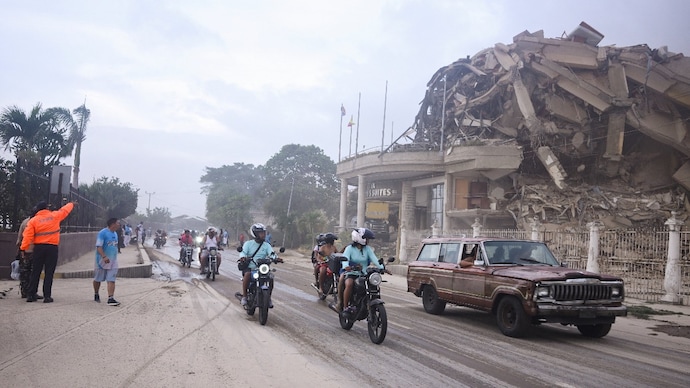
More than 24 hours after two powerful earthquakes struck northern Venezuela, rescuers, volunteers and grieving families continue to dig through mountains of rubble in the hope of finding survivors. Authorities said at least 235 people have died, more than 4,300 have been injured and thousands remain unaccounted for, making it one of the country’s deadliest natural disasters in recent History.
The twin earthquakes, measuring 7.2 and 7.5 in magnitude, struck within seconds of each other on Wednesday evening, sending powerful shockwaves across much of northern Venezuela and neighbouring Caribbean regions. Seismologists say the rare back-to-back tremors significantly amplified the destruction, leaving entire neighbourhoods in ruins and overwhelming emergency services.
LA GUAIRA BEARS THE BRUNT OF THE DISASTER
The coastal state of La Guaira, home to Venezuela’s principal international airport, has emerged as the worst-affected region. Apartment blocks, commercial buildings and public infrastructure suffered extensive damage, while sections of major roads cracked open, complicating rescue operations.
Authorities closed Simón Bolívar International Airport after engineers detected structural damage, forcing Humanitarian Aid flights to be redirected through alternative airports. The closure has slowed the arrival of rescue equipment, medical supplies and international emergency teams.
Acting President Delcy Rodríguez declared a nationwide state of emergency and mobilised military personnel, firefighters, civil defence units and disaster response agencies as search operations entered a critical phase.
RESIDENTS BECOME FIRST RESPONDERS
In many devastated neighbourhoods, residents began rescue efforts long before heavy equipment arrived.
Using shovels, crowbars and even their bare hands, neighbours worked through collapsed buildings searching for trapped relatives and strangers alike. Videos broadcast on Venezuelan television showed emotional rescues, including emergency workers pulling survivors from beneath slabs of concrete after hours of painstaking excavation.
Elsewhere, however, frustration grew over what many residents described as the slow arrival of specialised rescue teams.
Parents searched desperately for missing children, while handwritten notices carrying photographs of loved ones appeared across damaged streets and temporary shelters.
Hundreds of families spent the night sleeping in parks, football grounds and open spaces, fearing powerful aftershocks could bring down buildings that were still standing.
HEARTBREAK ACROSS THE CAPITAL
Scenes of grief unfolded across Caracas and surrounding cities as rescue workers continued searching damaged residential complexes.
Dayana Delgado, whose eight-year-old son remains missing, questioned why heavy rescue machinery had not reached her neighbourhood sooner.
“I just want to know where my child is,” she told local reporters, as volunteers continued digging through collapsed concrete nearby.
In another part of the city, grieving relatives watched emergency workers recover the bodies of two young children from a destroyed building, while dozens of others waited anxiously for updates about family members believed to be trapped.
Retired schoolteacher Juan Alberto Mendao described hearing cries for help coming from beneath collapsed structures but said rescuers lacked the equipment needed to reach survivors quickly.
AFTERSHOCKS COMPLICATE SEARCH OPERATIONS
Emergency crews continue to work under dangerous conditions as frequent aftershocks threaten already weakened buildings.
Several rescue operations have been temporarily suspended after fresh tremors caused additional collapses, forcing teams to reassess unstable structures before continuing their search.
Authorities have urged residents to avoid entering damaged buildings until engineers complete safety inspections, warning that many structures remain at risk of sudden collapse.
WHY THE EARTHQUAKES CAUSED SO MUCH DAMAGE
Although Venezuela lies near the boundary between the South American and Caribbean tectonic plates, earthquakes of this magnitude are relatively uncommon.
According to the United States Geological Survey (USGS), both earthquakes originated near Morón, approximately 170 kilometres west of Caracas, at relatively shallow depths.
Geophysicists say shallow earthquakes typically produce much stronger ground shaking than deeper events, increasing the likelihood of severe structural damage.
Researchers also believe the near-simultaneous occurrence of the two powerful earthquakes intensified ground motion, exposing buildings to repeated violent shaking before they had time to stabilise.
INTERNATIONAL AID BEGINS ARRIVING
As Venezuela’s emergency services struggled to cope with the scale of destruction, governments across the world pledged humanitarian assistance.
Mexico, Brazil, Canada, Spain, Portugal, Qatar and several Caribbean nations announced emergency aid packages, while specialised search-and-rescue teams from Mexico, El Salvador and the Dominican Republic arrived with trained personnel, medical equipment and rescue dogs.
The United States also announced emergency assistance despite logistical challenges created by the closure of Venezuela’s main airport.
International humanitarian agencies are coordinating with Venezuelan authorities to deliver medical supplies, temporary shelters, food assistance and heavy rescue equipment to the hardest-hit communities.
COMMUNICATION DISRUPTIONS ADD TO THE CRISIS
The disaster has also exposed the vulnerability of Venezuela’s communications infrastructure.
Power outages, damaged mobile towers and internet disruptions have left thousands unable to contact relatives, both within Venezuela and abroad.
Following appeals from United Nations officials, restrictions affecting access to certain Social Media platforms were eased, allowing many families to reconnect and share information about missing relatives.
Across Latin America, Venezuelan expatriate communities have organised donation drives, collecting medicines, clothing, food and emergency supplies for those affected by the disaster.
LONG ROAD TO RECOVERY
President Delcy Rodríguez has announced a reconstruction fund worth 200 million US dollars to support repairs to hospitals, schools, housing and public infrastructure. The government has also appealed to private construction companies to provide cranes, excavators and heavy machinery to accelerate rescue efforts.
Disaster management experts caution that rebuilding affected regions will likely take years. Beyond restoring damaged infrastructure, authorities face the challenge of housing thousands of displaced residents, reopening hospitals and schools, and rebuilding transport networks critical to Venezuela’s economy.
For now, however, the immediate priority remains saving lives.
With rescue crews continuing to search collapsed buildings across La Guaira, Caracas and neighbouring cities, officials warn that the death toll is likely to rise further as access improves to heavily damaged areas. For thousands of families still waiting for news of missing loved ones, hope now rests on every hour of the ongoing Rescue Operation.
For breaking news and live news updates, like us on Facebook or follow us on Twitter and Instagram. Read more on Latest World on thefoxdaily.com.



COMMENTS 0