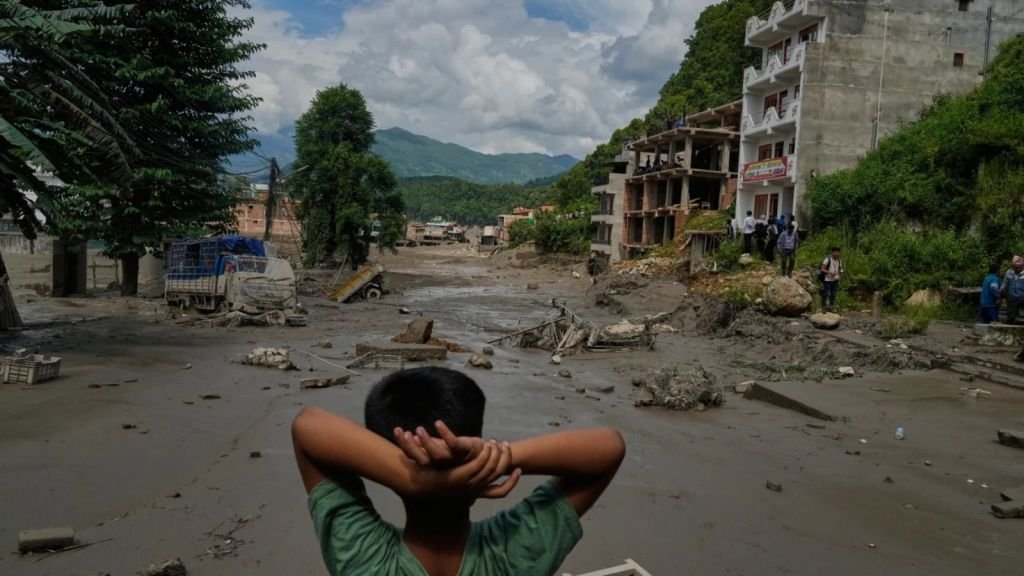
Flash floods near the Tibet-Nepal border have killed at least 16 people in Tibet and left 546 people missing, including 49 Indians, Chinese officials said on Sunday, as rescue teams continued searching areas devastated by torrents of water, ice and rock.
The disaster struck the Gyirong-Nepal border Immigration port on August 26, when large numbers of people were waiting on both sides of the crossing to enter or leave Tibet. The incident has become an international emergency because the missing include hundreds of foreign nationals from more than 20 countries.
The situation is even more severe across the border in Nepal. Nepal’s death toll has risen to 734, while nearly 2,500 people remain missing following devastating floods and landslides. The scale of the disaster has disrupted roads, border movement and rescue operations across the mountainous region.
For India, the presence of 49 missing nationals is particularly significant. A large number of Indian pilgrims had travelled to Tibet for the Kailash Manasarovar Yatra following an improvement in India-china ties, placing Indian travellers among those caught up in the disaster.
What happened at the Gyirong-Nepal border?
The flash floods struck the Gyirong-Nepal border port on August 26. The immigration crossing was crowded with people travelling between Tibet and Nepal when the sudden flooding hit the area.
Chinese authorities said rescue and relief operations are continuing in Gyirong county. The disaster is believed to have been triggered by a collapse or avalanche involving ice and rock near the border, sending large quantities of water and debris through vulnerable mountainous terrain.
Such events can become particularly dangerous in high-altitude regions because steep slopes, unstable rock and rapidly changing water conditions can turn a relatively local collapse into a destructive downstream flood.
The border location has added another layer of difficulty. Rescue teams must operate across rugged terrain while authorities on both sides of the frontier try to establish who has survived, who has been evacuated and who remains unaccounted for.
16 dead and 546 missing in Tibet
Chinese officials said the death toll in Tibet had reached 16 by Sunday. A further 546 people remained missing.
The missing group includes both Chinese nationals and foreigners. Of the total, 261 are foreign nationals from 23 countries, demonstrating how heavily the disaster has affected people travelling through the border region.
The numbers remain subject to change as rescue teams continue searches and authorities verify information about people who may have reached safety without immediately being accounted for.
Authorities have carried out multiple rounds of searches, site inspections and checks of individuals at the border port. Chinese state-run Xinhua reported that no foreign tourists were currently stranded in Gyirong county after these checks.
That distinction is important. A person being listed as missing does not necessarily mean authorities have confirmed that the person remains trapped at the border. In a disaster of this scale, communication failures, disrupted transport and separated travel groups can make it difficult to establish people’s whereabouts immediately.
49 Indians among those missing
Indian nationals account for 49 of the 261 foreign nationals reported missing in Tibet.
The presence of Indian pilgrims is linked to the Kailash Manasarovar Yatra, a major pilgrimage journey to the sacred Mount Kailash and Lake Manasarovar region in Tibet.
The movement of pilgrims through the area has made the disaster especially important for Indian authorities and families trying to establish the whereabouts of relatives travelling in Tibet.
Chinese authorities said they had informed the embassies and consulates of countries whose nationals are among the missing. This diplomatic coordination is critical because family members often depend on their governments for verified information during emergencies overseas.
The reported missing foreign nationals come from a wide range of countries, making the Gyirong disaster an international humanitarian concern rather than a purely local emergency.
Foreign nationals from 23 countries affected
According to Xinhua, the missing foreign nationals include people from 23 countries.
Nepalese nationals make up the largest group among those specifically identified, with 104 people reported missing. Other reported figures include 33 people from Latvia, 18 from the United States and 15 from the United Kingdom.
Nationals from Canada, Australia, South Africa, Malaysia, Germany, Russia and Ireland are also among those reported missing.
| Category | Reported number |
|---|---|
| Total missing in Tibet | 546 |
| Foreign nationals among the missing | 261 |
| Countries represented among foreign missing persons | 23 |
| Indian nationals among the missing | 49 |
| Nepalese nationals among the missing | 104 |
| Latvian nationals among the missing | 33 |
| US nationals among the missing | 18 |
| UK nationals among the missing | 15 |
| Deaths reported in Tibet | 16 |
The figures highlight the international character of the emergency. They also explain why Chinese authorities have been working with foreign diplomatic missions while continuing searches around the border area.
Why the search is proving difficult
The geography of the region is one of the biggest challenges facing rescue teams.
The Tibet-Nepal border runs through some of the world’s most rugged mountainous terrain. A sudden ice-and-rock collapse followed by flooding can destroy access routes, scatter debris across large areas and make conventional searches difficult.
Border infrastructure can also be particularly vulnerable because roads and crossings are concentrated through narrow valleys and mountain corridors. Damage to a single route can isolate communities and prevent rescue personnel from reaching affected locations quickly.
There is another problem: identifying missing people after a major disaster requires more than simply searching damaged buildings. Authorities must cross-check passenger records, immigration information, evacuation lists and reports from survivors.
For foreign nationals, that process also requires communication with embassies and consulates so that governments can notify families and distinguish confirmed survivors from people whose status remains uncertain.
China says rescue operations are continuing
Chinese authorities said relief and rescue operations remain underway in Gyirong county.
Teams have conducted repeated searches and inspections around the affected border port. Officials have also checked people in the area to determine whether individuals previously listed as missing have reached safety.
The announcement that no foreign tourists are currently stranded in Gyirong county provides some reassurance, but it does not resolve the wider missing-person investigation.
The priority remains locating people whose whereabouts have not been confirmed and establishing reliable information for their families and governments.
China opens hotlines for families
Chinese authorities have opened two 24-hour English-language telephone hotlines for families seeking information about missing foreign nationals.
The numbers provided by Chinese authorities are 0086-891-6817165 and 0086-18308026705.
The hotlines are intended to provide a direct communication channel during a situation in which normal travel and communication networks may be disrupted.
For families of missing Indian nationals, coordination between Chinese authorities and Indian diplomatic officials will be particularly important. Until a person’s status is confirmed, reports of missing travellers should not automatically be treated as confirmed deaths.
Nepal faces an even larger humanitarian crisis
The disaster at Gyirong is part of a much wider emergency affecting Nepal.
Nepal’s death toll has climbed to 734, while nearly 2,500 people remain missing. Flooding and landslides have caused extensive damage in multiple areas, compounding the difficulties faced by rescue workers.
The geographical connection between the affected areas matters. Rivers and valleys do not stop at political borders, meaning a major event in the high mountains can have consequences downstream in Nepal.
The situation has therefore required authorities on both sides of the border to monitor water flows, infrastructure damage and the movement of displaced people.
The high number of missing people also means that rescue operations are not limited to searching for survivors. Teams must simultaneously identify victims, locate separated travellers and determine which missing-person reports can be resolved through contact with people who have reached safety.
Kailash Manasarovar pilgrims face particular risks
The presence of Indian pilgrims among the missing has drawn attention to the risks faced by travellers undertaking the Kailash Manasarovar Yatra.
Pilgrimage groups often travel through remote areas where access to medical facilities, communication networks and transportation can be limited. When extreme weather or a sudden Natural Disaster strikes, the distance from major population centres can make evacuation more complicated.
The current disaster also illustrates why travel through high-altitude border regions depends heavily on weather and terrain conditions.
For travellers and their families, the immediate priority is reliable information rather than unverified reports circulating through Social Media or informal networks.
What the missing-person numbers tell us
The figure of 546 missing people in Tibet needs to be viewed carefully because missing-person counts can change rapidly during a large-scale emergency.
Some people initially reported missing may later be located at evacuation centres, hospitals or other safe areas. Others may remain unaccounted for because communications have failed or travel groups have been separated.
At the same time, searches can uncover additional victims or identify people whose status was previously unclear.
That is why authorities continue updating casualty and missing-person figures as verification progresses.
The reported 261 foreign nationals among those missing also demonstrates how a border disaster can quickly become an international coordination exercise. Rescue teams, immigration officials, diplomatic missions and families all depend on accurate information to determine what happened to individual travellers.
India-China coordination becomes important
The disaster comes against the backdrop of increased travel by Indian pilgrims to Tibet following an improvement in India-China ties.
That makes the safety of Indian travellers an immediate concern for both governments.
When citizens are missing during an overseas disaster, diplomatic channels become essential for obtaining verified information, communicating with local authorities and assisting affected families.
The Chinese authorities’ decision to notify the embassies and consulates of countries whose nationals are missing provides an important mechanism for that coordination.
For India, the priority will be establishing the status of the 49 Indian nationals reported missing and ensuring that families receive confirmed information as search operations progress.
What happens next in the Tibet-Nepal flood disaster
The immediate focus will remain on rescue and search operations around Gyirong county and other affected locations.
Authorities will also continue reconciling missing-person records and casualty figures as more people are located or formally identified.
For foreign governments, maintaining contact with Chinese authorities will be crucial. For families, the official hotlines and diplomatic channels provide more reliable sources of information than unverified online reports.
Across the border, Nepal faces the much larger task of dealing with hundreds of deaths and thousands of missing people while repairing infrastructure damaged by floods and landslides.
A border disaster with international consequences
The Gyirong flash floods demonstrate how quickly a natural disaster in a remote mountain region can become an international emergency.
The 16 deaths reported in Tibet and 546 missing people include nationals from 23 countries, while 49 Indians are among those unaccounted for. The presence of pilgrims travelling to Kailash Manasarovar has added particular significance for India.
At the same time, Nepal is dealing with an even greater humanitarian toll, with 734 deaths and nearly 2,500 people still missing.
For now, the most important development is the continuation of rescue operations and the verification of missing-person reports. The numbers are likely to evolve as search teams cover more ground and authorities establish the whereabouts of people who survived the floods.
The disaster has also underlined the vulnerability of transport and border infrastructure in mountainous areas, where a sudden combination of ice, rock and water can overwhelm roads and settlements with little warning. Until rescue teams complete their searches and the affected communities receive reliable communication and assistance, the full human cost of the Tibet-Nepal floods will remain uncertain.
For breaking news and live news updates, like us on Facebook or follow us on Twitter and Instagram. Read more on Latest World on thefoxdaily.com.





COMMENTS 0