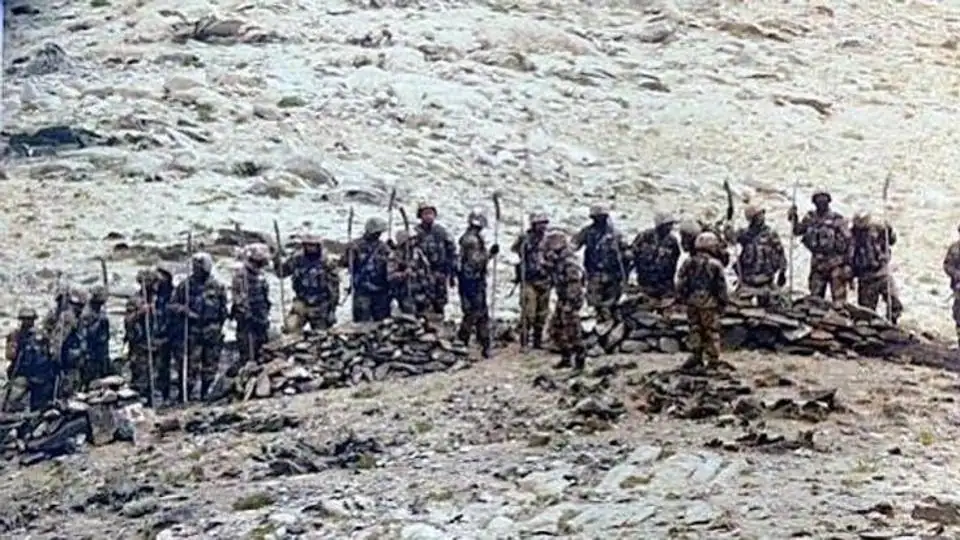
The Indian Army on Saturday, November 7, rejected social media claims alleging that Chinese troops had defeated Indian soldiers, advanced nearly 50 kilometres into Arunachal Pradesh and established control over Indian territory. Describing the allegations as false and unsubstantiated, the Army said the posts were being circulated in a coordinated effort to create a misleading narrative against the Indian military.
The clarification comes amid reports of continuing face-offs between Indian and Chinese personnel at multiple locations along the Line of Actual Control (LAC) in Arunachal Pradesh. Recent remarks by the Director General of the Indo-Tibetan Border Police (ITBP), Shatrujeet Kapur, about confrontations in the region had already generated political debate and public attention.
In a statement shared through its official fact-checking account on X, the Army said several suspected Pakistan-sponsored social media accounts were amplifying claims about a major Chinese military advance. It rejected suggestions that the People’s Liberation Army (PLA) had taken control of Indian territory or inflicted a major defeat on Indian forces.
The Army also identified six social media handles that it said had circulated similar misleading content within a short period. It urged people to verify information about the sensitive border situation through credible and official sources before sharing it online.
What did the Indian Army say about the alleged Chinese advance?
The Indian Army’s fact-checking account issued a clarification under the heading “Coordinated Inauthentic Behaviour Exposed”. It directly addressed posts claiming that Chinese forces had defeated Indian troops and occupied territory in Arunachal Pradesh.
“Several suspected Pak-sponsored social media accounts are circulating misleading claims that Chinese forces have severely defeated Indian troops, advanced nearly 50 km into Arunachal Pradesh and established PLA control over Indian territory,” the Army said.
It further stated that the allegations were being amplified in a coordinated manner to promote a misleading anti-Indian Army narrative.
The Army described the claims as exaggerated and unsubstantiated. Its clarification was intended to counter the impression that a major military setback had taken place along the India-China border.
The distinction is important because the region has experienced reported military friction in recent months. However, reports of face-offs or disagreements over patrolling patterns do not establish that Chinese troops have advanced 50 kilometres into Indian territory or taken control of the areas mentioned in the viral posts.
The Army’s statement specifically rejected those claims. It did not suggest that all border-related tensions had disappeared or that every reported confrontation was fabricated.
Army identifies six X accounts behind the misleading claims
Alongside its clarification, the Indian Army identified six X accounts that it said had circulated similar content between November 6 and the early hours of November 7.
The handles named in the Army’s fact-check were:
- @SongWeilonzob1
- @letmehandleyou1
- @_Finding_sarah
- @DarkReal09
- @War_Updates5
- @sumit_sarkr
According to the Army, the accounts shared similar claims about Chinese forces advancing into Arunachal Pradesh and establishing control over Indian territory. The posts reportedly appeared between 3:06 pm on November 6 and 1:46 am on November 7.
The Army described the pattern as coordinated inauthentic behaviour, suggesting that the similarity and timing of the posts were part of an effort to amplify the same misleading narrative across social media.
It also tagged the Ministry of Electronics and Information Technology (MeitY) in its fact-check post.
However, the Army’s identification of the accounts should be distinguished from an independently established finding about the identities of the people operating them or their alleged connections. The military described them as suspected Pakistan-sponsored accounts, but the public statement did not provide detailed evidence establishing who controlled each handle.
Why the claims are significant amid reported Arunachal border face-offs
The Army’s clarification comes against the backdrop of reported tensions between Indian and Chinese personnel in Arunachal Pradesh, particularly around the Taksing area in Upper Subansiri district.
In October, ITBP Director General Shatrujeet Kapur spoke about face-offs at several locations in Arunachal Pradesh. His remarks attracted attention because he said the confrontations had continued and praised the performance of the force’s newly formed Shaurya commando teams.
Kapur made the comments while addressing ITBP personnel at a felicitation ceremony in Alwar, Rajasthan. He said that a situation had developed in Arunachal Pradesh in which face-offs occurred at different locations and that the specialised teams had performed exceptionally well.
A video of his remarks circulated widely on social media, prompting questions about the nature of the confrontations and the situation along the border.
The ITBP chief’s comments did not establish that Chinese forces had occupied Indian territory or defeated Indian troops. They referred to face-offs and the role of specialised teams in handling such situations.
Reports about the Taksing area had emerged earlier in July and August, when concerns were raised about access to certain patrolling locations near the LAC. These developments led to further military-level communication between the two countries.
What did the government say about Chinese troops and patrolling patterns?
The Ministry of External Affairs (MEA) addressed questions about the reported tensions after Kapur’s remarks attracted public attention.
MEA spokesperson Randhir Jaiswal said the situation along India-China border areas can become disturbed when Chinese forces move away from established patrolling patterns.
He explained that both countries continue to use existing diplomatic and military mechanisms to address outstanding issues and prevent misunderstandings or miscalculations along the LAC.
The two sides have also discussed ways to improve their understanding of the LAC in appropriate areas to strengthen border management.
Such mechanisms include meetings between military commanders and diplomatic consultations through established bilateral frameworks. They are intended to manage disagreements on the ground and reduce the possibility of local incidents escalating into a larger confrontation.
The government’s position highlights the difference between an ongoing border-management challenge and claims of a major territorial loss. While disagreements over patrolling patterns can create friction, they do not automatically mean that one side has established permanent control over disputed territory.
India and China held military talks after reports of tension in Taksing
India and China held Corps Commander-level talks in the eastern sector on September 6 and 7, following reports of friction around Taksing in Arunachal Pradesh’s Upper Subansiri district.
The discussions took place at the Wacha-Damai border meeting point on the Indian side. The talks followed multiple engagements between local military commanders from both countries aimed at addressing issues along the LAC.
Indian troops continued to remain deployed in the area as the two sides worked through the reported disagreements. The meetings were part of established military communication mechanisms designed to prevent misunderstandings and maintain stability along the border.
The discussions also took place against the backdrop of broader diplomatic engagement between New Delhi and Beijing. National Security Adviser Ajit Doval and Chinese Foreign Minister Wang Yi, who serve as special representatives for boundary negotiations, held talks in Beijing on August 25, 2026.
The two sides discussed the boundary question and agreed to continue using existing diplomatic and military channels to address situations on the ground. They also discussed additional communication arrangements and measures intended to improve border management.
These engagements demonstrate that border disagreements remain an issue requiring sustained attention, even as both countries pursue wider efforts to improve bilateral relations.
India-China relations have been affected by the prolonged LAC standoff
The latest developments cannot be viewed separately from the broader history of tensions along the India-China border. Relations between the two countries deteriorated sharply after the military standoff in eastern Ladakh began in April-May 2020.
The confrontation continued for more than four years and included the deadly clash in the Galwan Valley in June 2020, in which soldiers from both sides lost their lives. The incident marked a major turning point in bilateral relations and significantly affected diplomatic and military engagement.
India and China subsequently held several rounds of negotiations involving military commanders, diplomats and senior political representatives. The discussions focused on disengagement, reducing the risk of further confrontation and restoring stability along the LAC.
In October 2024, the two countries reached an understanding on patrolling arrangements in the remaining friction areas of eastern Ladakh. The agreement helped facilitate disengagement in the relevant areas and created an opening for gradual efforts to improve bilateral relations.
Since then, both governments have taken steps to restore communication and expand engagement through diplomatic, military and other channels. However, the boundary dispute remains unresolved, and differences over the alignment of the LAC continue to create the possibility of local confrontations.
Why the Line of Actual Control remains sensitive
The Line of Actual Control is the de facto boundary separating Indian-controlled territory from Chinese-controlled territory. Unlike an internationally agreed and fully demarcated border, the LAC has differing perceptions in several sectors.
India and China do not have a mutually accepted final boundary alignment across the entire frontier. As a result, patrols by the two countries’ personnel can sometimes enter areas that both sides consider part of their respective claims.
These differences can lead to face-offs, temporary confrontations and disagreements over access to traditional patrolling locations. Military commanders generally use established protocols and communication channels to manage such situations and avoid escalation.
Arunachal Pradesh is particularly sensitive in the eastern sector. China claims parts of the state and refers to it as Zangnan or South Tibet, while India maintains that Arunachal Pradesh is an integral and inalienable part of the country.
India has consistently rejected Chinese claims over the state. New Delhi has also opposed attempts by Beijing to assign Chinese names to locations in Arunachal Pradesh, describing such actions as efforts to make territorial claims without changing the situation on the ground.
The continuing boundary dispute makes accurate reporting particularly important. Unverified claims about military defeats, territorial occupation or troop movements can create unnecessary public anxiety and complicate an already sensitive security environment.
Earlier misleading videos also triggered Army fact-checks
The latest clarification is part of a wider series of fact-checks issued by the Indian Army in response to misleading social media content about the India-China border.
In October, the Army rejected a digitally manipulated video that falsely attributed remarks to Lieutenant General Girish Kalia, claiming that Chinese forces had taken control of locations including Asaphila, Longju and Taksing in Arunachal Pradesh.
The Army said the video used manipulated footage, voice cloning and artificial intelligence-generated lip-syncing to make it appear that a senior military officer had admitted to Chinese territorial advances. It clarified that the original footage came from an earlier media briefing in Kupwara, Jammu and Kashmir, in October 2023.
Other misleading posts have also used unrelated footage to suggest that Chinese troops were confronting or searching Indian personnel in Arunachal Pradesh.
In one case, footage from a security mock drill in Karnataka was circulated with claims that it showed Chinese soldiers checking Indian security personnel. Another video from a military exercise in Kazakhstan was presented as footage of an India-China confrontation near Taksing.
Fact-checking investigations have also identified old footage from the 2020 India-China military confrontation being circulated as evidence of a recent incident in Arunachal Pradesh.
These examples show how unrelated, outdated or manipulated videos can be presented with misleading captions to create the impression of a new military development. The latest Army statement indicates that similar tactics are also being used through coordinated text-based posts.
Why verifying border-related information matters
Social media platforms allow information about military developments to spread rapidly, often before official agencies have released detailed statements. While this can help bring attention to important events, it also creates opportunities for misinformation to circulate widely.
Border-related claims require particular caution because military movements, operational details and diplomatic discussions may not be publicly available immediately. A video or post shared without its original date, location or context can easily lead to incorrect conclusions.
For readers, checking whether an image or video has appeared previously, identifying its original source and comparing claims with official statements can help prevent the spread of misleading information.
Information from the Indian Army, the Ministry of Defence, the MEA and other relevant government agencies can provide important clarification. Independent reporting from established news organisations can also help place developments in context.
At the same time, official statements and social media claims should be understood in their proper context. An Army fact-check rejecting a specific allegation does not mean that all border tensions have ended. Similarly, reports of face-offs do not prove claims of territorial occupation or military defeat.
What happens next along the Arunachal Pradesh border?
The immediate focus remains on managing reported face-offs and maintaining communication between Indian and Chinese forces. Both countries have established military and diplomatic mechanisms to address disagreements along the LAC and reduce the risk of escalation.
The Indian Army’s latest statement specifically rejects claims that Chinese forces advanced nearly 50 kilometres into Arunachal Pradesh and established control over Indian territory. It has urged citizens to avoid forwarding unverified information and to rely on credible sources for updates.
Meanwhile, the wider boundary dispute remains unresolved, and local disagreements over patrolling patterns continue to require attention from both governments.
The latest episode underlines the importance of distinguishing genuine border developments from fabricated claims. While military face-offs deserve serious attention and accurate reporting, unverified allegations of territorial losses can distort public understanding of the situation.
For now, the Indian Army has categorically rejected the viral claims of a Chinese advance and military defeat. Any further assessment of the situation will depend on official updates and verified information from the border region.
For breaking news and live news updates, like us on Facebook or follow us on Twitter and Instagram. Read more on Latest India on thefoxdaily.com.




COMMENTS 0