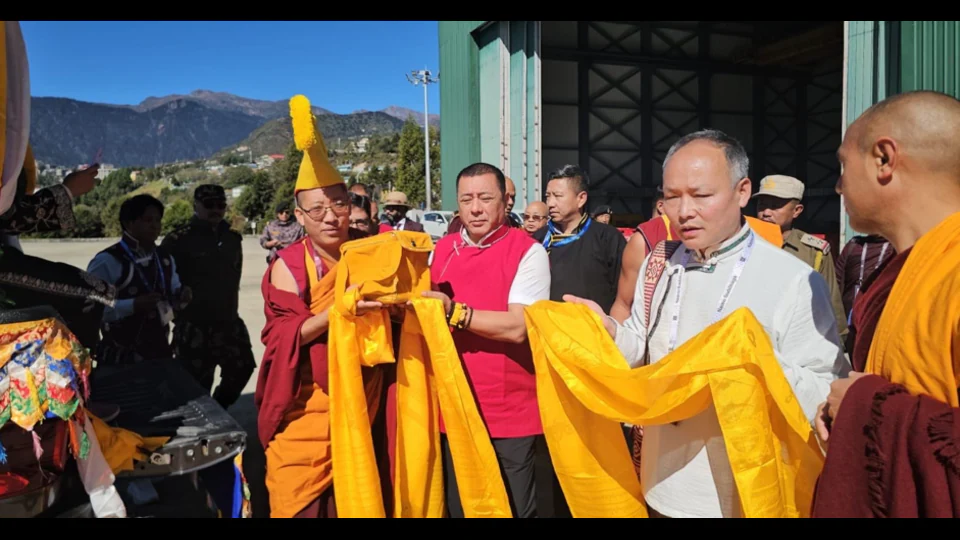
More than 31,000 devotees and visitors gathered at the historic Tawang Monastery in Arunachal Pradesh over seven days to pay homage to the sacred relics of Shakyamuni Buddha. The exposition concluded on November 7, marking the end of its first leg in the Himalayan state and drawing an overwhelming response from Buddhist monks, local residents and visitors from neighbouring areas.
The sacred relics, which arrived in Tawang from the National Museum in New Delhi on October 31, are now travelling to other important Buddhist centres in Arunachal Pradesh. After their public display in Bomdila, they are scheduled to reach the Golden Pagoda in Namsai, where devotees will be able to seek blessings from November 14 to 20.
31,000 devotees visit Tawang Monastery during seven-day exposition
The seven-day exposition at Gaden Namgyal Lhatse, popularly known as Tawang Monastery, provided devotees with an opportunity to pay their respects to relics associated with Gautama Buddha, also known as Shakyamuni Buddha. According to the Ministry of Culture, a total of 31,000 people visited the monastery during the event.
The large turnout reflected the continuing religious significance of Buddhist relics for followers across the Himalayan region. Monks, nuns and devotees from Tawang and surrounding areas visited the monastery to offer prayers and participate in the exposition.
The relics were ceremonially received by Arunachal Pradesh Chief Minister Pema Khandu on October 31 in the presence of Union Culture and Tourism Minister Gajendra Singh Shekhawat. Their arrival marked the beginning of a three-location exposition intended to bring an important part of India’s Buddhist heritage closer to communities in the Northeast.
The Tawang programme concluded on November 7. The relics were subsequently moved to Bomdila for the second phase of the exposition, with arrangements involving the Indian Air Force and local authorities to ensure their safe transportation.
Where devotees can see the sacred Buddha relics next
After completing their public exposition in Tawang, the sacred relics are being displayed at TGL Monastery, also known as Lower Gompa, in Bomdila. The public darshan period at the monastery runs from November 8 to November 13, giving devotees in the West Kameng region an opportunity to pay their respects.
The next destination is the Golden Pagoda in Namsai, where the relics are scheduled to remain available for public veneration from November 14 to November 20. Following the conclusion of the Arunachal Pradesh tour, they are expected to return to the National Museum in New Delhi on November 21.
The exposition schedule covers three Buddhist centres with distinct religious and cultural traditions. The movement of the relics across the state is intended to make the occasion accessible to a wider range of communities rather than limiting the opportunity to visitors travelling to Tawang.
The planned schedule is:
| Location | Venue | Public darshan dates |
|---|---|---|
| Tawang | Gaden Namgyal Lhatse (Tawang Monastery) | November 1–7, 2026 |
| Bomdila | TGL Monastery (Lower Gompa) | November 8–13, 2026 |
| Namsai | Golden Pagoda | November 14–20, 2026 |
| New Delhi | National Museum | Return scheduled for November 21, 2026 |
Visitors planning to attend the remaining stages should check local announcements for any changes to timings or transportation arrangements. The movement of sacred objects across mountainous areas can depend on weather, security and operational conditions.
What are the sacred Piprahwa relics of Shakyamuni Buddha?
The relics being displayed in Arunachal Pradesh are known as the Piprahwa relics. They originate from Piprahwa, an archaeological site in present-day Siddharthnagar district of Uttar Pradesh, which is associated with ancient Kapilavastu and the Shakya community to which Gautama Buddha belonged.
The site became internationally significant in 1898, when British engineer and landowner William Claxton Peppé excavated a large stupa at Piprahwa. The excavation revealed stone containers and other objects, including a reliquary bearing an inscription that has been interpreted as referring to the Buddha and the Sakya community.
The discovery became an important part of the archaeological study of early Buddhism. The remains and associated objects helped researchers examine ancient Buddhist burial practices, the development of stupas and the historical traditions surrounding the Buddha’s life and the Shakya clan.
Further archaeological work at Piprahwa was conducted during the 1970s under Indian archaeologist K. M. Srivastava. These excavations brought additional material to light and added to the site’s importance as a centre for understanding early Buddhist history.
For Buddhist followers, relics associated with the Buddha carry deep spiritual meaning. They are treated as objects of veneration and provide a tangible connection with the teacher whose teachings spread across Asia and influenced religious, philosophical and cultural traditions for centuries.
Why the Piprahwa relics have renewed significance for India
The current exposition also carries a wider heritage dimension because India has recently brought important Piprahwa relics back into the country after more than a century. In 2025, the Ministry of Culture intervened to stop an auction of a portion of the relics at Sotheby’s in Hong Kong. The objects were subsequently repatriated to India on July 30, 2025, through an arrangement involving the government and the Godrej Industries Group.
The repatriation was presented as an important step in recovering cultural heritage connected with India’s Buddhist past. In January 2026, Prime Minister Narendra Modi inaugurated an international exposition in New Delhi titled ‘The Light and the Lotus: Relics of the Awakened One’. It brought together repatriated relics and archaeological material from national museum collections.
The Arunachal Pradesh programme extends the public presentation of this heritage beyond the national capital. Instead of remaining accessible primarily through a museum exhibition, the relics are being taken to Buddhist centres where communities can participate in religious observances and learn about their historical background.
The journey also highlights the relationship between archaeological preservation and living religious traditions. Museums and archaeological institutions help protect and study objects, while public expositions allow people to engage with their cultural and spiritual significance.
Two exhibitions highlight Buddhism’s historical and cultural legacy
The Tawang exposition included two special exhibitions designed to provide visitors with historical and cultural context beyond the opportunity to view the relics.
The first exhibition, titled ‘Unearthing the Sacred Piprahwa: The Story of the Holy Buddha Relics and Their Discovery’, was organised by the International Buddhist Confederation. It traced the discovery of the Piprahwa relics in 1898 and presented the archaeological story associated with the sacred objects.
The exhibition helped connect the relics on display with the wider history of their discovery and preservation. It also offered visitors an opportunity to understand why Piprahwa holds an important place in the study of early Buddhism.
The second exhibition, ‘Crossroads of Dhamma: Classical Legacies, Living Art, and Anthropological Perspectives’, was curated by the National Museum. It showcased different dimensions of Buddhism’s historical, artistic and cultural legacy.
Together, the exhibitions explored how Buddhist ideas travelled across regions and became part of local artistic traditions, religious practices and community identities. They also highlighted the importance of preserving material heritage alongside the traditions and knowledge systems that have developed around it.
International conference examines Buddhism’s spread across the Himalayas
An international conference titled ‘Buddhism: Dissemination in the Himalayan Region and Beyond’ was held on November 2 at the Kalawangpo Convention Centre in Tawang. Organised by the International Buddhist Confederation, the event brought together Buddhist scholars, religious leaders and representatives from India and other countries.
Participants discussed the spread of Buddhist teachings across the Himalayan region, the preservation of religious heritage and the role of Buddhist institutions in sustaining traditional knowledge. The discussions also placed the region within the wider history of cultural and religious exchanges between India and other parts of Asia.
The Himalayan region has played an important role in the transmission of Buddhist philosophy, texts, art and monastic traditions. Religious institutions in areas such as Arunachal Pradesh have helped preserve practices and teachings across generations.
The conference added an academic and international dimension to the exposition. While devotees came to pay homage to the relics, scholars and religious representatives used the gathering to discuss how Buddhist heritage can be protected and shared in a changing world.
Tawang Monastery’s importance in Himalayan Buddhism
Tawang Monastery is one of the most important Buddhist institutions in northeastern India. Known by its traditional name, Gaden Namgyal Lhatse, the monastery was established in the 17th century and is closely associated with the Gelug school of Tibetan Buddhism.
Located in the mountainous landscape of western Arunachal Pradesh, the monastery is a major centre of religious learning, prayer and community life. Its history is closely connected with the Monpa people and the wider development of Himalayan Buddhist traditions.
The monastery’s religious significance made it a fitting first location for the exposition. Its established role as a centre of Buddhist learning meant that the arrival of the relics brought together an important historical collection and a living religious community.
Arunachal Pradesh itself has a diverse Buddhist landscape. Tawang and neighbouring parts of West Kameng are strongly associated with Himalayan Mahayana and Vajrayana traditions. In eastern Arunachal Pradesh, particularly around Namsai, Theravada Buddhism is practised by communities including the Tai Khamti.
Taking the relics from Tawang to Bomdila and then Namsai therefore brings the exposition into contact with different Buddhist communities and traditions within the same state.
Why the exposition is important for Arunachal Pradesh
The three-location programme is part of the Union government’s broader efforts to promote India’s Buddhist heritage and strengthen cultural and spiritual ties with Buddhist communities in India and abroad. It is being organised by the Ministry of Culture in collaboration with the Arunachal Pradesh government and the International Buddhist Confederation.
For Arunachal Pradesh, the event highlights the state’s place in India’s wider Buddhist heritage. Its monasteries, religious festivals, traditional art forms and community practices connect the region with a broader Himalayan cultural network.
The exposition also creates opportunities for visitors to learn about the state’s religious diversity. The contrast between the Himalayan Buddhist traditions of Tawang and Bomdila and the Theravada traditions of Namsai demonstrates that Buddhism in India is not represented by a single institutional or cultural form.
Bringing the relics to these locations can also encourage interest in local monasteries, heritage sites and cultural institutions. Such attention may support Religious Tourism and create opportunities for local communities, although the long-term benefits will depend on how tourism and heritage activities are managed.
From Tawang to Namsai, the sacred relics continue their journey
The response in Tawang has marked a successful first stage of the exposition, with more than 31,000 people visiting the monastery in seven days. The next phase in Bomdila will extend the opportunity for public darshan to another important Buddhist centre before the relics travel to Namsai.
The Golden Pagoda exposition from November 14 to 20 will be the final public stage of the Arunachal Pradesh programme. The relics are scheduled to return to the National Museum in New Delhi on November 21, completing a journey that has connected archaeological heritage with the religious traditions of three regions.
Beyond the visitor numbers, the exposition has brought together worship, historical education and international dialogue. Its significance lies in making an important part of India’s Buddhist heritage accessible to communities while highlighting the enduring influence of the Buddha’s teachings across the Himalayan region and beyond.
For breaking news and live news updates, like us on Facebook or follow us on Twitter and Instagram. Read more on Latest India on thefoxdaily.com.





COMMENTS 0