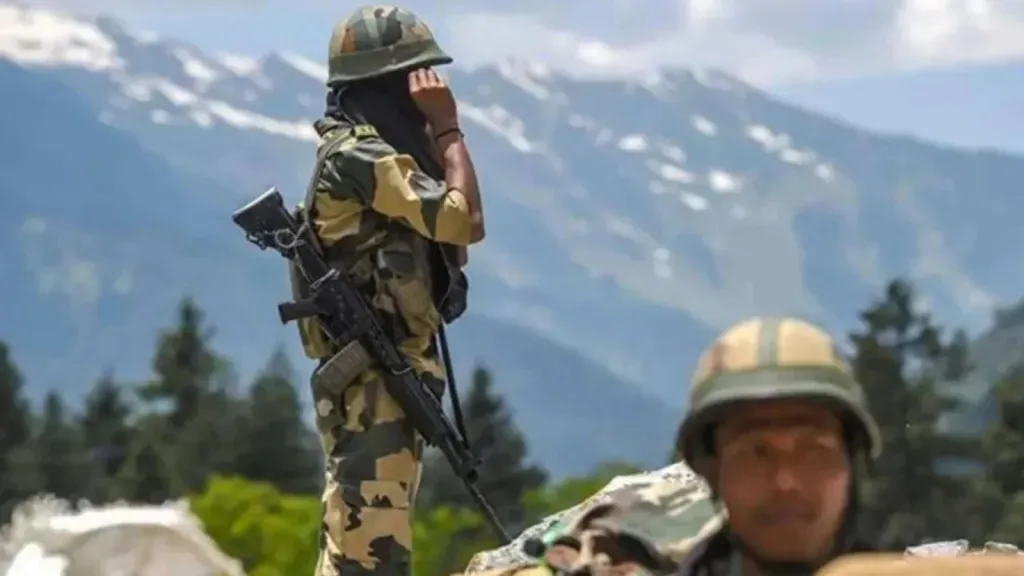
Arunachal Pradesh Chief Minister Pema Khandu has said that transgressions along the India-China border continue to occur because China does not recognise the McMahon Line as the boundary in the state. He described the current situation as normal, adding that Indian armed forces were guarding the frontier effectively.
Khandu’s remarks came a week after Indo-Tibetan Border Police (ITBP) Director General Shatrujeet Kapur disclosed that face-offs with the Chinese People’s Liberation Army (PLA) had taken place at several locations in Arunachal Pradesh. The comments had prompted the Congress to seek immediate answers from the central government about the situation along the border.
Pema Khandu Says Border Transgressions Are Not New
Speaking to reporters on Thursday on the sidelines of the International Tourism Mart in Tawang, Khandu acknowledged that transgressions had occurred along the frontier. He said such incidents were not new because the boundary between India and China remained undefined in the disputed area.
“No doubt transgression has happened. It keeps happening. It is nothing new since the border is not defined. The situation is quite normal now and our Armed Forces are guarding the border very well,” Khandu said.
Explaining the circumstances behind the incidents, the chief minister pointed to China’s rejection of the McMahon Line, which serves as the de facto boundary between India and China in Arunachal Pradesh.
“China doesn’t consider the McMahon Line in Arunachal and since the state shares a very long border with Tibet, China, sometimes patrolling parties transgress. Our soldiers go (to) that side, their patrolling parties also come (to) this side sometimes,” he said.
His remarks highlighted the challenges faced by security forces operating along a frontier where the two countries do not share the same understanding of the boundary.
What Is the McMahon Line?
The McMahon Line was agreed upon in 1914 between British India and Tibet. It serves as the de facto boundary between India and China in Arunachal Pradesh and remains a central point of disagreement between New Delhi and Beijing.
China does not recognise the line, arguing that Tibet did not have the authority to enter into such an agreement. India’s position on the boundary differs from Beijing’s, contributing to recurring tensions and encounters between patrols along the frontier.
Because the boundary is disputed, patrols from both sides sometimes operate in areas that the other country considers part of its territory. Khandu referred to these circumstances while explaining why transgressions continue to occur in Arunachal Pradesh.
India-China Border Tensions in Arunachal Pradesh
The latest remarks came amid reports of tensions in the Taksing area of Arunachal Pradesh’s Upper Subansiri district. In September, India and China held Corps Commander-level talks at the Wacha-Damai border meeting point as concerns emerged over developments in the region.
Wacha, located in the Kibithoo sector, is India’s easternmost border personnel meeting point. The discussions formed part of the ongoing engagement between the two countries over border-related issues.
Sources said Indian troops continued to remain deployed in large numbers in the area to prevent any escalation. The deployment reflects the security forces’ continued presence along a strategically important stretch of the frontier.
ITBP Chief Reports Face-Offs at Several Locations
On October 22, ITBP Director General Shatrujeet Kapur spoke about recent encounters between Indian and Chinese forces while addressing an event in Alwar, Rajasthan. He said newly raised Shaurya commandos had played an important role during face-offs at multiple locations in Arunachal Pradesh.
“Our newly raised Shaurya commandos are doing great work. Recently, a situation arose where a face-off took place at several locations in Arunachal and is still ongoing. There, our Shaurya Commando teams played an exemplary role,” Kapur said.
His statement drew political attention, with the Congress demanding “immediate answers” from the government regarding the reported encounters and the continuing situation along the border.
The Ministry of External Affairs responded by saying that conditions along the Line of Actual Control (LAC) could be disturbed when Chinese forces moved away from established patrolling patterns.
“The situation along the Line of Actual Control gets disturbed from time to time when Chinese forces diverge from established patrolling patterns,” the ministry said.
The developments have again brought attention to the challenges of maintaining stability along the India-China frontier, where differing territorial claims and patrolling practices can lead to face-offs between personnel from the two sides.
Siang Upper Multipurpose Project Draws Protests
During his interaction with reporters, Khandu also addressed protests against the proposed Siang Upper Multipurpose Project in Arunachal Pradesh. The project, planned by NHPC Limited, has an estimated capacity of 11,200 megawatts and has faced opposition from local communities.
Khandu described the proposal primarily as a defence-related initiative rather than a hydropower project, saying that power generation would be a secondary outcome. He added that the project remained under discussion and that the administration was engaging with local residents.
“It is not a hydropower project. It is a defence mechanism project. Hydropower is an offshoot. It is in the discussion stage. Discussions with the public are going on,” the chief minister said.
His comments came after protests against the proposed project turned violent the previous week. Security personnel fired tear gas shells at demonstrators, while incidents of arson and vandalism were reported in Pasighat in East Siang district.
The protests have added another challenge for the state administration as it seeks to discuss the proposed project with affected communities. Khandu said discussions with the public were continuing, indicating that the proposal remained at the consultation stage.
Arunachal Pradesh Explores Border and Battlefield Tourism
Khandu also spoke about the state’s potential to develop battlefield tourism and tourism in border areas. Arunachal Pradesh has several destinations near the international frontier, offering opportunities to promote travel while operating within security restrictions.
“We are developing tourism potential for all border areas in the state. In fact, most of our tourist spots are located in border areas. However, since this is a strategic state, permits are required and access is controlled,” he said.
The chief minister’s comments highlighted the balance between promoting tourism and maintaining security in a strategically sensitive region. Visitors to certain areas must obtain permits, and access is managed in coordination with the relevant authorities.
One notable destination is Holy Waterfalls, a site revered by Buddhists. Located approximately 250 metres from the Line of Actual Control, the landmark receives daily visitors, according to the report.
Tourist access to the site is facilitated through coordination among the ITBP, the Army and the local administration. The arrangement illustrates how tourism activities in border areas depend on cooperation between civilian authorities and security forces.
Border Security Remains a Key Concern for Arunachal Pradesh
Khandu’s remarks come as Arunachal Pradesh continues to deal with the security implications of its long and sensitive frontier with China. The chief minister said transgressions were an ongoing feature of the disputed border but maintained that Indian armed forces were guarding the area effectively.
The reported face-offs, the deployment of Indian troops and the diplomatic engagement between New Delhi and Beijing underscore the importance of managing encounters along the LAC. At the same time, the state government faces domestic challenges, including protests over the proposed Siang Upper Multipurpose Project and efforts to expand tourism in strategically sensitive areas.
For Arunachal Pradesh, border management therefore involves both security coordination and the administration of local development priorities. Khandu’s comments addressed these parallel concerns, from recurring patrol encounters to infrastructure discussions and tourism opportunities along the frontier.
For breaking news and live news updates, like us on Facebook or follow us on Twitter and Instagram. Read more on Latest India on thefoxdaily.com.






COMMENTS 0