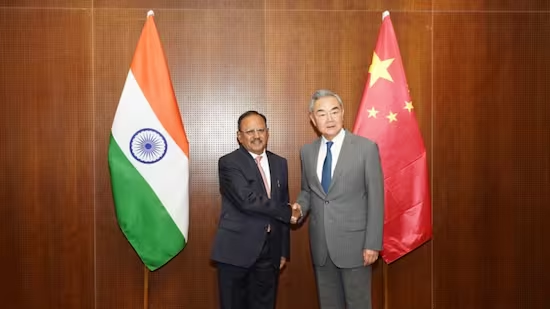
India’s National Security Advisor Ajit Doval met Chinese Vice President Han Zheng in Beijing on Tuesday as New Delhi and Beijing stepped up diplomatic engagement aimed at maintaining peace along their disputed border and improving relations after years of tension.
Doval is in China for a two-day visit for the latest round of talks under the India-China Special Representatives mechanism. He is scheduled to hold boundary discussions with Chinese Foreign Minister Wang Yi, with the talks covering the long-running territorial dispute as well as issues affecting the broader relationship.
The timing of the visit gives the discussions added importance. The engagement comes ahead of the BRICS summit scheduled for September 12-13 in New Delhi, where Chinese President Xi Jinping is expected to visit India and could meet Prime Minister Narendra Modi.
For New Delhi and Beijing, the immediate objective is not simply to resolve the boundary dispute, a goal that has remained elusive for decades. The more pressing task is to prevent fresh tensions along the frontier while creating enough political space for the two countries to gradually stabilise their relationship.
What Ajit Doval discussed with China’s Vice President
According to the Indian Embassy, Doval’s meeting with Han Zheng focused on strengthening peace and tranquillity in the border areas and taking steps to improve India-China Relations.
The discussions also covered wider bilateral engagement, including economic, political and multilateral issues. The emphasis reflects the understanding reached by the leaders of the two countries that maintaining stability along the border is an important foundation for improving the wider relationship.
The meeting was separate from Doval’s formal boundary negotiations with Wang Yi. Doval and Wang are the designated Special Representatives for the India-China boundary question, making their talks the principal structured diplomatic channel for addressing the dispute at this level.
The combination of meetings is significant. Doval’s discussion with China’s vice president provided a senior political-level engagement, while the talks with Wang focused specifically on the boundary mechanism and the broader strategic relationship.
Why the India-China boundary talks matter now
The India-China relationship has been under considerable strain since the 2020 Galwan Valley clash and the military stand-off that followed in eastern Ladakh.
The confrontation led to a prolonged deployment of troops along the Line of Actual Control and dramatically changed the atmosphere between the two countries. Although both sides have since taken steps to reduce tensions, the Border Dispute remains unresolved.
The situation has also affected cooperation in other areas. Political trust suffered, while Border Security became central to India’s assessment of its relationship with China.
Against that background, regular communication between senior officials has become important even when the two countries disagree on fundamental territorial questions.
The current Doval-Wang engagement therefore has a practical purpose. Keeping diplomatic channels open can help both governments manage disagreements, reduce the risk of miscalculation and discuss arrangements intended to preserve stability along the frontier.
What is the Special Representatives mechanism?
The Special Representatives mechanism was established in 2003 as a structured channel for addressing the India-China boundary dispute.
Doval represents India in the mechanism, while Wang Yi serves as China’s Special Representative. The process does not replace military-level communication or other diplomatic channels, but it provides a senior political framework for discussing the most difficult issue between the two countries.
The boundary question covers a disputed frontier extending roughly 3,488 kilometres. The two countries have never reached a final settlement of their territorial differences, making the dispute one of the most persistent challenges in their bilateral relationship.
Despite the absence of a final boundary settlement, officials on both sides continue to regard the Special Representatives mechanism as a useful forum for managing the dispute and discussing ways to prevent tensions from escalating.
China calls the talks a key channel for boundary negotiations
Chinese Foreign Ministry spokesperson Lin Jian said ahead of the meeting that the Special Representatives mechanism is the main channel for negotiations between China and India on the boundary question.
He also described it as an important platform for communication on issues of mutual interest.
According to Lin, the previous round of Special Representatives talks, held in August last year, involved candid and detailed exchanges on the boundary question and produced several common understandings.
Beijing’s description of the mechanism suggests that both governments continue to see senior-level diplomatic dialogue as necessary even though major differences remain.
For the current round, China said the two sides would continue communicating on the boundary question while working in accordance with understandings reached by their leaders. The stated objective is to jointly maintain peace and tranquillity in the border areas.
The talks are about more than the border
Although the boundary dispute is at the centre of Doval’s visit, the discussions are also expected to cover the wider India-China relationship.
China has said the Special Representatives will exchange views on bilateral relations as well as regional and international developments. That makes the meeting relevant beyond the immediate question of troop positions or border management.
India and China are major Asian economies and influential members of several multilateral groupings. Their relationship affects trade, regional security, diplomatic alignments and cooperation in international forums.
Improving communication could therefore have implications across multiple areas even if the fundamental boundary dispute remains unresolved.
Arunachal Pradesh remains a major point of friction
The boundary question is complicated by continuing differences over areas including Arunachal Pradesh.
India considers Arunachal Pradesh an integral part of the country, while China has repeatedly made claims over parts of the northeastern Indian state. The issue remains a recurring source of friction in bilateral relations.
For India, any effort to stabilise the border must therefore operate alongside its position on territorial sovereignty. Maintaining peace along the Line of Actual Control does not mean that New Delhi has abandoned its claims or accepted China’s position on disputed territories.
The distinction between border management and final boundary settlement is crucial. The first involves preventing confrontations and maintaining stability along a disputed frontier. The second would require an eventual political agreement resolving competing territorial claims.
The Special Representatives talks can contribute to the first objective even while the second remains difficult.
Why Xi Jinping’s expected India visit adds significance
Doval’s Beijing visit comes shortly before the BRICS summit in New Delhi, scheduled for September 12-13. Chinese President Xi Jinping is expected to Travel to India for the summit.
If Xi attends, the BRICS gathering could provide an opportunity for another meeting between the Chinese president and Prime Minister Narendra Modi.
The two leaders last met in August 2025 on the sidelines of the Shanghai Cooperation Organisation summit in Tianjin, according to the information provided for the talks.
A meeting between Modi and Xi would carry importance because high-level political engagement can help set the direction for negotiations conducted by officials on specific issues. It could also provide an opportunity to assess whether the recent efforts to stabilise relations can be expanded.
However, a leader-level meeting should not automatically be interpreted as evidence that the boundary dispute has been resolved. The two countries have substantial differences that cannot be removed through a single summit encounter.
From military confrontation to diplomatic stabilisation
The trajectory of India-China relations since 2020 explains why the current diplomatic engagement matters.
Following the Galwan clash and the prolonged stand-off in eastern Ladakh, the border became the dominant issue shaping bilateral ties. Both countries subsequently engaged in military and diplomatic discussions aimed at reducing tensions at various points along the frontier.
The gradual return of senior diplomatic engagement indicates an effort to prevent the border dispute from permanently defining every aspect of the relationship.
That does not mean the underlying security concerns have disappeared. Instead, the two governments appear to be pursuing a more controlled relationship in which disagreements can be managed through established channels.
This approach is particularly important because a disputed border involving large military deployments carries the risk of incidents escalating rapidly if communication breaks down.
What India wants from the current engagement
For India, maintaining peace and tranquillity along the border remains an essential condition for any meaningful improvement in bilateral ties.
New Delhi’s position has consistently linked the broader relationship with the need for stability along the frontier. The logic is straightforward: sustained tension at the border makes it considerably harder to rebuild political and economic trust elsewhere.
Doval’s role in the talks gives India A senior official with responsibility for national security and strategic affairs. His engagement with Wang therefore allows sensitive boundary issues to be discussed at a level above routine diplomatic consultations.
India’s immediate interest is likely to centre on maintaining stability, ensuring that established understandings are respected and keeping channels open for resolving disagreements before they become new confrontations.
What China wants from the talks
China’s public statements have similarly emphasised stability and continued communication.
By describing the Special Representatives mechanism as the main channel for boundary negotiations, Beijing is signalling the importance it places on keeping the established diplomatic framework functioning.
China has also linked the current discussions to broader bilateral, regional and international issues. This suggests that Beijing sees the relationship as extending beyond the border dispute and wants communication to continue across multiple areas.
However, public diplomatic language does not eliminate the underlying differences between the two sides. The boundary question remains unresolved, and both countries retain their respective positions on disputed territory.
What could happen next?
The immediate focus will be on the outcome of the Doval-Wang talks and whether the two sides can build on previous understandings regarding border stability.
The next important moment could come at the BRICS summit in New Delhi. If Xi Jinping and Narendra Modi meet, the leaders could review the progress made through diplomatic and security channels and provide broader political direction for the relationship.
The available developments suggest that the current emphasis is on stabilisation rather than a rapid settlement of the boundary dispute. That distinction is important. A final agreement on the frontier remains a much larger and more complicated objective than maintaining peace along it.
If diplomatic communication continues and both sides maintain mechanisms for dealing with disagreements, the relationship could gradually become more predictable. If border tensions rise again, however, progress in other areas could face renewed pressure.
Why Doval’s Beijing visit matters for India-China ties
Ajit Doval’s meetings in Beijing represent another effort by India and China to keep their most sensitive relationship issue within a structured diplomatic framework.
The significance lies less in the expectation of an immediate breakthrough and more in the effort to preserve communication after years of military tension.
The meeting with China’s vice president, followed by the Special Representatives talks with Wang Yi, brings together political and diplomatic channels at a crucial time. With the BRICS summit approaching and a possible Modi-Xi meeting on the horizon, both sides have an opportunity to reinforce the message that border stability remains essential to the wider relationship.
For India, the priority remains clear: peace along the border must accompany any meaningful effort to rebuild ties with China. For Beijing, keeping the diplomatic mechanism active provides a channel through which differences can be managed.
The latest engagement does not resolve the territorial dispute, but it does underline an important reality in India-China relations: when the boundary cannot be settled quickly, preventing the next crisis becomes an objective in its own right.
For breaking news and live news updates, like us on Facebook or follow us on Twitter and Instagram. Read more on Latest World on thefoxdaily.com.






COMMENTS 0