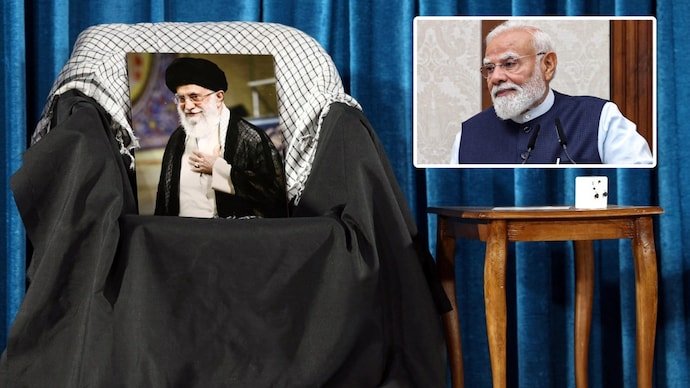
Diplomatic dilemmas rarely arrive with a formal invitation card. This one did.
Iran‘s decision to invite Prime Minister Narendra Modi to attend the state funeral of Ayatollah Ali Khamenei has placed New Delhi at the centre of a geopolitical balancing act that few countries would envy.
On paper, the decision should be straightforward. Nations routinely send representatives to state funerals as a gesture of respect and diplomatic continuity. But Khamenei was not an ordinary leader, and the circumstances surrounding his death are anything but ordinary.
Killed during a military confrontation involving Iran, Israel and the United States, Khamenei’s death has transformed what would normally be a ceremonial event into a geopolitical signal watched closely across Washington, Tehran, Jerusalem, Abu Dhabi and beyond.
For India, the question is no longer whether Iran matters. It does. The challenge is that Iran matters at a time when America’s strategic importance to India has never been greater and Israel remains one of New Delhi’s closest defence partners.
How India responds could offer important clues about the future direction of its Foreign Policy in an increasingly polarised world.
A Funeral That Has Become a Geopolitical Event
State funerals often serve as informal diplomatic summits. Leaders meet on the sidelines, alliances are reinforced and messages are sent without speeches ever being delivered.
But Khamenei’s funeral carries an additional layer of significance.
For nearly four decades, he stood at the centre of Iran’s political and religious establishment, shaping the country’s domestic governance, regional strategy and relationship with the wider world. His influence extended well beyond Iran’s borders, particularly among Shia communities across the Middle East and South Asia.
The circumstances of his death have ensured that attendance at the funeral will be interpreted not merely as a gesture of sympathy but as a statement of political positioning.
That is precisely why New Delhi’s decision has attracted such attention.
Why Iran Still Matters to India
Much has changed in global Geopolitics over the past decade, but Iran remains strategically important for India.
The most obvious reason is geography.
Iran sits at the crossroads of South Asia, Central Asia, the Middle East and Europe. For India, which has long sought greater access to Central Asian markets while bypassing Pakistan, Iran provides a critical gateway.
This strategic logic explains India’s continued investment in the Chabahar Port project.
Located on Iran’s southeastern coast, Chabahar is far more than a commercial venture. It is a cornerstone of India’s connectivity strategy, designed to link Indian trade routes with Afghanistan, Central Asia and potentially Europe.
While sanctions and regional instability have complicated progress, the project’s long-term significance remains unchanged.
Energy security also continues to shape India’s calculations.
Although India has diversified its oil imports in recent years, developments involving Iran still influence Energy Markets across the region. Any disruption near the Strait of Hormuz can have consequences for global oil prices, shipping costs and economic stability.
For a country that imports a significant portion of its energy needs, those realities cannot be ignored.
The Other Side of the Equation: America and Israel
If Iran is strategically important, the United States and Israel are equally critical to India’s long-term ambitions.
The United States has emerged as one of India’s most important partners across technology, defence, investment and advanced manufacturing.
From semiconductor cooperation and artificial intelligence initiatives to defence partnerships and Indo-Pacific security arrangements, India-US relations have expanded dramatically over the past two decades.
Meanwhile, Israel has become one of India’s most trusted defence suppliers.
Indian armed forces operate a wide range of Israeli-origin systems, including surveillance platforms, missile technologies and air defence equipment. Cooperation extends beyond defence into agriculture, water management and innovation.
This means that any decision involving Iran is no longer viewed in isolation.
Every diplomatic signal sent to Tehran is also observed carefully in Washington and Jerusalem.
That reality makes Khamenei’s funeral invitation far more complicated than a routine diplomatic engagement.
The Real Story: This Is Actually About Strategic Autonomy
Most discussions surrounding the funeral have focused on whether Prime Minister Modi will attend.
That may not be the most important question.
The bigger issue is whether India can continue pursuing its doctrine of strategic autonomy in an era when geopolitical rivalries are becoming sharper and global powers increasingly expect countries to take sides.
For decades, India has attempted to maintain productive relationships with competing powers simultaneously.
It buys weapons from Russia while expanding defence cooperation with the United States.
It works closely with Israel while maintaining strong relations with Arab nations.
It is a member of the Quad while also participating in BRICS.
This balancing strategy has become one of the defining features of modern Indian Diplomacy.
However, maintaining that balance becomes more difficult as geopolitical tensions intensify.
The Khamenei Funeral invitation is therefore not merely a question of protocol. It is a real-world test of whether India can continue navigating multiple power centres without becoming aligned with any single bloc.
History Suggests India Prefers Balance Over Symbolism
New Delhi has faced similar situations before.
When Iranian President Ebrahim Raisi died in a helicopter crash in 2024, India declared national mourning and sent senior-level representation to the funeral.
During the Russia-Ukraine conflict, India resisted pressure from multiple sides and maintained engagement with both Moscow and Western capitals.
Similarly, throughout periods of heightened tensions in West Asia, New Delhi has consistently advocated dialogue, restraint and diplomatic solutions rather than taking overtly partisan positions.
These precedents suggest that India values continuity and balance over dramatic symbolic gestures.
That approach has generally served the country well, allowing it to preserve relationships across competing geopolitical camps.
Why a Prime Ministerial Visit Appears Unlikely
While Iran’s invitation reflects the importance it attaches to its relationship with India, most diplomatic observers believe a visit by Prime Minister Modi remains unlikely.
The timing presents practical as well as strategic challenges.
Reports indicate that the Prime Minister may already be scheduled for international engagements during the same period. More importantly, a personal visit would inevitably attract global attention and could overshadow India’s carefully calibrated position on the broader regional conflict.
Instead, many analysts expect New Delhi to follow a familiar diplomatic formula: send a senior representative capable of conveying respect without fundamentally altering India’s broader geopolitical posture.
Such a move would allow India to acknowledge Iran’s importance while preserving flexibility in its relationships with other key partners.
The Chabahar Question Nobody Is Talking About
One aspect often overlooked in discussions surrounding the funeral is the future of Chabahar Port.
Regardless of who attends the funeral, the long-term trajectory of India-Iran relations may ultimately be shaped more by economic and strategic cooperation than by ceremonial diplomacy.
Connectivity projects, trade corridors and regional transport networks are likely to remain central to India’s calculations.
For New Delhi, preserving access to strategic infrastructure may prove far more important than the optics of funeral attendance.
In that sense, the real diplomatic work will begin after the funeral ceremonies conclude.
What India’s Decision Will Signal to the World
India’s response will be watched closely because it reflects a broader question facing many emerging powers.
Can countries maintain independent foreign policies in a world increasingly divided by competing geopolitical interests?
New Delhi has spent years building a reputation as a nation capable of engaging multiple rivals simultaneously. That reputation has become one of its greatest diplomatic assets.
The handling of the Khamenei funeral invitation will provide another indication of whether India can continue walking that tightrope successfully.
The answer matters not only for relations with Iran but also for India’s broader ambitions as a leading voice in a multipolar world.
Conclusion: A Diplomatic Tightrope With Global Implications
The invitation to Ayatollah Ali Khamenei’s funeral may appear to be a ceremonial matter, but its significance extends far beyond protocol.
It touches upon some of the most important questions facing Indian foreign policy today: how to maintain strategic autonomy, how to balance competing partnerships and how to navigate a rapidly changing geopolitical landscape without compromising national interests.
Iran remains important. So do the United States, Israel and the Gulf states. The challenge for New Delhi is ensuring that engagement with one does not come at the expense of the others.
India has managed similar balancing acts before, and it is likely to approach this one with the same caution and pragmatism that have increasingly defined its diplomacy.
Whatever decision ultimately emerges, the funeral invitation has already achieved one thing. It has highlighted the growing complexity of India’s role in world affairsand the increasingly difficult choices that come with being a rising Global Power.
For breaking news and live news updates, like us on Facebook or follow us on Twitter and Instagram. Read more on Latest India on thefoxdaily.com.



COMMENTS 0