- From Coastal Defense to Blue-Water Ambition
- Why Nuclear Propulsion Changes Everything
- Decoding the Signals: More Than Just Speculation
- The Technology Factor: Closing the Gap
- Global Comparison: Where China Stands
- Why This Matters for the Indo-Pacific
- The Bigger Picture: A Navy Built for the Future
- A Unique Insight: The “Psychological Deterrence” Factor
- What Comes Next?
- Conclusion: A Turning Point in Naval History
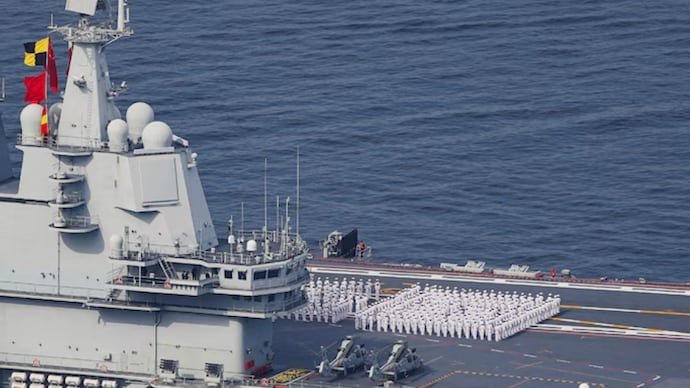
A quiet hint in a naval video has triggered loud questions across the Defense world. china, already home to the world’s largest navy by ship count, may now be stepping into a far more exclusive league: nations capable of operating nuclear-powered aircraft carriers. While no official confirmation has been issued, a mix of symbolism, industrial activity, and technological progress points in one direction Beijing is preparing for a new era of maritime power.
This development is not just about building a bigger ship. It’s about redefining how far, how long, and how effectively China can project power at sea. If realized, a nuclear-powered carrier would mark a turning point in global naval competition, particularly in regions like the Indo-Pacific where strategic tensions are already high.
So what exactly is happening, and why does it matter now more than ever?
From Coastal Defense to Blue-Water Ambition
To understand the significance of a nuclear-powered carrier, you have to look at how far China’s navy has come in a relatively short time.
Just over a decade ago, China’s first aircraft carrier was primarily a training platform a refurbished vessel designed to help the navy learn the basics of carrier operations. Today, the country operates multiple carriers, each more advanced than the last, and has demonstrated capabilities that were once limited to only a few global powers.
This progression isn’t accidental. It reflects a carefully planned strategy: move step-by-step from coastal defense toward a full-fledged “blue-water navy” one capable of operating across oceans, far beyond home territory.
Evolution in Motion
| Stage | Capability Shift | Strategic Meaning |
|---|---|---|
| Initial Carrier | Training and experimentation | Learning naval aviation basics |
| Second Carrier | Indigenous production | Reducing reliance on foreign designs |
| Third Carrier | Advanced launch systems | Closing technology gap with leading navies |
| Next Phase | Nuclear propulsion (speculated) | True global power projection |
The pattern is clear: each new carrier is not just an addition it’s a statement of intent.
Why Nuclear Propulsion Changes Everything
At first glance, the idea of a nuclear-powered ship might sound like a technical upgrade. In reality, it’s a strategic revolution.
Traditional carriers rely on conventional fuel, which limits how long they can stay at sea without resupply. A nuclear-powered carrier removes that limitation almost entirely. It can operate for years without refueling, constrained only by food supplies and crew endurance.
What This Means in Practice
- Persistent Presence: The ability to remain deployed in distant regions without frequent returns to port.
- Operational Flexibility: Faster response to crises across multiple theaters.
- Higher Combat Tempo: More power means more aircraft launches and sustained operations.
- Reduced Vulnerability: Less dependence on supply chains reduces exposure to disruption.
In essence, nuclear propulsion allows a navy to think globally rather than regionally. That’s the real shift.
Decoding the Signals: More Than Just Speculation
What makes the current discussion particularly compelling is the combination of cultural, visual, and technical clues pointing toward the same conclusion.
A recent navy film included a subtle but intriguing reference: a sequence involving multiple carriers, including one name that has not been officially announced. Linguistic interpretation suggests a possible connection to nuclear terminology a detail that might seem minor, but in highly curated official media, such elements are rarely accidental.
Meanwhile, independent observers tracking shipyard activity have noted the construction of a large vessel matching the scale of modern supercarriers. Some images have revealed structures that resemble components associated with nuclear reactors.
None of these clues alone provide confirmation. Together, however, they form a pattern that is difficult to ignore.
The Technology Factor: Closing the Gap
China’s third aircraft carrier already introduced a major technological milestone: electromagnetic aircraft launch systems. This system, used by only the most advanced navies, allows for smoother, more efficient aircraft launches compared to traditional methods.
Why does this matter?
Because electromagnetic systems require immense amounts of power something nuclear propulsion provides in abundance. The combination of these technologies is not coincidental. It suggests that China is aligning its carrier design with future operational needs.
In other words, the groundwork for a nuclear-powered fleet may already be in place.
Global Comparison: Where China Stands
Despite its rapid progress, China is still catching up in certain areas. The United States, for example, operates a fleet of nuclear-powered carriers and has decades of operational experience.
However, the gap is narrowing not necessarily in numbers, but in capability and ambition.
Key Differences Today
- Experience: Established navies have longer histories of carrier operations.
- Technology Integration: China is rapidly adopting cutting-edge systems.
- Fleet Strategy: China appears focused on regional dominance evolving into global reach.
The real question is not whether China matches existing powers today, but how quickly it could do so tomorrow.
Why This Matters for the Indo-Pacific
The implications of a nuclear-powered Chinese carrier are especially significant for the Indo-Pacific region.
This region is already a focal point of global trade and geopolitical competition. A carrier with extended range and endurance could operate more frequently in critical sea lanes, from the South China Sea to the Indian Ocean.
For neighboring countries, this means adapting to a more persistent and capable naval presence.
Potential Regional Impacts
- Increased Naval Activity: More frequent deployments in strategic waters.
- Shift in Power Balance: Greater competition among regional navies.
- Strategic Recalibration: Countries may invest more in maritime defense capabilities.
Even commercial shipping routes could feel indirect effects, as Security dynamics evolve.
The Bigger Picture: A Navy Built for the Future
China’s naval expansion is not happening in isolation. It’s part of a broader vision that includes securing trade routes, protecting overseas interests, and strengthening geopolitical influence.
A nuclear-powered carrier fits perfectly into this vision. It acts as both a military asset and a strategic symbol a visible demonstration of technological and industrial capability.
But there’s also a practical dimension. As China’s global economic footprint grows, so does the need to safeguard it. A navy capable of sustained global operations becomes not just desirable, but necessary.
A Unique Insight: The “Psychological Deterrence” Factor
One often overlooked aspect of aircraft carriers is their psychological impact.
A nuclear-powered carrier is not just a tool of war it’s a message. Its presence alone can influence decisions, deter actions, and shape perceptions without a single shot being fired.
In that sense, the move toward nuclear propulsion is as much about perception as it is about capability. It signals confidence, ambition, and a willingness to operate on a global stage.
What Comes Next?
If China does launch a nuclear-powered carrier, the immediate impact will be symbolic but the long-term effects will be structural.
Naval strategies will evolve. Alliances may strengthen. Defense spending could increase. And the concept of maritime dominance may shift from static presence to dynamic, global mobility.
It’s also likely that China will not stop at one. Historically, major naval powers build carriers in groups, creating fleets that can rotate deployments and maintain constant presence.
Conclusion: A Turning Point in Naval History
China’s potential move toward a nuclear-powered aircraft carrier represents more than just another milestone it marks a possible turning point in modern naval History.
From a single refurbished vessel to a cutting-edge fleet, the country’s progress has been both rapid and deliberate. A nuclear-powered carrier would complete a transformation from regional naval force to global maritime player.
The world is watching closely, not just for confirmation, but for what comes after. Because once the threshold is crossed, the rules of the game don’t just change they expand.
Future Outlook: Whether officially confirmed tomorrow or years from now, the trajectory is clear. China is building a navy designed not just for today’s challenges, but for tomorrow’s global stage. And if nuclear propulsion becomes part of that equation, the ripple effects will be felt far beyond the oceans.
For breaking news and live news updates, like us on Facebook or follow us on Twitter and Instagram. Read more on Latest World on thefoxdaily.com.





COMMENTS 0