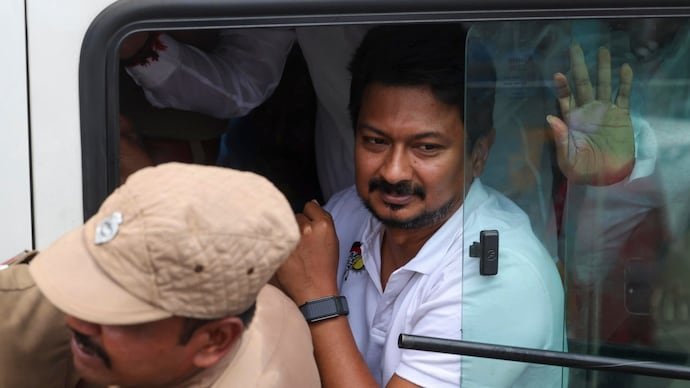
DMK leader and Tamil Nadu Leader of the Opposition Udhayanidhi Stalin has accused the ruling TVK government of subjecting him to excessive police action after he was detained in connection with a case over his alleged remarks during a public meeting. Speaking after being released on station bail, Stalin denied making any derogatory comments about women, described the case as politically motivated and alleged that authorities treated him “like a terrorist” despite the government’s earlier statement in court that it did not intend to arrest him.
The episode has intensified the political confrontation between the Dravida Munnetra Kazhagam (DMK) and the ruling Tamilaga Vettri Kazhagam (TVK), with both sides presenting sharply different interpretations of the Controversy. While complainants claim Stalin’s remarks indirectly referred to actor Trisha and offended the dignity of a woman, the DMK leader insists his speech has been taken out of context and misrepresented.
The case has also drawn attention to questions about political rhetoric, the handling of criminal complaints involving public figures and the broader debate over freedom of political speech versus accountability for allegedly offensive remarks.
Why Was Udhayanidhi Stalin Detained?
The case stems from a speech delivered by Udhayanidhi Stalin during a DMK protest over the Cauvery issue in Thanjavur.
Following the event, complaints were lodged by leaders of the ruling TVK, alleging that Stalin made a “double-meaning” remark that indirectly referred to actor Trisha, who is widely regarded as being close to actor-turned-Chief Minister Vijay.
According to the complainants, the alleged remarks outraged the modesty of a woman and warranted legal action.
Based on these complaints, police registered a case and later detained Stalin for questioning before releasing him on station bail after interrogation at the Sengipatti Police Station.
Authorities have not publicly stated that the allegations have been proven, and the matter remains subject to legal proceedings.
Stalin Alleges Excessive Police Action
Addressing reporters after his release, Stalin strongly criticized the manner in which the police handled the case.
He claimed that the Tamil Nadu government had informed the Madras High Court that it had no intention of arresting him, yet police subsequently took him into custody for questioning.
According to Stalin, nearly 3,000 police personnel were deployed during the operation, and he was transported by road from Chennai to Thanjavur.
Describing the experience, he said he was treated “like a terrorist,” arguing that such extensive police deployment was unnecessary given the nature of the allegations.
He further alleged that instead of being taken directly to Thanjavur, he was first brought to the Sengipatti Police Station, where he was questioned for several hours before eventually being released on station bail.
Government’s Position Before the Madras High Court
One of Stalin’s central criticisms concerns what he described as a contradiction between the government’s legal submissions and the subsequent police action.
According to his account, the government’s counsel informed the Madras High Court that there was no intention to arrest him.
Stalin argues that his later detention for questioning was inconsistent with that position, although the authorities have not publicly responded in the provided material to his allegation regarding the sequence of events.
The legal proceedings surrounding the case are expected to continue independently of the political statements made by either side.
DMK Leader Denies Making Derogatory Remarks
Rejecting the accusations against him, Stalin maintained that he neither intended nor attempted to insult women.
He said his comments had been misunderstood and insisted that he never made the statements attributed to him by his critics.
During his press conference, Stalin emphasized that he had no intention of speaking about women in a derogatory manner or diminishing their dignity.
He also stressed that respect for women has always been an important personal principle, referring to members of his own family while rejecting suggestions that he would intentionally make offensive remarks.
According to Stalin, the allegations are based on an incorrect interpretation of his speech rather than what he actually said.
Political Motivation Alleged by Stalin
The DMK leader described the case as politically motivated, accusing the ruling government of attempting to divert public attention from other issues.
He claimed the controversy had been created around statements that he never made and alleged that the legal action formed part of a broader political strategy.
These allegations represent Stalin’s political position. The government has not, in the provided material, responded to his claim that the case was filed for political reasons.
Political disputes involving criminal complaints are not uncommon in Indian Politics, particularly when prominent opposition leaders and ruling parties are engaged in intense public rivalry. Whether such claims are ultimately substantiated depends on the evidence presented through the legal process.
How the Complaint Against Stalin Originated
The complaint was filed after Stalin addressed a DMK protest linked to the Cauvery issue in Thanjavur.
TVK leaders alleged that remarks made during the speech indirectly referred to actor Trisha and constituted an offensive statement against a woman.
These allegations formed the basis for registering the criminal case.
Stalin has consistently denied that interpretation, saying his speech has been selectively presented and taken out of context.
The dispute therefore centers not only on what was said but also on how those remarks should be interpreted.
Criticism of Political Opponents
Stalin also expressed disappointment with political leaders who criticized him following the controversy.
According to him, several leaders publicly condemned his remarks without first listening to his complete speech.
He said this criticism had caused him personal disappointment because he believes his words have been misrepresented.
The episode illustrates how political speeches are often rapidly debated in the public arena, with differing interpretations emerging before legal proceedings establish the facts surrounding a complaint.
Understanding Station Bail
After questioning at the Sengipatti Police Station, Stalin was released on station bail.
Station bail is a legal mechanism under which an accused person may be released by the police, subject to applicable legal procedures, instead of being kept in custody. It does not determine guilt or innocence and allows the Investigation to continue while the accused remains at liberty.
The grant of station bail should not be interpreted as a conclusion regarding the merits of the allegations.
Timeline of the Case
| Event | Development |
|---|---|
| DMK protest in Thanjavur | Udhayanidhi Stalin delivers a speech during a protest over the Cauvery issue. |
| Complaints filed | TVK leaders allege the remarks indirectly referred to actor Trisha and insulted a woman. |
| Police action | A case is registered and Stalin is detained for questioning. |
| Questioning | He is questioned at Sengipatti Police Station. |
| Release | Stalin is released on station bail and later addresses the media. |
Political Significance of the Controversy
The dispute has become more than a legal matter because it involves senior political figures from Tamil Nadu’s two major political camps.
For the ruling TVK, the case reflects allegations that an opposition leader made objectionable remarks deserving investigation.
For the DMK, the detention has become an opportunity to criticize the government’s handling of law enforcement and to argue that criminal proceedings are being used against political opponents.
Such contrasting narratives are common in politically sensitive cases, where legal proceedings and political messaging often unfold simultaneously.
The Role of Public Statements in Ongoing Legal Cases
Public comments by political leaders can significantly shape public perception before courts examine the evidence in detail.
In this case, both the allegations and Stalin’s denials have attracted widespread attention because of the prominence of the individuals involved.
However, allegations made in complaints do not amount to proof of wrongdoing. Likewise, political statements defending one’s actions do not determine the legal outcome.
The investigation and any subsequent court proceedings remain the appropriate forums for evaluating the evidence surrounding the disputed remarks.
Freedom of Political Speech and Legal Accountability
The controversy also highlights the broader balance between robust political speech and legal protections against allegedly offensive or defamatory remarks.
Political speeches often attract scrutiny, particularly when they involve public figures or comments that can be interpreted in different ways. When complaints are filed, investigators must determine whether the available evidence supports the allegations under applicable law.
At the same time, opposition leaders frequently argue that legal complaints should not be used to suppress legitimate political criticism. Whether a case reflects genuine legal concerns or political rivalry depends on the facts established through due process.
What Could Happen Next?
The next stage of the matter will likely focus on the ongoing legal investigation into the complaint registered against Udhayanidhi Stalin.
Authorities may continue gathering evidence, reviewing recordings of the speech and examining the circumstances surrounding the allegations. Any further legal action will depend on the findings of the investigation and subsequent judicial proceedings.
Politically, the controversy is expected to remain a point of confrontation between the DMK and the ruling TVK, with both parties likely to continue defending their respective positions in public.
For now, the key facts remain that a case has been registered, Stalin has denied wrongdoing, he has been questioned and released on station bail, and the legal process will determine how the matter proceeds. Until then, the allegations remain subject to judicial examination rather than established findings of fact.
For breaking news and live news updates, like us on Facebook or follow us on Twitter and Instagram. Read more on Latest India on thefoxdaily.com.





COMMENTS 0