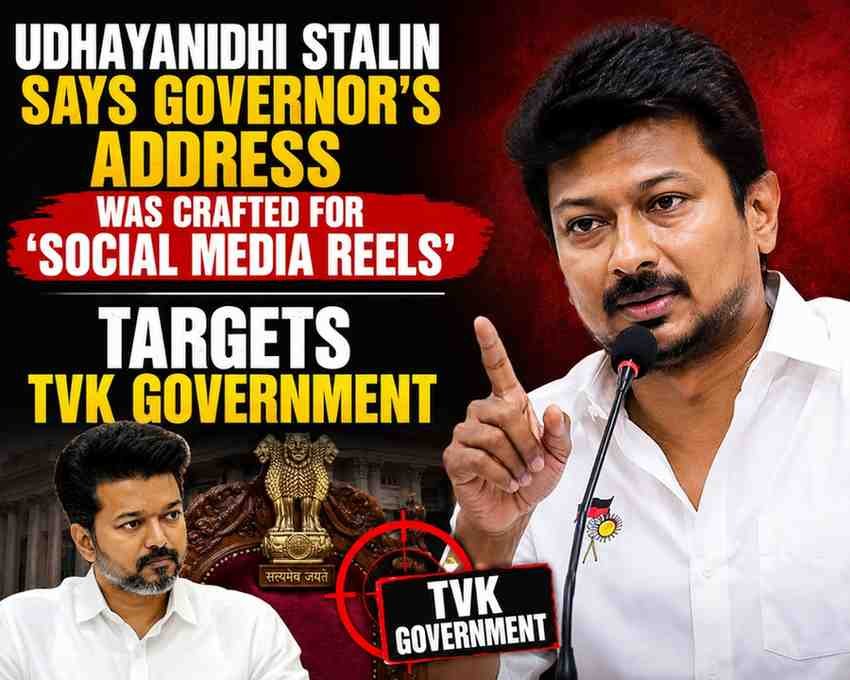
Tamil Nadu politics witnessed another sharp exchange after Opposition leader Udhayanidhi Stalin criticized the Governor’s address, claiming it was designed to generate social media clips rather than serve as a serious statement of governance.
According to Udhayanidhi, the address appeared intended to help Chief Minister C. Joseph Vijay and the ruling Tamilaga Vettri Kazhagam (TVK) showcase achievements and create viral content, rather than present a comprehensive roadmap for the State.
The remarks add to the increasingly combative political atmosphere in Tamil Nadu, where both the ruling party and the Opposition have sought to shape narratives not only inside the Assembly but also across digital platforms.
What Did Udhayanidhi Stalin Say?
The Opposition leader alleged that the Governor’s speech was structured to allow the Chief Minister to “blow his own trumpet” and focus on image-building.
According to him, the address lacked the seriousness traditionally associated with such constitutional occasions and instead emphasized promotional messaging that could be repackaged for social media audiences.
His comments reflect broader concerns often raised by Opposition parties regarding the increasing role of digital communication in modern politics.
Why the Governor’s Address Matters
The Governor’s address at the beginning of a legislative session is considered an important constitutional exercise. It outlines the government’s priorities, achievements, and legislative agenda for the coming period.
Typically, such speeches include:
- Economic priorities.
- Infrastructure projects.
- Welfare schemes.
- Legislative proposals.
- Long-term development goals.
Because the speech reflects the government’s policy direction, it often becomes a focal point for political debate.
The Rise of Social Media Politics
Udhayanidhi Stalin’s criticism highlights a larger transformation occurring across Indian politics. Social media platforms have increasingly become central tools for political communication.
Parties now design campaigns and messaging with digital audiences in mind, recognizing that short video clips and viral moments can shape public perception.
This shift has changed how politicians communicate with voters, emphasizing:
- Visual storytelling.
- Short-form videos.
- Instant engagement.
- Personality-driven campaigns.
- Rapid response to controversies.
Supporters argue that these platforms help leaders connect directly with citizens, while critics contend that they sometimes prioritize optics over substance.
| Traditional Political Communication | Social Media Era Politics |
|---|---|
| Long speeches and policy documents | Short clips and reels |
| Assembly debates | Digital engagement |
| Newspaper coverage | Instant viral content |
| Party manifestos | Personality-driven messaging |
| Detailed explanations | Simplified narratives |
An Overlooked Shift: Politics Has Become Performance-Oriented
Political analysts note that modern politics increasingly operates in a media ecosystem driven by attention. Leaders are expected not only to govern but also to communicate constantly across multiple platforms.
This environment often rewards memorable moments over lengthy policy discussions.
As a result, critics argue that speeches and public events are sometimes tailored to maximize online engagement rather than encourage deeper debate.
Supporters, however, maintain that adapting to new communication tools is necessary in an era where citizens consume information differently.
TVK’s Communication Strategy Under Scrutiny
Since assuming office, the TVK government under Chief Minister C. Joseph Vijay has attracted attention for its emphasis on public outreach and digital engagement.
Political observers note that the party has effectively used social media to connect with younger voters and amplify its message.
However, this strategy has also made it vulnerable to accusations that image management sometimes overshadows governance.
Udhayanidhi Stalin’s remarks appear aimed at challenging this narrative and portraying the government as more focused on publicity than policy.
Why Political Messaging Is Evolving
The growth of smartphones and social media has transformed voter engagement.
Today’s political communication increasingly relies on:
- Video-based content.
- Influencer-style messaging.
- Real-time updates.
- Emotional storytelling.
- Shareable digital moments.
This evolution is not unique to Tamil Nadu but reflects broader trends across India and the world.
The Bigger Question: Substance vs. Optics
The controversy raises a larger question about contemporary democracy: how should governments balance effective communication with detailed policymaking?
Public outreach is an essential part of governance, but critics argue that governance should ultimately be judged by implementation and outcomes rather than presentation.
Supporters counter that communicating achievements effectively is itself a vital responsibility in a digital age.
The debate between substance and optics is likely to remain central to modern politics.
Conclusion
Udhayanidhi Stalin’s criticism of the Governor’s address as content designed for social media reels reflects the growing importance of digital communication in Indian politics. While the TVK government may view outreach and visibility as strengths, the Opposition sees them as signs of excessive focus on image-building.
As political battles increasingly unfold both inside legislative chambers and across smartphone screens, the challenge for governments will be ensuring that viral moments are accompanied by meaningful governance and long-term policy vision.
For breaking news and live news updates, like us on Facebook or follow us on Twitter and Instagram. Read more on Latest Entertainment on thefoxdaily.com.




COMMENTS 0