- Why Pawan Kalyan Felt the Need to Respond
- The Big Difference Between Tamil Nadu and Andhra Pradesh Politics
- The Shadow of NTR and the Legacy of Telugu Political Cinema
- Why Jana Sena Chose Alliance Politics
- Why Vijay’s Success Was Politically Unique
- The Cinema-Politics Relationship in South India
- Pawan Kalyan’s Ideology Argument
- The BJP Factor in Andhra Politics
- What This Means for Regional Politics in India
- Could Jana Sena Eventually Contest Alone?
- Conclusion
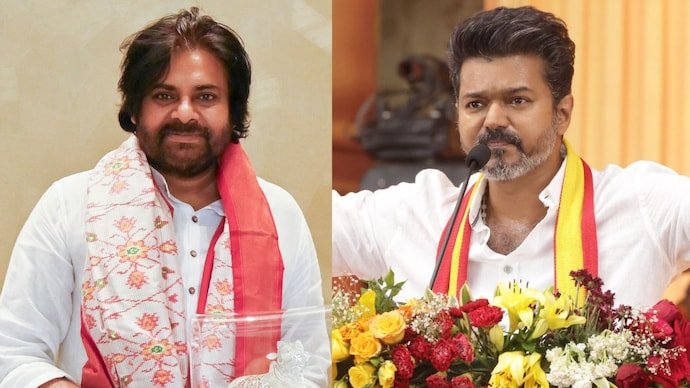
Andhra Pradesh Deputy Chief Minister and Jana Sena Party chief Pawan Kalyan has finally addressed the comparison that has dominated political discussions across South India in recent weeks: why did actor-turned-politician Vijay rise to power so quickly in Tamil Nadu while Jana Sena chose alliance Politics in Andhra Pradesh?
Speaking to party workers in Mangalagiri, Pawan Kalyan argued that the political conditions of Andhra Pradesh and Tamil Nadu are fundamentally different and cannot be compared through a simplistic “star power” lens.
His remarks come at a politically sensitive moment. Vijay’s dramatic electoral success in Tamil Nadu has reshaped conversations about celebrity politics in India, especially in the South, where cinema and politics have historically shared a uniquely powerful relationship.
But beneath the surface-level comparisons between two actor-politicians lies a much deeper story — one involving political culture, caste arithmetic, alliance systems, regional identity, anti-incumbency patterns, and the evolving nature of South Indian electoral politics.
Why Pawan Kalyan Felt the Need to Respond
The trigger for the discussion was Vijay’s stunning political debut in Tamil Nadu through Tamilaga Vettri Kazhagam (TVK), which emerged as the single-largest party in the state Assembly.
For many Jana Sena supporters, Vijay’s rapid ascent naturally raised uncomfortable questions:
- Why did Jana Sena not contest independently?
- Why align with the TDP and BJP?
- Could Pawan Kalyan have become Chief Minister by pursuing a solo path?
- Did alliance politics limit Jana Sena’s growth?
Pawan Kalyan’s response was effectively an attempt to explain that electoral success depends not only on popularity, but also on political timing and regional conditions.
His core argument was simple: Tamil Nadu’s political ecosystem is structurally different from Andhra Pradesh’s.
The Big Difference Between Tamil Nadu and Andhra Pradesh Politics
At first glance, both states appear similar.
Both have:
- Strong regional identities
- Massive film industries
- Long histories of actor-politicians
- Emotion-driven political campaigns
- Charismatic leadership cultures
But beneath those similarities, the political dynamics are very different.
| Tamil Nadu Politics | Andhra Pradesh Politics |
|---|---|
| Dominated by Dravidian ideology for decades | Dominated by caste and regional alliance structures |
| Strong anti-national party tradition | More coalition-friendly political culture |
| Cinema-politics connection deeply institutionalized | Star power matters, but alliances are often decisive |
| Frequent space for anti-establishment waves | Highly polarized between major regional forces |
| Political branding heavily personality-driven | Electoral machinery and cadre networks matter more |
In Tamil Nadu, political transitions driven by charismatic personalities have historical precedent. Leaders like M.G. Ramachandran, J. Jayalalithaa, and M. Karunanidhi shaped a political culture where mass emotional appeal often became the defining electoral currency.
Andhra Pradesh, by contrast, operates through a more layered political structure involving regional calculations, caste alignments, welfare politics, and organizational strength.
That is the context Pawan Kalyan was attempting to emphasize.
The Shadow of NTR and the Legacy of Telugu Political Cinema
Pawan Kalyan’s remarks about watching the political journey of N.T. Rama Rao were especially important.
NTR remains the gold standard for actor-politicians in Telugu politics.
When NTR launched the Telugu Desam Party in 1982, he transformed Andhra politics almost overnight by combining Telugu regional pride with cinematic charisma.
However, political conditions then were radically different:
- The Congress dominated Andhra Pradesh
- There was growing resentment toward central control
- Regional identity politics was surging
- Television media was limited
- Political alternatives were fewer
NTR successfully positioned himself as the embodiment of Telugu self-respect.
Modern Andhra politics is far more fragmented and competitive.
Pawan Kalyan appears to recognize that recreating an NTR-style independent political wave today is significantly harder.
Why Jana Sena Chose Alliance Politics
Pawan Kalyan defended the alliance with the TDP and BJP as a strategic necessity rather than a compromise born out of weakness.
His comments suggest three major reasons behind the decision:
1. Preventing Vote Splitting
In Andhra Pradesh’s highly polarized environment, opposition fragmentation can dramatically benefit the ruling party.
By aligning with the TDP and BJP, Jana Sena helped consolidate anti-incumbency sentiment.
2. Political Stability
Pawan Kalyan repeatedly emphasized “stability” in his remarks.
This indicates he viewed coalition-building as necessary during a politically volatile period following the arrest of Chandrababu Naidu.
3. Long-Term Party Building
Unlike a personality-driven electoral gamble, alliances allow smaller parties to gradually expand organizational networks while remaining electorally relevant.
For Jana Sena, this may represent a long-term growth strategy rather than a short-term surrender.
Why Vijay’s Success Was Politically Unique
While comparisons between Vijay and Pawan Kalyan are inevitable because both emerged from cinema, Vijay’s political rise occurred under unusually favorable circumstances.
Several factors contributed to TVK’s rapid breakthrough:
- Public fatigue with traditional Dravidian parties
- Fragmentation within opposition camps
- Vijay’s massive youth following
- Strong anti-establishment sentiment
- Carefully controlled political messaging
- Tamil Nadu’s long history of accepting actor-politicians
Most importantly, Vijay entered politics at a moment when Tamil Nadu voters appeared more open to disruption.
Political timing matters enormously.
Charisma alone rarely guarantees electoral success.
Even globally, outsider political movements succeed only when public dissatisfaction aligns with a credible alternative narrative.
The Cinema-Politics Relationship in South India
The comparison between Vijay and Pawan Kalyan also reflects a broader phenomenon unique to South India: the extraordinary overlap between cinema and politics.
In few regions of the world do film stars transition into political leadership as successfully and repeatedly as they do in southern India.
This phenomenon exists because cinema in South India historically functions as more than entertainment.
Film stars often become:
- Cultural symbols
- Political messengers
- Social icons
- Regional identity figures
- Emotional connection points for voters
Fan clubs frequently evolve into grassroots political networks.
However, the relationship is changing.
Modern voters increasingly demand:
- Administrative credibility
- Economic vision
- Governance capability
- Welfare delivery
- Policy clarity
Star power still matters enormously, but it no longer guarantees automatic political dominance.
Pawan Kalyan’s Ideology Argument
One of the most revealing parts of Pawan Kalyan’s speech was his emphasis on ideology over power.
He referred to:
- NTR’s influence
- The Naxalite era
- Youth sacrifice for political causes
- Social change as the purpose of politics
This was likely an attempt to distinguish Jana Sena from purely personality-centric political projects.
Pawan Kalyan appears eager to frame himself not merely as an actor seeking office, but as someone motivated by political philosophy and systemic reform.
Whether voters fully accept that framing is another question, but it represents an important strategic positioning effort.
The BJP Factor in Andhra Politics
The BJP’s presence in the alliance also matters.
Unlike Tamil Nadu, where national parties historically struggle to dominate state politics independently, Andhra Pradesh’s coalition environment allows greater flexibility.
The BJP may not currently be the central electoral force in Andhra, but its national influence, resources, and organizational network still make it a valuable alliance partner.
Pawan Kalyan’s alignment with the BJP also reflects a broader trend where regional parties increasingly balance local identity politics with national political realities.
What This Means for Regional Politics in India
The debate sparked by Vijay’s rise and Pawan Kalyan’s response reveals a larger shift happening in Indian politics.
Regional politics is entering a new phase where:
- Celebrity influence remains powerful
- Digital campaigning matters more than ever
- Youth-driven movements are growing
- Traditional party loyalties are weakening
- Alliance politics remains critical in many states
However, the lessons from Tamil Nadu may not automatically apply elsewhere.
India’s states operate almost like separate political ecosystems.
A strategy successful in one state can completely fail in another because of differences in:
- Language identity
- Caste dynamics
- Political history
- Economic conditions
- Regional narratives
Pawan Kalyan’s central point was essentially this: political formulas cannot simply be copied and pasted across states.
Could Jana Sena Eventually Contest Alone?
Despite defending alliances, Pawan Kalyan also acknowledged growing sentiment within Jana Sena for an independent political path.
That internal pressure is likely to continue.
Every regional party ultimately seeks independent expansion because alliances can limit long-term growth and leadership ambition.
The key question is timing.
Jana Sena may currently view coalition politics as strategically necessary while gradually strengthening its cadre base, voter penetration, and administrative credibility.
If the party expands significantly in future elections, demands for a solo contest could become much stronger.
Conclusion
Pawan Kalyan’s response to comparisons with Vijay’s meteoric rise was about far more than defending an electoral alliance.
It was a reflection of the deeper realities shaping South Indian politics today.
While both Tamil Nadu and Andhra Pradesh share strong traditions of actor-politicians, the political structures, voter expectations, and alliance dynamics in the two states are fundamentally different.
Vijay’s success in Tamil Nadu represents a unique political moment shaped by anti-establishment sentiment and the state’s distinctive political culture. Pawan Kalyan, meanwhile, appears to believe Andhra Pradesh requires a more cautious and coalition-oriented approach.
The comparison between the two leaders will likely continue for years. But the larger lesson may be that modern Indian politics no longer rewards charisma alone.
Today, electoral success increasingly depends on timing, alliances, organization, ideology, and the ability to adapt to highly localized political realities.
And as Pawan Kalyan’s remarks suggest, even the biggest film stars eventually discover that politics is a very different kind of script.
For breaking news and live news updates, like us on Facebook or follow us on Twitter and Instagram. Read more on Latest India on thefoxdaily.com.





COMMENTS 0