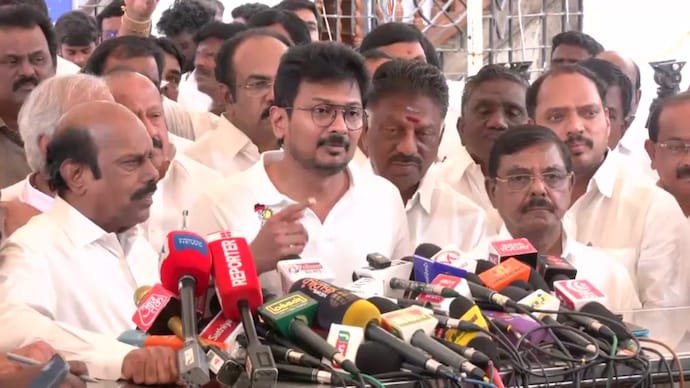
Tamil Nadu Leader of Opposition Udhayanidhi Stalin on Wednesday sharply criticised the Vijay-led Tamilaga Vettri Kazhagam (TVK) government’s Budget, awarding it what he described as a “big zero” and alleging that many of its flagship announcements were not new initiatives but Welfare Schemes introduced during the previous Dravida Munnetra Kazhagam (DMK) administration.
Addressing reporters after the Budget presentation, Udhayanidhi claimed that the government had failed to fulfil key election promises while taking credit for programmes launched under the earlier DMK government. His remarks came just a day after his arrest over comments related to actor Trisha, an episode he described as politically motivated and intended to divert public attention.
Why Udhayanidhi Stalin Rejected the Budget
The central focus of Udhayanidhi Stalin’s criticism was his allegation that the government had repackaged existing welfare programmes instead of introducing fresh policies.
According to him, the administration had changed the names of several schemes while leaving their core structure unchanged, allowing it to claim credit for initiatives that originated under the previous government.
Speaking to reporters, he questioned why committees and consultations were necessary if the outcome was simply the renaming of existing programmes rather than the introduction of new public welfare measures.
He also argued that voters were still waiting for the implementation of several election commitments made by the ruling party and said the Budget did not provide satisfactory answers on when those promises would be fulfilled.
Political Significance of the Budget Criticism
Budget sessions are among the most politically significant events in any state because they outline the government’s spending priorities, development agenda, and welfare commitments. They also provide opposition parties with an opportunity to evaluate whether campaign promises have translated into policy.
In this case, Udhayanidhi’s criticism was aimed not only at individual schemes but also at the broader narrative surrounding the government’s performance. By alleging that previously launched programmes had merely been renamed, he sought to challenge the administration’s claims of introducing new governance initiatives.
The ruling government has not, in the information available, publicly responded to these specific allegations.
What Does ‘Rebranding Government Schemes’ Mean?
Governments occasionally rename or restructure existing schemes after taking office. In some cases, programmes continue with expanded funding, revised eligibility, or altered implementation mechanisms. In other instances, only the branding changes while the underlying objectives remain largely the same.
Whether a scheme represents a genuinely new initiative or a continuation of an earlier programme often becomes a matter of political debate between the ruling party and the opposition.
In the present case, Udhayanidhi alleged that several announcements fell into the latter category. The information currently available does not independently verify which individual schemes, if any, were entirely new or substantially modified.
Election Promises Become a Fresh Political Flashpoint
Another major theme of Udhayanidhi’s criticism was the implementation of election promises.
He said the opposition had repeatedly asked the government when its campaign commitments would be fulfilled and argued that the Budget did not adequately address those expectations.
Election manifestos often serve as a benchmark against which governments are judged during their tenure. Opposition parties frequently compare Budget announcements with campaign promises to assess whether commitments have translated into policy decisions or budgetary allocations.
Udhayanidhi’s remarks reflect that broader political contest, with the opposition attempting to hold the government accountable for its pre-election assurances.
Budget Debate Overshadowed by Udhayanidhi’s Arrest
The Budget criticism came just one day after Udhayanidhi Stalin’s arrest in connection with remarks allegedly concerning actor Trisha.
Describing the arrest as a “diversionary tactic,” he alleged that the ruling government was attempting to shift public attention away from larger political issues.
According to Udhayanidhi, police officers entered his Chennai residence, took him into custody, and transported him by road to Thanjavur, where a case had been registered.
He maintained that the episode was politically motivated rather than a routine legal process.
Allegations of Political Targeting
During his interaction with the media, Udhayanidhi broadened his criticism beyond his own arrest.
He alleged that members of the DMK were being systematically targeted by the ruling administration, claiming that party legislators and workers were facing increasing pressure.
Among his allegations, he stated that DMK cadres had been arrested while opposition legislators were being subjected to political pressure.
These statements represent allegations made by Udhayanidhi Stalin. The information provided does not include the government’s response to these claims.
The Controversy Over the Trisha Remarks
Udhayanidhi was arrested over allegations that he made a “double-meaning” remark allegedly directed at actor Trisha.
He has firmly denied the allegation, maintaining that his comments were taken out of context.
According to his explanation, his speech focused exclusively on the need to secure Cauvery water for farmers in Tamil Nadu and did not contain any intention to insult women.
Following his release on bail pursuant to a court direction, he reiterated that portions of his speech had been selectively edited, leading to what he described as a misleading interpretation.
He also stated that he regarded every mother and sister in Tamil Nadu as members of his own family and rejected suggestions that he intended to make disrespectful remarks.
Claims About Police Deployment During His Transfer
Udhayanidhi further alleged that approximately 3,000 police personnel were deployed during his transfer from Chennai to Thanjavur.
He criticised the manner in which the authorities handled the operation, claiming that he had been treated “like a terrorist.”
The available information does not independently verify the scale of the police deployment described in his statement.
Support From DMK Workers and Alliance Leaders
After securing bail, Udhayanidhi thanked DMK workers and leaders of allied parties who staged Protests demanding his release.
He also called for the release of party supporters who had reportedly been detained during demonstrations linked to his arrest.
The protests added another political dimension to an already contentious week in Tamil Nadu, combining debate over the state’s Budget with disagreements surrounding law enforcement and political rhetoric.
Why the Budget Debate Matters
State Budgets are more than financial documents. They outline government priorities across sectors such as infrastructure, welfare, Agriculture, Education, Healthcare, and social development. Because of their significance, opposition parties often examine whether announced schemes represent new policy initiatives or continuations of earlier programmes.
Disputes over policy ownership are common in competitive politics. Governments may argue that they are improving or expanding existing programmes, while opposition parties may contend that previously established schemes are being presented as entirely new achievements.
For citizens, the more important question is often whether programmes continue to receive adequate funding, reach intended beneficiaries, and deliver measurable outcomes regardless of political branding.
Timeline of Recent Developments
| Event | Development |
|---|---|
| Remarks during public speech | Udhayanidhi’s comments became the subject of controversy over allegations of inappropriate remarks. |
| Arrest | Police arrested Udhayanidhi and transported him from Chennai to Thanjavur in connection with the registered case. |
| Bail granted | He was released on bail following a court direction and denied wrongdoing. |
| Budget presented | The Vijay-led government presented its Budget outlining policy priorities and schemes. |
| Opposition response | Udhayanidhi criticised the Budget, alleging that several announcements merely renamed schemes introduced by the previous DMK government. |
What Could Happen Next?
The political debate surrounding the Budget is likely to continue as the opposition examines individual schemes and compares them with earlier government programmes. Whether the allegations of rebranding gain wider traction may depend on detailed scrutiny of the Budget documents and subsequent responses from the ruling administration.
Separately, developments relating to the legal case against Udhayanidhi Stalin will continue through the judicial process. Any further political or legal developments are likely to shape public discussion in the coming weeks.
Broader Political Context
The latest exchange illustrates how Budget presentations often become central political battlegrounds, extending beyond financial allocations to questions of governance, accountability, and policy ownership. While the ruling government seeks to present its development agenda, the opposition aims to test whether those initiatives represent genuine policy innovation or continuity under a different name.
As the Budget debate progresses, the discussion is expected to focus not only on political claims but also on how individual schemes are implemented, funded, and experienced by the people they are intended to serve.
For breaking news and live news updates, like us on Facebook or follow us on Twitter and Instagram. Read more on Latest India on thefoxdaily.com.



COMMENTS 0