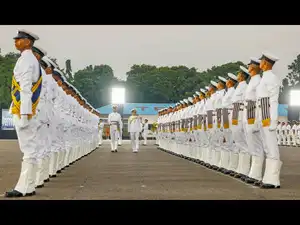
The Indian Navy has relaxed its marriage restrictions for Agniveers who complete their initial four-year service and choose to continue for an additional two years. Under the revised policy, eligible Agniveers opting for the extension can now get married after completing their training, removing a restriction that previously applied during their service period.
The policy change follows the Union Cabinet’s approval of the proposed Second Tour of Duty, which allows selected Agniveers to serve beyond the original four-year engagement. Those who opt for the additional two years will also receive higher remuneration during the extended service period.
The decision marks a change in the service conditions for Agniveers who choose to continue in the Navy after their initial engagement. It also reflects the evolving framework of the Agnipath recruitment scheme as the armed forces consider ways to retain trained personnel for longer periods.
Indian Navy Relaxes Marriage Rules for Agniveers Taking Two-Year Extension
Under the revised arrangement, Agniveers who complete four years of service and opt for the additional two-year extension will be permitted to marry after completing their training.
The relaxation is significant because marriage restrictions have been among the conditions associated with service under the Agnipath scheme. The revised provision gives eligible personnel greater flexibility in making personal and family-related decisions while continuing their military careers.
The change specifically concerns Agniveers who choose the extended service option. It should not be interpreted as an automatic relaxation for every recruit at the time of joining. The eligibility and timing of marriage will remain linked to the applicable service conditions and completion of training.
The revised policy also distinguishes between the initial four-year engagement and the additional period of service. Agniveers who leave after completing their original tenure and those who continue under the extension may therefore have different service conditions.
What Is the Second Tour of Duty for Agniveers?
The Second Tour of Duty is an extension mechanism that allows eligible Agniveers to continue serving for two additional years after completing their initial four-year engagement.
The arrangement follows the Union Cabinet’s approval of the extended service provision. It offers selected personnel an opportunity to remain in the armed forces beyond the original period, allowing the services to retain individuals who have already completed military training and gained operational experience.
Under the Agnipath scheme, recruits are initially enrolled for four years. At the end of this period, a portion of the personnel may be selected for regular service, while others exit according to the scheme’s existing provisions.
The additional two-year option introduces another route for eligible personnel who want to continue serving. It could also help the armed forces retain trained manpower for longer without changing the basic four-year structure of the Agnipath programme.
Extended Agniveers to Receive Higher Remuneration
Apart from the marriage-rule relaxation, Agniveers choosing the additional two years will receive increased remuneration during their extended service.
The higher pay is an important part of the revised arrangement because personnel continuing beyond their initial engagement will be contributing additional years of service and experience. Improved remuneration may also make the extension more attractive to those considering whether to remain in uniform.
However, the available details do not specify the revised salary structure, the exact increase in monthly pay or the detailed eligibility criteria for the extension. Agniveers will need to refer to the Navy’s official instructions for the applicable terms.
Could the Indian Army and Air Force Also Relax Their Rules?
The Indian Navy’s decision has also raised the possibility of similar changes in the other two services. Comparable provisions may be introduced by the Indian Army and the Indian Air Force as the armed forces implement the broader Second Tour of Duty framework.
However, the available information does not confirm that the Army and Air Force have already adopted identical marriage-rule relaxations. Their respective service headquarters would need to issue applicable instructions before any such changes could be treated as official policy.
If similar provisions are introduced across all three services, the changes could create a more consistent framework for Agniveers choosing to extend their military careers.
What the Change Means for Agniveers
The revised marriage provision gives eligible Navy Agniveers opting for the two-year extension greater flexibility over an important personal decision. Combined with higher remuneration, it makes the extended service option different from the original four-year engagement.
For the Navy, the arrangement provides an opportunity to retain personnel who have already undergone training and gained experience. For Agniveers, it offers a longer period of service with revised conditions and the possibility of planning personal milestones while continuing their military responsibilities.
The key point is that the relaxation applies to eligible Agniveers who choose the additional two-year service and complete their training. It does not automatically change the marriage rules for all personnel recruited under the Agnipath scheme.
For breaking news and live news updates, like us on Facebook or follow us on Twitter and Instagram. Read more on Latest India on thefoxdaily.com.






COMMENTS 0