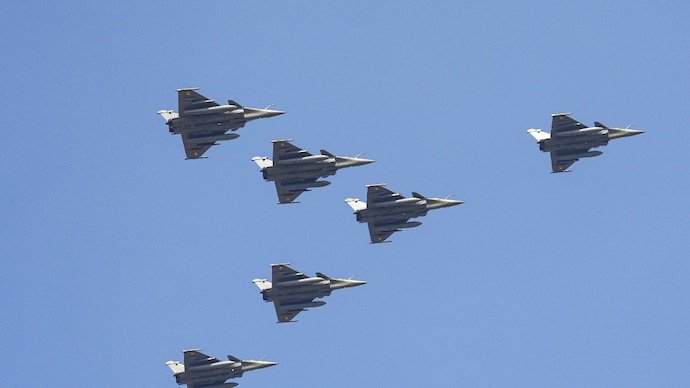
The Controversy surrounding Pakistan’s repeated claims that India lost multiple Rafale fighter jets during Operation Sindoor has resurfaced after an official Indian Air Force (IAF) document appeared to contradict those assertions in a significant way. A recently issued Request for Proposal (RFP) from Air Headquarters seeks bridge support for all 36 Rafale aircraft currently serving in the IAF, reinforcing India’s position that its entire fleet remains intact.
The development is important not only because it challenges a narrative promoted by Pakistan since Operation Sindoor, but also because it highlights the strategic importance of the Rafale fleet within India’s evolving air power doctrine. At a time when South Asia remains one of the world’s most heavily militarized regions, questions surrounding fighter aircraft inventories, operational readiness, and military credibility carry enormous geopolitical significance.
Why the Rafale Fleet Matters to India’s Defence Strategy
The Rafale is widely regarded as one of the most advanced multi-role fighter aircraft currently in operation. Manufactured by France’s Dassault Aviation, the aircraft was acquired by India under a government-to-government agreement signed in 2016.
India purchased 36 Rafale fighter jets to strengthen its air combat capabilities amid growing security challenges along both its western and northern borders. The induction of the aircraft significantly enhanced the Indian Air Force’s ability to conduct precision strikes, air superiority missions, reconnaissance operations, and long-range combat engagements.
Unlike many legacy platforms, Rafale combines advanced avionics, electronic warfare systems, beyond-visual-range combat capabilities, and precision-guided strike technology into a single platform.
For India, the aircraft serves as a critical force multiplier.
What the New IAF Document Reveals
The latest Air Headquarters tender seeks maintenance, logistics, and technical support for all 36 Rafale aircraft for a period extending beyond September 2026.
The bridge support arrangement is intended to ensure uninterrupted operational readiness while a longer-term maintenance agreement is finalized. According to details contained in the proposal, the support package covers approximately 2,250 planned flying hours over a five-month period.
The key detail attracting attention is straightforward: the document explicitly references all 36 Rafale aircraft.
If India had indeed suffered the loss of multiple Rafale fighters during Operation Sindoor, as claimed by Pakistan, the fleet size reflected in official maintenance planning would likely have shown a reduced number.
Instead, the support requirement matches the full complement originally acquired from France.
Operation Sindoor and the Origins of the Rafale Debate
Operation Sindoor emerged as one of India’s most closely watched military operations in recent years. Conducted in response to the Pahalgam terror attack, the operation involved precision strikes against terrorist Infrastructure and strategic targets linked to hostile networks operating from Pakistani territory.
During and after the operation, Pakistan launched a coordinated information campaign claiming that several Indian fighter aircraft, including Rafales, had been shot down.
These claims spread rapidly across Social Media platforms, state-backed media outlets, and various online networks.
However, Pakistan never publicly released independently verifiable evidence proving the destruction of multiple Rafale aircraft.
India consistently rejected the allegations, describing them as disinformation intended to undermine the perceived success of the operation.
The Role of Information Warfare in Modern Conflicts
The Rafale controversy illustrates how modern military conflicts increasingly extend beyond the battlefield into the information domain.
Today, governments often attempt to shape public perception through narratives that can influence domestic audiences, international observers, and even financial markets.
Military victories are no longer measured solely by territory gained or targets destroyed. Control of the information space has become equally important.
In recent conflicts around the world, competing claims regarding aircraft losses, missile interceptions, battlefield successes, and casualty figures have frequently become as important as the actual military engagements themselves.
For this reason, official documents, procurement records, maintenance contracts, and satellite imagery often become critical tools for verifying claims.
Previous Evidence Had Already Raised Doubts
The latest tender is not the first piece of evidence challenging Pakistan’s narrative.
Following Operation Sindoor, several Rafale aircraft whose tail numbers had been circulated online as supposedly destroyed later appeared in operational photographs and official footage.
Defence analysts pointed out that aircraft allegedly claimed as losses were subsequently observed participating in routine flying activities.
This created significant credibility issues for the claims being made.
The new maintenance tender strengthens that body of evidence by providing an official administrative record linked directly to fleet management and operational planning.
How Military Logistics Often Reveal the Truth
One of the lesser-discussed aspects of defence reporting is the importance of logistics documentation.
Military organizations cannot maintain fictional fleet sizes because procurement planning, maintenance schedules, spare parts requirements, and flight-hour projections must reflect operational realities.
Large support contracts are based on actual aircraft inventories.
Any substantial discrepancy between fleet strength and maintenance planning would quickly create budgeting, Supply Chain, and operational challenges.
This is why defence experts often study maintenance tenders, procurement requests, and logistics contracts when assessing military capabilities.
Such documents frequently provide a more accurate picture than political statements or social media claims.
Comparison: Pakistan’s Claims vs Available Evidence
| Issue | Pakistan’s Claim | Available Evidence |
|---|---|---|
| Rafale losses during Operation Sindoor | Multiple aircraft destroyed | No independently verified proof released |
| Fleet strength | Reduced operational numbers | IAF support tender covers all 36 aircraft |
| Aircraft tail numbers | Several identified as destroyed | Some later seen in operational service |
| Operational readiness | Alleged degradation of capability | India continues full maintenance and flying plans |
What This Means for India’s Air Power
The confirmation that all 36 Rafales remain operational carries strategic significance.
India faces a complex security environment involving both Pakistan and china. Maintaining a fully operational Rafale fleet strengthens deterrence and enhances India’s ability to conduct rapid-response missions across multiple theatres.
The aircraft’s advanced sensors, long-range weapons, and electronic warfare capabilities make it a central component of India’s modern combat strategy.
Its availability also supports network-centric warfare concepts increasingly adopted by the Indian military.
In simple terms, every operational Rafale contributes significantly to India’s overall air combat effectiveness.
The Bigger Story: India’s Plan to Expand Rafale Numbers
While the debate continues over alleged losses, India is already looking toward expanding its Rafale fleet.
The Multi-Role Fighter Aircraft (MRFA) programme aims to acquire 114 additional fighter jets to strengthen the Indian Air Force’s combat inventory.
Dassault Aviation’s Rafale remains one of the leading contenders.
Recent discussions between Prime Minister Narendra Modi and French President Emmanuel Macron have focused on deeper defence cooperation, technology transfer, and local manufacturing opportunities.
India has emphasized a framework centered on co-development, co-design, and co-production, reflecting the country’s broader push for defence self-reliance.
Under current proposals, only a portion of future aircraft would arrive fully built, while the majority could be manufactured within India with substantial indigenous content.
Why Indigenous Manufacturing Matters
India’s defence modernization strategy increasingly prioritizes domestic production.
The objective extends beyond simply acquiring advanced equipment.
By manufacturing aircraft domestically, India seeks to develop industrial capabilities, create skilled jobs, strengthen supply chains, and reduce long-term dependence on foreign suppliers.
The Rafale programme could become a key test case for how effectively India balances foreign technology acquisition with indigenous production goals.
Success in this area would influence future military procurement decisions across multiple sectors.
What Defence Analysts Are Watching Next
Several developments will be closely monitored over the coming months.
- Progress on the long-term Rafale support contract.
- Advancement of the 114-aircraft MRFA programme.
- Potential expansion of India-France defence cooperation.
- Operational lessons emerging from Operation Sindoor.
- Continued information warfare campaigns surrounding military operations.
Each of these factors could shape the future trajectory of India’s air power modernization efforts.
Conclusion: Official Records Deliver Another Blow to Rafale Loss Narratives
The latest Indian Air Force support tender provides one of the strongest indicators yet that the entire fleet of 36 Rafale fighter jets remains operational. By seeking maintenance and technical support for all aircraft acquired under the original India-France agreement, the document directly challenges Pakistan’s repeated claims of multiple Rafale losses during Operation Sindoor.
Beyond the immediate controversy, the episode highlights the growing importance of verifiable evidence in an era of information warfare. Official logistics records, maintenance contracts, and operational planning documents increasingly serve as critical tools for separating fact from narrative.
As India moves forward with plans to potentially acquire more than 100 additional Rafale fighters under the MRFA programme, the focus is gradually shifting from questions about alleged losses to the larger issue of how the country intends to build one of the world’s most capable and technologically advanced air forces in the coming decade.
For breaking news and live news updates, like us on Facebook or follow us on Twitter and Instagram. Read more on Latest India on thefoxdaily.com.






COMMENTS 0