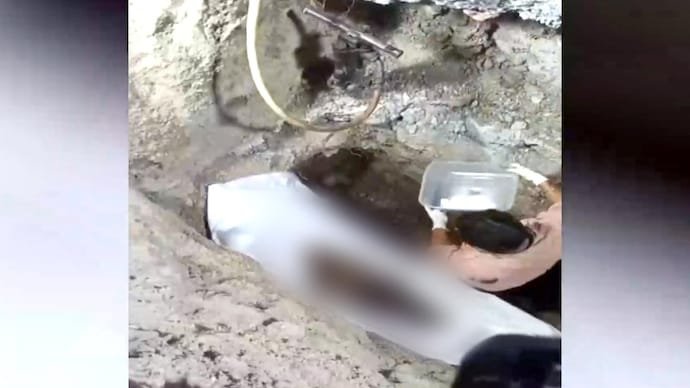
What began as a seemingly routine Missing Person‘s case has evolved into one of Gujarat‘s most shocking criminal investigations in recent years. Police in Jamnagar allege that a man WHO was believed by relatives to be working in Australia had actually been murdered, secretly buried beneath a factory floor, and hidden under a thick layer of concrete in an attempt to erase all evidence.
The Investigation gained widespread attention because of the elaborate concealment allegedly used by the accused, drawing comparisons on Social Media to fictional crime thrillers. However, investigators stress that the case is a real criminal probe supported by forensic evidence, witness statements, and police investigation not a work of fiction.
Authorities have arrested the victim’s wife, her alleged former boyfriend, and another man in connection with the case. The skeletal remains recovered from the burial site have been sent for forensic examination to establish their identity conclusively.
What Happened in the Jamnagar Missing Person Case?
According to Gujarat Police, relatives believed for nearly two years that Jignesh Mavadiya had relocated to Australia for employment. Family members were allegedly told that his work conditions prevented him from making phone calls or maintaining regular contact.
The explanation appeared convincing for a long period until one of the victim’s relatives planned to Travel to Australia and requested his address and contact details. Investigators say the inability to provide basic information raised suspicion within the family.
Following growing concerns, the victim’s brother filed a missing person’s complaint, prompting police to launch a detailed investigation.
How Police Reached the Burial Site
During the investigation, police questioned several individuals connected to the missing man and examined inconsistencies in statements provided by those close to him.
The inquiry eventually led investigators to an industrial premises in Jamnagar, where officials suspected evidence might have been concealed.
After reconstructing the alleged sequence of events with the accused present, excavation work began at the identified location.
Authorities reportedly had to use heavy drilling equipment to break through a thick concrete slab before digging several feet underground, where skeletal remains were recovered.
| Case Detail | Information |
|---|---|
| Location | Jamnagar, Gujarat |
| Victim | Jignesh Mavadiya (identity under forensic verification) |
| Burial Depth | Approximately 12 feet underground |
| Concealment Method | Covered with soil and sealed beneath a concrete floor |
| Current Status | Police investigation ongoing |
Police Allegations Against the Accused
According to investigators, the victim was allegedly lured to an industrial shed under the pretext of attending a social gathering.
Police allege that after consuming liquor allegedly mixed with poison, the victim died. Investigators further claim that the accused buried the body inside a deep pit before sealing the location with concrete to prevent discovery.
Authorities have emphasized that these allegations form part of the ongoing criminal investigation and will ultimately be tested through the judicial process.
How the Alleged Cover-Up Lasted Nearly Two Years
One of the most striking aspects of the case is the alleged effort to convince relatives that the missing man had moved overseas.
Investigators claim that repeated explanations about employment abroad, combined with claims of limited communication, delayed suspicion for a considerable period.
Cases involving missing persons can become particularly challenging when family members believe the individual is voluntarily living elsewhere, reducing the likelihood of an immediate police investigation.
This case demonstrates how consistent narratives, even if later found to be false, can significantly delay the discovery of a serious crime.
The Importance of Forensic Investigation
Although skeletal remains have been recovered, police have sent them for forensic examination before making a final identification.
Forensic experts typically rely on several scientific methods during such investigations, including:
- DNA profiling.
- Dental record comparison.
- Bone examination.
- Anthropological analysis.
- Personal evidence recovered from the burial site.
These procedures help investigators establish identity with greater certainty and strengthen evidence presented before the courts.
Why Concealed Burials Present Investigative Challenges
Criminal investigations involving buried human remains are among the most complex handled by Law Enforcement agencies.
Investigators must carefully preserve evidence while excavating the site to avoid damaging important forensic material.
Even after long periods underground, forensic specialists may recover valuable evidence that helps reconstruct events surrounding a person’s death.
Timeline of the Investigation
| Stage | Development |
|---|---|
| Victim reportedly disappears | Family informed he had gone abroad for work |
| Relatives seek contact details | Questions begin to arise over missing information |
| Missing person complaint filed | Police launch investigation |
| Interrogation and reconstruction | Investigators identify suspected burial location |
| Excavation conducted | Skeletal remains recovered for forensic analysis |
| Current stage | Investigation and forensic examination continue |
Criminal Charges Filed
Police have registered offences relating to:
- Murder.
- Destruction of evidence.
- Criminal conspiracy.
- Other applicable provisions under Indian law.
Investigators continue collecting documentary, forensic, and witness evidence to establish the complete sequence of events.
What Investigators Will Focus on Next
Although arrests have been made, several important questions remain under investigation.
Authorities are expected to examine:
- The forensic identification of the recovered remains.
- The alleged motive behind the crime.
- Whether additional individuals assisted in concealing evidence.
- Digital records, financial transactions, and communication history.
- Scientific evidence linking the accused to the burial site.
The findings from forensic laboratories will play a crucial role in strengthening the prosecution’s case.
Expert Insight: Why Missing Person Investigations Often Take Unexpected Turns
Criminal Justice experts note that many homicide investigations begin as missing person complaints. When a person appears to have voluntarily relocated, investigators often have limited evidence during the early stages.
Small inconsistencies such as the inability to verify employment, travel, or communication records can eventually become the breakthrough that changes the direction of an investigation.
The Jamnagar case highlights the importance of verifying claims through official records rather than relying solely on verbal explanations.
Lessons From the Investigation
The case underscores several broader issues in criminal investigations:
- Timely reporting of suspicious disappearances is critical.
- Forensic science plays a central role in solving cold or delayed cases.
- Physical evidence often remains recoverable despite attempts to conceal crimes.
- Careful investigation of inconsistencies can uncover long-hidden offences.
What Happens After the Forensic Examination?
Once forensic experts complete the identification process, investigators are expected to finalize the evidence collected from the crime scene, witness testimonies, and scientific reports.
If sufficient evidence is established, the police will submit a detailed chargesheet before the appropriate court. The accused will then have the opportunity to contest the allegations during judicial proceedings, where guilt or innocence will be determined according to law.
Conclusion
The Jamnagar murder investigation demonstrates how a missing person’s case can evolve into a complex criminal inquiry through persistent police work, forensic science, and careful examination of inconsistencies. The recovery of skeletal remains from beneath a concrete floor represents a significant breakthrough, but investigators are continuing to establish the complete facts surrounding the alleged crime.
As forensic experts analyze the recovered remains and police gather additional evidence, the case will move into the judicial process, where the allegations against the accused will be examined in accordance with the law. Until then, the investigation remains ongoing, with authorities working to reconstruct every stage of what they allege was an elaborate attempt to conceal a serious crime.
For breaking news and live news updates, like us on Facebook or follow us on Twitter and Instagram. Read more on Latest India on thefoxdaily.com.






COMMENTS 0