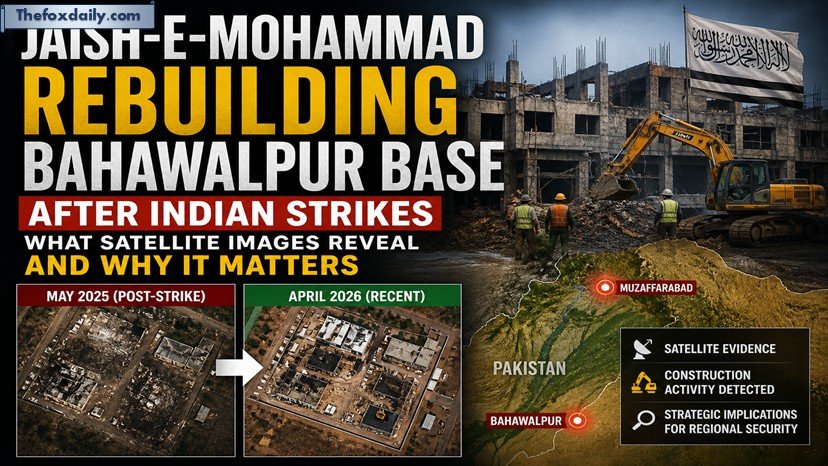
- What the satellite images indicate
- Operation Sindoor: A brief context
- The pattern: disruption vs destruction
- Why reconstruction matters more than it seems
- The funding question: where is the money coming from?
- FATF and the challenge of enforcement
- A comparison: strike impact vs long-term outcomes
- The role of satellite intelligence
- A deeper insight: rebuilding as a signal
- Regional implications: why this matters beyond one site
- What happens next?
- Future outlook: disruption alone may not be enough
- Conclusion: a reminder of the long game
Nearly a year after Indian airstrikes targeted key terror Infrastructure, new satellite imagery suggests that Jaish-e-Mohammad is rebuilding parts of its damaged network in Bahawalpur and beyond. The development is not just about reconstruction it signals a deeper, more complex challenge in counterterror operations.
Nearly a year after Indian airstrikes targeted key infrastructure, fresh satellite imagery from April 2026 suggests that Jaish-e-Mohammad has begun rebuilding parts of its damaged network in Bahawalpur and Muzaffarabad. The visuals show construction activity, heavy machinery on site, and visible structural repairs pointing to a gradual effort to restore facilities that were hit during Operation Sindoor.
But the bigger story lies beneath the images: what does rebuilding tell us about the effectiveness and limitations of military strikes?
What the satellite images indicate
Recent high-resolution imagery shows visible signs of construction at previously damaged compounds. Structures that once showed clear impact marks now appear repaired or in the process of being restored.
In Bahawalpur, one of the most significant locations, visual indicators suggest:
- Repair work on damaged structures
- Deployment of construction equipment
- Clearing of debris from previously hit areas
At another site in Muzaffarabad, the approach appears different. Instead of repair, the site seems to have undergone clearance possibly preparing for a complete rebuild.
This difference is important. It suggests that while some structures were repairable, others may have suffered deeper structural damage.
Operation Sindoor: A brief context
The reconstruction activity traces back to the aftermath of Indian strikes conducted under Operation Sindoor in 2025. The strikes targeted infrastructure believed to be linked to terror operations.
At the time, the operation was seen as a significant tactical move, aimed at degrading operational capacity.
And it did at least temporarily.
But as the latest developments suggest, the long-term picture is more complicated.
The pattern: disruption vs destruction
Counterterror strikes often aim to disrupt networks quickly. However, disruption does not always translate into permanent dismantling.
This situation reflects a familiar pattern seen globally:
- Infrastructure is damaged or destroyed
- Activities slow down temporarily
- Rebuilding begins once pressure eases
The cycle highlights a key reality physical infrastructure can be rebuilt faster than networks can be dismantled.
Why reconstruction matters more than it seems
At first glance, rebuilding may look like a predictable outcome. But its implications are significant.
Reconstruction suggests:
- Access to financial resources
- Organizational continuity
- Confidence in operating conditions
In other words, rebuilding is not just about bricks and cement it reflects resilience.
And that resilience is what concerns security analysts.
The funding question: where is the money coming from?
One of the most critical aspects of this development is funding. Rebuilding infrastructure requires resources, planning, and logistical support.
Reports of fundraising activity linked to digital platforms add another layer to the story. If accurate, they indicate how modern financial tools can be used to sustain operations even under scrutiny.
This brings the focus to global monitoring systems.
FATF and the challenge of enforcement
Pakistan’s status under global financial monitoring frameworks has long been a subject of international attention. While the country was removed from the grey list in 2022, it continues to remain under observation.
The idea behind such monitoring is straightforward: limit the flow of funds to organizations involved in illicit activities.
However, the current situation raises a critical question how effective is monitoring if reconstruction can still take place?
This is not necessarily a failure of policy, but it does highlight the complexity of enforcement in a rapidly evolving financial landscape.
A comparison: strike impact vs long-term outcomes
| Aspect | Immediate Impact | Long-Term Outcome |
|---|---|---|
| Infrastructure | Damaged | Rebuilt or repaired |
| Operations | Disrupted | Potentially restored |
| Visibility | High (post-strike) | Reduced over time |
| Pressure | Intense | Gradually decreases |
This comparison explains why reconstruction activity becomes a key indicator of long-term effectiveness.
The role of satellite intelligence
One of the most important aspects of this story is how it came to light.
Satellite imagery and open-source intelligence (OSINT) have transformed how such developments are tracked. What once required ground-level intelligence can now be observed from space with increasing precision.
This shift has two major implications:
- Greater transparency in monitoring activity
- Faster identification of changes on the ground
In many ways, satellite data has become a powerful accountability tool.
A deeper insight: rebuilding as a signal
Here’s something often overlooked rebuilding is not just a logistical step, it’s also a signal.
It signals intent.
When infrastructure is restored, it suggests that the organization believes it can continue operating without immediate disruption.
That perception whether accurate or not can influence regional security calculations.
Regional implications: why this matters beyond one site
The developments in Bahawalpur and Muzaffarabad are not isolated. They feed into a broader regional dynamic involving security, Diplomacy, and strategic positioning.
For policymakers, the key concern is not just what has been rebuilt, but what that rebuilding enables.
Even limited restoration of infrastructure can have wider implications if it supports coordination, training, or planning activities.
What happens next?
In the near term, reconstruction activity is likely to continue. Monitoring agencies and analysts will closely track changes in infrastructure, movement, and activity levels.
Possible developments include:
- Completion of repairs at key sites
- Expansion of rebuilt facilities
- Increased scrutiny from international observers
At the same time, responses both diplomatic and strategic will depend on how these developments evolve.
Future outlook: disruption alone may not be enough
The situation highlights a broader lesson in counterterror strategy.
While military action can deliver immediate results, long-term effectiveness often depends on sustained pressure financial, diplomatic, and strategic.
Without that continuity, there is always a risk of recovery.
And recovery, as current developments suggest, can happen quietly but steadily.
Conclusion: a reminder of the long game
The rebuilding of Jaish-e-Mohammad-linked sites is not just a follow-up to past events it is a reminder of how complex and persistent such challenges can be.
Strikes may change the landscape overnight, but what happens afterward is what truly defines the outcome.
In this case, the story is still unfolding.
And as satellite images continue to reveal changes on the ground, they also underline a simple truth: in matters of security, the long game matters more than any single moment.
For breaking news and live news updates, like us on Facebook or follow us on Twitter and Instagram. Read more on Latest World on thefoxdaily.com.





COMMENTS 0