- Tehran’s Streets Have Become a Political Message
- The Strait of Hormuz Remains Central to Iran’s Identity and Strategy
- Why Public Displays of Resistance Matter in Iran
- The Delayed Funeral of Ali Khamenei Reflects Deeper Security Concerns
- Why Large Gatherings Have Become a Security Risk
- The Other Tehran: Civilian Lives Disrupted by Conflict
- The Hidden Cost of War Is Often Cultural
- War Is Reshaping Psychological Life in Tehran
- The Gap Between State Narratives and Civilian Experience
- Why Civilian Damage Raises Difficult Questions
- Iran’s Youth Face an Uncertain Future
- Why Tehran’s Visual Defiance Resonates Globally
- Conclusion
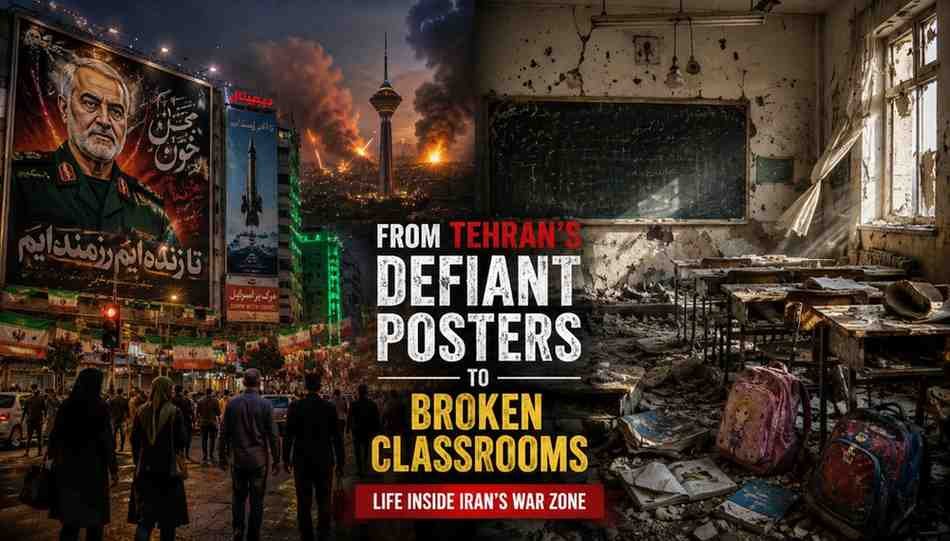
Tehran today presents two dramatically different faces to the world.
One is carefully constructed: giant patriotic posters, Iranian flags stretching across streets, slogans of resistance, and public imagery designed to project national unity and defiance. Across parts of the Iranian capital, murals and visual propaganda reinforce a message that Iran will not surrender to external pressure, particularly amid rising tensions surrounding the Strait of Hormuz and regional Military confrontations.
The other face is quieter and far more painful.
Behind the banners and symbolism are shattered buildings, traumatised civilians, disrupted classrooms, and ordinary people attempting to rebuild lives damaged by conflict. In neighbourhoods like Pirozzi Street, the scars of missile strikes and destroyed civilian spaces tell a story rarely visible in geopolitical rhetoric.
Together, these contrasting realities reveal how modern conflict operates inside Iran: a state projecting resilience while civilians absorb the emotional, economic and psychological costs of prolonged instability.
Tehran’s Streets Have Become a Political Message
Public spaces in Tehran increasingly resemble visual extensions of Iran’s strategic messaging.
One of the most striking examples is a massive depiction of the Strait of Hormuz covered by a giant net trapping American warships, drones and aircraft. The symbolism is unmistakable: Iran is warning adversaries that attempts to dominate or militarily pressure the waterway will face resistance.
The imagery is not merely artistic. It serves several political purposes simultaneously:
- Projecting military confidence
- Strengthening domestic morale
- Demonstrating resistance to foreign pressure
- Reinforcing nationalist identity
- Signaling strategic capability to international audiences
In times of geopolitical tension, governments often rely on visual symbolism to shape public perception. Tehran’s streets have effectively become part of Iran’s information strategy.
Flags, patriotic music and public gatherings create an atmosphere of collective resilience, particularly important during periods of uncertainty and external pressure.
The Strait of Hormuz Remains Central to Iran’s Identity and Strategy
The repeated focus on the Strait of Hormuz is no coincidence.
The narrow maritime corridor is one of the world’s most strategically important waterways, handling a major share of Global Oil shipments. For Iran, Hormuz represents far more than geography it symbolizes leverage, sovereignty, and survival.
Iran’s messaging around the strait reflects a broader strategic doctrine: even if economically pressured or militarily challenged, Tehran wants adversaries to understand that regional stability cannot exist without considering Iranian interests.
This is why imagery connected to Hormuz dominates public messaging inside Tehran.
The government is reinforcing the idea that Iran remains capable of influencing one of the world’s most critical energy routes despite Sanctions, isolation, and military tensions.
Why Public Displays of Resistance Matter in Iran
Nationalist demonstrations and symbolic public gatherings play a particularly important role in Iranian political culture.
During periods of crisis, public displays of unity serve multiple functions:
| Public Symbolism | Political Purpose |
|---|---|
| Flags and rallies | Demonstrating national unity |
| Patriotic posters | Strengthening resistance narratives |
| Street murals | Sending strategic messages abroad |
| Public chants and slogans | Boosting morale during uncertainty |
| Mass gatherings | Projecting regime stability |
These displays are also designed for international audiences. In modern geopolitical conflicts, perception management matters almost as much as military capability.
By visually emphasizing unity and resilience, Iran attempts to counter narratives portraying internal weakness or instability.
The Delayed Funeral of Ali Khamenei Reflects Deeper Security Concerns
One of the most revealing developments in Tehran is the continued delay surrounding the funeral ceremony of Supreme Leader Ali Khamenei.
According to reports, more than 40 days have passed since Khamenei’s death, yet official state funeral proceedings have not been completed due to security concerns.
This delay is extraordinary given Khamenei’s position within Iran’s political and religious structure.
State funerals in Iran are not simply ceremonial events. They are massive political moments involving:
- Religious symbolism
- National identity
- Public legitimacy
- Political continuity
- Regional messaging
The expected funeral location the mausoleum of Imam Khomeini in south Tehran carries immense historical weight. It is deeply connected to the identity of the Islamic Republic itself.
The fact that authorities remain hesitant to proceed underscores how fragile the current security Environment appears to be.
Why Large Gatherings Have Become a Security Risk
The delay in funeral arrangements also highlights broader fears surrounding mass gatherings during periods of regional instability.
Iranian authorities are likely balancing several concerns:
- Potential security threats
- Risk of attacks during large crowds
- Political unpredictability
- Regional tensions spilling into domestic unrest
- Challenges in securing millions of mourners
Major funerals in Iran historically attract enormous participation. The funeral of Imam Khomeini decades ago drew millions into Tehran’s streets and became a defining moment in modern Iranian History.
A similar turnout would be expected for Khamenei.
However, today’s security conditions are far more volatile, making such a gathering both symbolically important and strategically risky.
The Other Tehran: Civilian Lives Disrupted by Conflict
While state messaging emphasizes resistance and sovereignty, ordinary civilians in Tehran are confronting a very different reality.
On Pirozzi Street, the Jalal Building stands as a stark reminder of how modern conflict often reaches civilians who have no direct connection to military or political operations.
The building housed homes, businesses, and a music institute where teacher Hamid Reza taught nearly 250 students alongside other instructors.
Then came the strike.
According to Hamid, the attack occurred around 5 am. The aftermath left instruments destroyed, equipment scattered, and years of work reduced to debris.
What makes the incident especially troubling for residents is the absence of any visible military infrastructure nearby.
The neighbourhood was largely civilian.
The Hidden Cost of War Is Often Cultural
One overlooked consequence of conflict is the destruction of cultural and educational spaces.
Military analysis often focuses on infrastructure, casualties, and strategic targets. Yet war also damages the quieter foundations of society classrooms, music schools, libraries, art spaces, and community institutions.
Hamid’s music institute represented more than a workplace.
For students, it was:
- A learning space
- A cultural centre
- A social environment
- An emotional refuge
- A connection to Persian artistic tradition
Its destruction highlights how civilian trauma extends far beyond physical damage.
Communities lose continuity, identity, and emotional stability when cultural institutions disappear.
War Is Reshaping Psychological Life in Tehran
One of the most significant but least visible consequences of prolonged instability is psychological exhaustion.
Even when daily life appears functional on the surface, uncertainty changes how people experience ordinary routines.
Residents begin adapting constantly:
- Monitoring security conditions
- Avoiding certain areas
- Preparing for disruptions
- Living with fear of escalation
- Balancing patriotism with anxiety
For civilians like Hamid and his students, the emotional impact can last far longer than the physical destruction itself.
Students reportedly considered the institute a “second home.” Losing such spaces creates emotional dislocation difficult to measure in official assessments of war damage.
The Gap Between State Narratives and Civilian Experience
The situation in Tehran reveals an important contrast between official narratives and civilian reality.
The state projects:
- Strength
- Defiance
- Resistance
- National unity
- Strategic confidence
Meanwhile, civilians often experience:
- Economic hardship
- Psychological stress
- Infrastructure damage
- Disrupted livelihoods
- Uncertainty about safety
Both realities can exist simultaneously.
In many modern conflicts, governments rely heavily on symbolic resilience while ordinary citizens navigate the practical consequences of instability.
Why Civilian Damage Raises Difficult Questions
The Jalal Building strike also reflects a larger issue surrounding contemporary warfare: the increasing difficulty of separating military and civilian impact.
Residents questioned why a music institute and residential area would be affected at all.
Such incidents often generate broader public anxiety because civilians recognize how vulnerable ordinary neighbourhoods can become during geopolitical confrontations.
Even when civilians are not intentional targets, urban conflict environments increase the likelihood of collateral damage, misidentification, or proximity-based destruction.
This blurring of military and civilian risk is one reason modern urban warfare produces such deep social trauma.
Iran’s Youth Face an Uncertain Future
The destruction of educational and artistic spaces also carries long-term implications for younger generations.
Many Iranian students already face:
- Economic uncertainty
- International isolation
- Restricted opportunities
- Political tension
- Social pressure
When schools, institutes, and cultural centres are damaged, young people lose spaces that provide stability, creativity, and emotional escape.
This matters because societies under prolonged geopolitical pressure often experience generational psychological strain that extends beyond immediate conflict periods.
Why Tehran’s Visual Defiance Resonates Globally
Despite internal hardship, Iran’s public displays of resistance continue to resonate strongly across parts of the region.
For supporters, the imagery represents sovereignty and refusal to submit to foreign pressure.
For critics, it highlights how states use symbolism to project strength while civilians bear the hidden burden of geopolitical confrontation.
Either way, Tehran’s streets have become a visual representation of a larger global conflict involving:
- Regional power struggles
- Energy security
- US-Iran tensions
- Military deterrence
- Information warfare
- National identity politics
Conclusion
Tehran today stands between symbolism and survival.
Its streets project resistance through giant posters, patriotic displays, and strategic messaging aimed at both domestic and international audiences. The delayed funeral of Ali Khamenei reflects the gravity of current security concerns and the fragile atmosphere surrounding Iran’s political future.
But beyond the slogans lies another reality civilians rebuilding destroyed classrooms, artists trying to preserve culture amid instability, and families navigating the psychological toll of living inside a conflict zone.
The story of the Jalal Building reveals what geopolitical headlines often overlook: wars are not experienced only through military operations or diplomatic negotiations. They are experienced through broken instruments, damaged homes, interrupted education, and ordinary people struggling to hold onto routine.
In Tehran, the message of resistance may dominate the streets. But the quieter story unfolding behind those banners is ultimately about endurance the endurance of civilians trying to preserve everyday life while history moves violently around them.
For breaking news and live news updates, like us on Facebook or follow us on Twitter and Instagram. Read more on Latest World on thefoxdaily.com.

COMMENTS 0