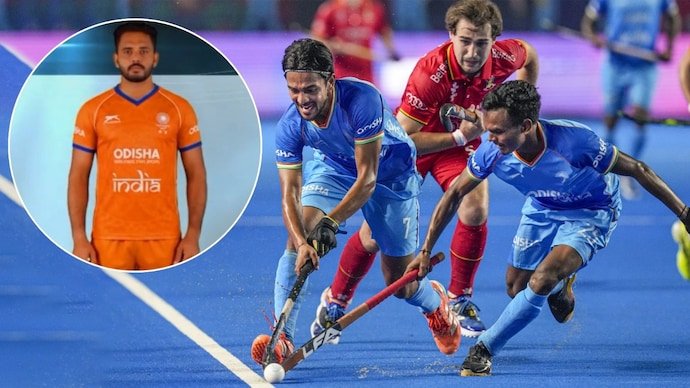
For generations of Indian sports fans, the blue hockey jersey has symbolized pride, excellence, and one of the country’s richest sporting legacies. From India’s golden era of Olympic dominance to its recent resurgence on the global stage, the Blue Jersey has become almost inseparable from Indian hockey.
That is why Hockey India‘s decision to introduce a saffron primary jersey for the FIH Hockey World Cup 2026 has generated intense debate across the sporting community. While the federation argues the change is a technical decision aimed at improving player visibility on modern blue synthetic pitches, former players, sports administrators, journalists, and political leaders believe the issue goes far beyond on-field performance.
The controversy has evolved into a larger discussion about sporting traditions, national identity, governance in sports, and whether iconic team colours should change after decades of history.
Why Did Hockey India Change India’s Traditional Blue Jersey?
Hockey India says the decision was based on recommendations from support staff and was intended to improve visibility during matches played on modern blue hockey turfs.
According to the federation, players wearing blue uniforms can visually blend with the blue synthetic playing surface, making it more difficult for teammates to identify one another during the fast-paced action of international hockey.
The governing body maintains that the decision was entirely technical and had no political motivation.
However, the explanation has been widely questioned by former players, coaches, analysts, and fans who argue that international hockey has been played on blue pitches for well over a decade without similar concerns becoming a major issue.
Why Is the Blue Jersey So Important to Indian Hockey?
Unlike many sports uniforms that change frequently, India’s blue hockey jersey represents nearly a century of sporting history.
Some of Indian hockey’s greatest achievements have come while wearing blue, including:
- Eight Olympic gold medals.
- The country’s only Hockey World Cup title.
- Multiple Asian Games victories.
- Commonwealth and Asian Champions Trophy successes.
- The recent revival that brought Olympic medals back to Indian hockey.
For many former internationals, changing the primary jersey means altering one of the strongest visual symbols associated with Indian hockey.
How Team Colours Become Sporting Identities
Across the world, successful national teams become closely associated with specific colours. Those colours eventually become part of their sporting identity rather than simply their uniforms.
| Country | Iconic Team Colour | Global Identity |
|---|---|---|
| India (Hockey) | Blue | Olympic legacy and World Cup champions |
| Brazil (Football) | Yellow | Five-time FIFA World Cup winners |
| Argentina (Football) | Sky Blue and White | Recognized worldwide |
| New Zealand (Rugby) | Black | All Blacks brand |
| Pakistan (Hockey) | Green | Historic hockey powerhouse |
Former India captain Viren Rasquinha compared India’s blue jersey to Argentina’s famous Football stripes, arguing that iconic sporting colours should not be changed without compelling reasons.
The Visibility Argument: Does Blue Blend Into Blue Turf?
The central justification offered by Hockey India revolves around visibility.
Modern international hockey is played on blue synthetic pitches, which became the global standard after the 2012 London Olympics.
The federation argues that players wearing blue jerseys can sometimes merge visually with the playing surface during high-speed movement, reducing on-field clarity.
Sports vision is an important area of performance science. Contrast between uniforms, the playing surface, and the ball can affect reaction times, peripheral vision, and decision-making, especially in sports where play develops within fractions of a second.
However, critics point out that nearly every major hockey nation has continued competing successfully on blue turfs while retaining traditional colours.
Why Was Blue Turf Introduced in International Hockey?
Interestingly, blue turf was never introduced to solve player visibility issues.
The International Hockey Federation adopted blue pitches primarily to improve the viewing experience for television audiences.
The blue surface creates stronger contrast with the bright yellow hockey ball, making one of the fastest-moving balls in world sport easier to follow for spectators and broadcasters.
Since its introduction during the London 2012 Olympic Games, blue turf has become standard across international competitions.
| Traditional Hockey Pitch | Modern Hockey Pitch |
|---|---|
| Green artificial turf | Blue artificial turf |
| White ball used historically | Bright yellow ball |
| Designed mainly for players | Optimized for television viewing |
Why Critics Are Questioning Hockey India’s Explanation
Opponents of the jersey change argue that the visibility explanation raises several unanswered questions.
- International hockey has been played on blue turf for more than a decade.
- Several successful teams continue wearing blue or similarly coloured uniforms.
- No major international federation has recommended changing traditional team colours for visibility reasons.
- Reports suggested some current players were not consulted before the decision.
These concerns have fueled skepticism about whether visibility alone explains the decision.
Pakistan’s Green Jersey Became a Key Part of the Debate
One of the strongest arguments raised by critics involves Pakistan‘s historic success.
Pakistan, widely known for its iconic green kit, won major international tournaments while playing on green artificial surfaces long before blue turf became standard.
Critics argue that if green jerseys did not prevent Pakistan from becoming one of hockey’s greatest teams, blue jerseys should not suddenly become a competitive disadvantage for India.
While green turf and blue turf are different playing environments, the comparison has become symbolic of the wider argument that sporting success depends more on preparation, tactics, and skill than uniform colour.
The Political Dimension of the Controversy
The debate expanded beyond sports after political leaders entered the discussion.
Former Odisha Chief Minister Naveen Patnaik strongly criticized the jersey change, describing India’s blue hockey jersey as an emotional part of the nation’s sporting heritage.
His intervention carried particular weight because Odisha has played a transformative role in Indian hockey over the past decade.
Odisha’s Role in Reviving Indian Hockey
When Indian hockey faced financial uncertainty several years ago, the Odisha government became the principal sponsor of both the men’s and women’s national teams.
The state also invested heavily in:
- International-standard hockey stadiums.
- Grassroots talent development.
- High-performance academies.
- Hosting multiple FIH Hockey World Cups.
- Sports infrastructure recognized globally.
These investments significantly strengthened India’s position in world hockey and helped improve facilities available to elite players.
Questions Over the Decision-Making Process
The controversy intensified after Hockey India President Dilip Tirkey reportedly sought clarification regarding how the jersey decision was made.
Media reports also suggested that some current players were unaware of any consultation process, creating fresh questions about governance and transparency.
Whether or not those reports accurately reflect the complete process, they have highlighted the importance of involving athletes in decisions that affect team identity.
What Sports Branding Experts Say About Team Colours
In modern sports, jerseys are much more than competition uniforms.
They serve several important functions:
- Represent national identity.
- Create emotional connections with fans.
- Strengthen commercial branding.
- Increase merchandise sales.
- Preserve sporting history across generations.
Changing an iconic primary jersey therefore requires balancing performance considerations with brand value and historical significance.
Could Technology Solve Visibility Without Changing the Jersey?
The current debate has also raised an important question that has received relatively little attention.
If visibility is genuinely becoming a challenge in elite hockey, several alternative solutions may exist:
- Adjusting jersey shades while retaining blue.
- Improving uniform contrast through sleeves and trim.
- Using enhanced sports fabrics that improve visual definition.
- Further research into sports vision science before permanent changes are introduced.
Such approaches could potentially address technical concerns without abandoning a colour closely associated with India’s hockey heritage.
How Other Countries Handle Traditional Jerseys
Most successful sporting nations rarely replace their traditional primary colours entirely.
Instead, they introduce alternate kits for selected tournaments while preserving the iconic home jersey that supporters instantly recognize.
This approach allows innovation without weakening decades of sporting identity.
Why the Debate Matters Beyond Hockey
The discussion surrounding India’s hockey jersey illustrates how sport often intersects with Culture, history, branding, and public perception.
Colours carry emotional meaning. They become associated with memorable victories, legendary athletes, and shared national moments.
Whether supporters agree or disagree with Hockey India’s decision, the strong public reaction demonstrates how deeply sports symbols resonate with fans.
Future Outlook: Will the Saffron Jersey Become Permanent?
It remains unclear whether the Saffron Jersey will become India’s long-term primary kit or be limited to specific tournaments.
The reaction from former players, administrators, and supporters may influence future decisions, especially if Hockey India conducts broader consultations after the World Cup.
The federation could also consider retaining blue as the primary identity while introducing alternate colours for selected competitions, a model widely used across international sports.
Conclusion
The controversy over India’s saffron hockey jersey is about far more than a change in colour. It represents a broader debate over sporting tradition, technical innovation, governance, branding, and national identity.
Hockey India maintains that the decision was driven by performance considerations linked to modern blue playing surfaces. Critics, however, argue that the blue jersey represents nearly a century of history and should not be replaced without overwhelming evidence and wider consultation.
As India prepares for the 2026 FIH Hockey World Cup, attention will not only be on the team’s performance but also on how one of the country’s most recognizable sporting symbols evolves. Regardless of the final outcome, the debate has highlighted an important truth: in international sport, a jersey is never just a uniform it is a living part of a nation’s sporting legacy.
For breaking news and live news updates, like us on Facebook or follow us on Twitter and Instagram. Read more on Latest India on thefoxdaily.com.





COMMENTS 0