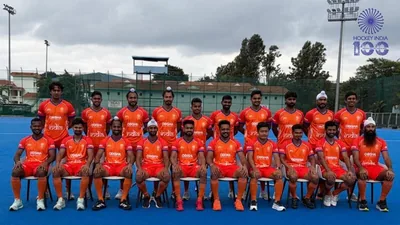
The Indian Hockey team’s decision to replace its iconic blue jersey with a saffron kit for the upcoming 2026 FIH Hockey World Cup has become one of the biggest talking points in Indian sport. Initially presented as a technical change aimed at improving player visibility on blue artificial turf, the decision has now sparked a broader debate involving transparency, governance, player consultation, team identity, and administrative accountability.
The controversy intensified after Hockey India President Dilip Tirkey publicly stated that he had not been informed before the decision was implemented. His comments came shortly after multiple reports quoted members of both the men’s and women’s national teams claiming they were never consulted, contradicting earlier assertions that the move had been approved collectively by players and coaches.
With the World Cup set to begin on August 15 in Belgium and the Netherlands, what should have been a celebration of India’s preparations has instead shifted attention toward questions about how major decisions affecting the national team are made.
Why the Jersey Change Has Generated So Much Debate
India’s hockey jersey is more than a uniform—it is one of the country’s most recognizable sporting symbols. For over four decades, the national teams have primarily worn different shades of blue or white at international competitions, creating a visual identity recognized by fans worldwide.
The announcement that both the men’s and women’s teams would wear saffron jerseys at the World Cup therefore represented a significant departure from tradition.
Supporters of the change argue that sports evolve constantly, with teams around the world periodically redesigning kits for performance, branding, or commercial reasons. Critics, however, believe changes involving national colors deserve greater transparency because they affect the team’s historical identity and public perception.
Hockey India Says the Decision Was Technical
Hockey India has consistently maintained that the jersey redesign was based on sporting considerations rather than political or symbolic ones.
According to the federation, the traditional blue jersey often blends with modern blue synthetic hockey pitches, making it more difficult for players to identify teammates quickly during high-speed matches.
Officials argued that switching to a contrasting color would improve on-field visibility and potentially benefit communication and passing accuracy during matches.
Such considerations are not unique to hockey. Across several sports, governing bodies regularly evaluate jersey colors to maximize contrast for athletes, referees, broadcasters, and spectators.
Captain Harmanpreet Singh Defended the Move
Indian men’s captain Harmanpreet Singh sought to calm the growing controversy by insisting that the decision had emerged through discussions involving the players and coaching staff.
“We are not paying much attention to these things. It was a collective decision by the team and the coaches.”
His remarks suggested that the dressing room viewed the issue primarily through a sporting lens rather than a political one.
However, subsequent reports complicated that narrative after several players reportedly stated they had never been consulted before the decision was finalized.
Players Dispute Consultation Claims
The controversy escalated significantly when anonymous members from both the men’s and women’s national teams reportedly denied participating in any formal consultation regarding the jersey change.
While none of the players claimed to represent the views of the entire squad, their comments challenged the earlier assertion that the decision reflected a collective consensus.
The differing accounts have shifted the focus away from the jersey itself and toward the administrative process behind the decision.
Whether consultations occurred with only a limited group or were communicated informally has now become one of the central questions in the debate.
Dilip Tirkey’s Statement Raises Fresh Governance Questions
The biggest development came when Hockey India President Dilip Tirkey stated that he had not been informed before the jersey change was implemented.
According to an internal communication, Tirkey said the decision had not been placed before the Executive Board for discussion and that he had no prior knowledge of its approval.
He requested a written explanation from Hockey India officials outlining:
- The basis for changing the jersey.
- The approval process that was followed.
- Who authorized the decision.
- Why it was implemented without Executive Board discussion.
His remarks transformed what initially appeared to be a branding issue into a broader governance debate within Indian hockey.
Hockey India Secretary Rejects Claims of Procedural Lapses
Hockey India Secretary Bhola Nath Singh offered a different version of events.
He maintained that the proposal had been circulated internally among officials and insisted that the decision involved discussions with players and coaching staff.
He also rejected suggestions that any external influence or political pressure played a role in selecting the new jersey color.
According to Singh, the issue has become unnecessarily politicized, while emphasizing that any future reconsideration would require collective discussion among Hockey India’s leadership.
Conflicting Statements Create Credibility Challenge
The most significant aspect of the controversy is no longer the color of the jersey but the conflicting explanations provided by different stakeholders.
| Stakeholder | Position on Consultation |
|---|---|
| Hockey India President Dilip Tirkey | Says he was not informed before implementation. |
| Hockey India Secretary Bhola Nath Singh | States the decision followed internal discussions and player consultation. |
| India Captain Harmanpreet Singh | Describes it as a collective decision involving players and coaches. |
| Anonymous Men’s & Women’s Players | Claim they were never consulted. |
These contrasting accounts have created uncertainty about how the decision was ultimately approved, placing additional pressure on Hockey India to clarify its internal processes.
Why Team Identity Matters in International Sport
National team jerseys carry emotional significance that extends well beyond their practical purpose.
They become symbols associated with historic victories, legendary athletes, and generations of supporters. India’s blue hockey jersey has been worn during Olympic campaigns, World Cups, Asian Games, and numerous memorable international tournaments.
Changing such an established identity inevitably attracts attention, regardless of the sporting rationale behind it.
Sports branding experts often note that successful identity changes require clear communication, transparency, and stakeholder engagement to minimize unnecessary controversy.
Former Players Voice Their Concerns
Several respected former Indian captains and hockey legends have questioned both the reasoning behind abandoning the traditional blue jersey and the overall decision-making process.
Their concerns are not necessarily limited to the choice of color itself. Many have argued that altering a long-standing national sporting identity should involve extensive consultation with players, administrators, former athletes, sponsors, and other key stakeholders.
The criticism reflects a broader belief that symbols representing Indian sport deserve careful consideration before significant changes are introduced.
Odisha Government Also Seeks Clarification
The issue has attracted additional attention because the Odisha Government, the principal sponsor of the Indian hockey teams, has reportedly requested an explanation regarding the controversy.
As one of Indian hockey’s most significant institutional partners, Odisha has invested heavily in developing the sport through infrastructure, tournaments, and financial support.
Its interest highlights how administrative decisions involving national teams can extend beyond sporting organizations to include sponsors and government partners.
Could the Controversy Affect India’s World Cup Preparation?
With the 2026 FIH Hockey World Cup approaching rapidly, maintaining focus on performance will become increasingly important.
Elite athletes generally prefer minimizing off-field distractions during major tournaments, allowing attention to remain on tactical preparation, fitness, and competition.
Whether the ongoing debate has any lasting impact inside the dressing room remains uncertain. However, resolving administrative disagreements before the tournament begins would likely benefit everyone involved.
The Bigger Lesson: Governance Matters as Much as the Decision
One important lesson emerging from this episode is that transparency often matters as much as the final decision itself.
Sporting organizations regularly introduce changes involving uniforms, competition formats, commercial partnerships, and branding. Such decisions rarely generate lasting controversy when stakeholders clearly understand how they were reached.
In this case, the conflicting public statements have become the primary issue.
If Hockey India provides a comprehensive explanation detailing the consultation process and approval mechanism, much of the uncertainty surrounding the controversy could be addressed.
What Happens Next?
The federation now faces several important questions:
- Will Hockey India publish details of the approval process?
- Will the Executive Board formally review the decision?
- Will additional players publicly comment on the issue?
- Could the jersey design be reconsidered before the World Cup?
- How will the controversy influence future governance procedures?
Any further clarification from Hockey India’s leadership is likely to determine whether the discussion gradually subsides or continues throughout the tournament.
Conclusion
The Indian hockey saffron jersey controversy has evolved far beyond a debate over uniform colors. Conflicting statements from Hockey India officials, reports that several players were not consulted, and President Dilip Tirkey’s request for an internal explanation have shifted attention toward questions of governance, transparency, and institutional decision-making.
As India prepares for the 2026 FIH Hockey World Cup, supporters will ultimately hope the focus returns to performances on the field. Regardless of the final outcome, the episode serves as a reminder that decisions involving national sporting symbols require not only sound reasoning but also open communication, broad consultation, and administrative clarity. Those principles are often just as important as the decisions themselves in maintaining trust among players, officials, and fans.
For breaking news and live news updates, like us on Facebook or follow us on Twitter and Instagram. Read more on Latest Sports on thefoxdaily.com.






COMMENTS 0