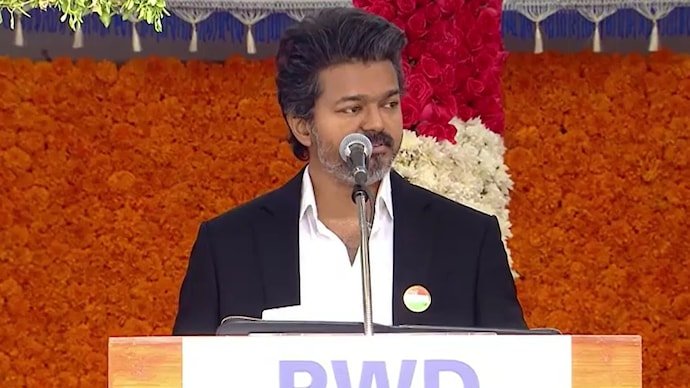
Tamil Nadu Chief Minister Vijay used his first Independence Day address from Fort St George in Chennai to deliver a political message alongside his call for development, saying any “conspiracies” directed against his government would be thwarted. Without naming political opponents, Vijay said his administration would remain focused on transparent Governance, corruption control, social justice and the interests of Tamil Nadu.
The speech was significant not only because it marked Vijay’s first Independence Day address as chief minister, but also because it offered an early indication of how the Tamilaga Vettri Kazhagam (TVK) government wants to define itself. Vijay presented his administration as transparent and corruption-free while drawing a direct connection between governance, social equality and the broader meaning of freedom.
His remarks also touched on the relationship between the Tamil Nadu government and the Centre, welfare schemes inherited from earlier administrations, economic ambitions for the state and the role of citizens after elections. The address combined political messaging with a broader appeal for public participation in the government’s development agenda.
Vijay warns that attempts to destabilise his government will be resisted
One of the strongest political messages in Vijay’s Independence Day speech was his warning against forces working against his administration. He said “conspiracies” targeting his government would be thwarted, though he did not publicly name the political groups he had in mind.
The remarks are politically significant in a state where the new TVK administration is operating in an established political environment dominated for decades by the DMK and AIADMK. By avoiding direct names while speaking about attempts against his government, Vijay kept the focus on his administration’s stated priorities rather than turning the Independence Day platform into an explicit attack on individual opponents.
His broader message was that the government would not allow political opposition or other pressures to derail its agenda. Vijay portrayed the TVK administration as having a clear mandate to pursue its programme and asked people to remain involved in the process rather than considering their responsibility finished after voting.
‘Rescuing Tamil Nadu from corruption is also a form of freedom’
Corruption was one of the central themes of Vijay’s address. He argued that Independence Day should not be understood only through the historical struggle against British rule, but also through the freedom of citizens from practices that weaken public institutions and governance.
“Rescuing Tamil Nadu from corruption is also a form of freedom and that’s what our government is doing,” Vijay said.
He claimed that revenue that previously went to private individuals had been stopped and said his administration was continuing action against corruption across government departments. The message fits closely with the governance agenda Vijay’s TVK has promoted, including its emphasis on transparent administration and reducing corruption.
For the government, the challenge now is to turn that political promise into measurable administrative outcomes. A claim of corruption-free governance ultimately depends on how government departments function, how public services are delivered, how complaints are handled and whether citizens can see greater transparency in the use of public money.
That makes corruption control one of the areas where the TVK government is likely to face sustained public scrutiny. The Independence Day speech established the political objective; implementation will determine how that objective is judged.
Vijay links freedom with breaking caste and religious divisions
The chief minister also gave Independence Day a social message, arguing that political freedom is incomplete if people remain divided by caste and religion.
Vijay said people begin to feel united when they recognise the forces that have kept them divided and described breaking the “shackles” of caste and religion as a form of real freedom. He invoked Mahatma Gandhi while connecting the idea to the country’s freedom struggle.
The emphasis is notable because caste and social identity remain deeply connected to Tamil Nadu’s political history. Vijay’s choice to place social unity alongside corruption, governance and development suggests that his government wants to present itself as a political alternative built around a broader social coalition.
His remarks also reflected the language of equality that has featured prominently in his political messaging. Rather than treating Independence Day solely as a celebration of the past, he used the occasion to argue that freedom should have a practical meaning in everyday life.
State interests will come first, Vijay says
Vijay also addressed one of the most important issues for any Tamil Nadu government: its relationship with the Union government.
He said the state would cooperate with the Centre on administrative matters but would not compromise on Tamil Nadu’s interests.
“We are working with the central government for administration, but when it comes to state interests, there will be no compromise,” Vijay said.
The formulation indicates an approach based on cooperation where necessary while maintaining a firm position on issues the state considers important. For Tamil Nadu, Centre-state relations can influence areas ranging from development funding and Infrastructure to Education, federal policy and other matters involving state and Union responsibilities.
Vijay’s statement therefore goes beyond a routine Independence Day reference. It establishes a political principle for his administration: cooperation with New Delhi does not mean accepting every position without contest when the state’s interests are involved.
TVK government says useful welfare schemes will continue
Another important part of Vijay’s speech was his acknowledgement that effective government programmes should not necessarily be discarded simply because they were introduced by political rivals.
He said the TVK government would continue welfare schemes launched by previous administrations if they benefited the people. He specifically referred to Amma Unavagam, introduced under the AIADMK government, and the breakfast scheme for schoolchildren introduced by the DMK government.
The approach provides an important distinction between political competition and policy continuity. A change in government does not automatically mean that every programme associated with a previous administration has to disappear. For beneficiaries, continuity can be more important than which political party originally introduced a scheme.
Vijay’s position also allows the new government to frame itself as willing to evaluate policies on their public benefit rather than their political ownership. Whether that principle is consistently applied across departments will be an important test of the administration’s governance philosophy.
$1.5 trillion Tamil Nadu economy target by 2036
Economic development was another major component of Vijay’s Independence Day message. He reiterated the ambition of building a Tamil Nadu economy worth $1.5 trillion by 2036.
The target is part of the wider economic vision associated with the TVK government. Vijay’s political platform has previously linked the goal to investment, business development, Technology and administrative reforms.
Reaching such a target would require sustained economic expansion over many years rather than a single government initiative. It would depend on factors including investment, industrial growth, infrastructure, employment, productivity, technology adoption and the ability of businesses to operate efficiently.
The importance of the target therefore lies not only in the headline number but in the policies used to pursue it. A large economic ambition needs to translate into jobs, higher incomes, stronger industries and improved opportunities across different parts of the state.
For Vijay’s government, the $1.5 trillion objective will consequently become one of the clearest long-term benchmarks against which its economic performance can be assessed.
Vijay asks voters to remain involved after elections
The chief minister also made an unusual appeal for continued public engagement with the government. He told people not to believe that their responsibility ends once they have cast their vote.
“Please don’t think the job is done after voting. Now is when we need your support and only then can we implement schemes,” Vijay said.
The appeal reflects the administration’s attempt to build a relationship with citizens beyond election campaigns. Public participation can take many forms, including awareness of government programmes, reporting problems, monitoring public services and engaging with local administration.
For a relatively new political organisation governing a state with a large and complex administrative system, maintaining public engagement could be particularly important. Political support alone does not guarantee successful implementation. Government programmes ultimately depend on institutions, officials and citizens working within the system.
Women, social justice and a drug-free Tamil Nadu remain priorities
Vijay said his government was being run according to the principle that “All lives are born equal” and highlighted women’s safety and social justice among its priorities.
He also described his administration as committed to fighting bribery, corruption and drug Culture. These issues have been presented as part of a broader governance agenda rather than as isolated policy areas.
For women, the emphasis on safety creates an expectation that government action will extend beyond political statements to policing, public infrastructure, administration and access to justice. Similarly, the focus on social justice requires policies that address unequal access to opportunities and public services.
The administration’s challenge will be to demonstrate how these broad priorities are converted into concrete programmes and measurable improvements for citizens.
Tribute to freedom fighters and appeal to younger generations
Vijay paid tribute to the freedom fighters who sacrificed their lives for India’s independence and said their spirit should continue to guide society.
He extended his Independence Day message to Tamil people across the world and to Gen Z, asking younger citizens to participate in Tamil Nadu’s development journey. The emphasis on younger people is particularly relevant to Vijay’s political identity, given his transition from a major film Career into electoral politics.
His appeal positioned the younger generation not merely as voters but as participants in the state’s economic and social future. That message also connects with the administration’s wider focus on development and its ambition to build a technology-driven economy.
New measures announced for freedom fighters and their families
Vijay also announced new measures concerning freedom fighters and their families during the Independence Day programme. The announcements formed part of the ceremonial and policy dimensions of the address, linking the state’s current priorities with the people associated with the freedom movement.
The tribute was consistent with the broader theme of the speech: Vijay repeatedly connected present-day governance with the ideals associated with India’s independence struggle.
Trisha Krishnan attends Independence Day celebrations
The ceremony also drew attention because actor Trisha Krishnan, who is a friend of Vijay, attended the Independence Day celebrations. She was seated in the front row before Vijay arrived for the flag-hoisting ceremony.
Videos from the event showed Trisha wearing a yellow saree with a gajra. She was also seen seated alongside Vijay’s parents, S A Chandrasekhar and Shoba Chandrasekhar. Trisha had arrived with her mother, Uma Krishnan, and was seen saluting Vijay during the parade.
Her presence added a celebrity dimension to an event otherwise centred on Vijay’s first Independence Day address as chief minister. The images and videos from the ceremony quickly became part of the wider public attention surrounding the event.
What Vijay’s first Independence Day speech signals for the TVK government
Vijay’s first Independence Day speech brought together several themes that are likely to shape the TVK government’s political identity: corruption-free administration, social equality, welfare continuity, economic expansion, public participation and protection of Tamil Nadu’s interests.
The warning about “conspiracies” against his government was the clearest political element of the speech, but the larger message was about defining what Vijay wants his administration to represent. He presented the government as independent of political pressure, willing to retain useful schemes from previous administrations and determined to pursue an ambitious economic agenda.
The $1.5 trillion target by 2036 provides a long-term economic benchmark, while the promises on corruption, women’s safety and social justice address issues with more immediate relevance to citizens.
The next stage will be implementation. Political declarations can establish priorities, but their credibility ultimately depends on administrative performance and the experiences of people using government services. For Vijay, the coming years will show whether the TVK government can translate the themes of its first Independence Day speech into lasting changes across Tamil Nadu.
For now, the address marked a clear attempt by the chief minister to frame his government’s first year around a combination of political resilience, administrative reform, social unity and economic ambition, while making it clear that he intends to defend the government’s mandate against attempts to undermine it.
For breaking news and live news updates, like us on Facebook or follow us on Twitter and Instagram. Read more on Latest India on thefoxdaily.com.




COMMENTS 0