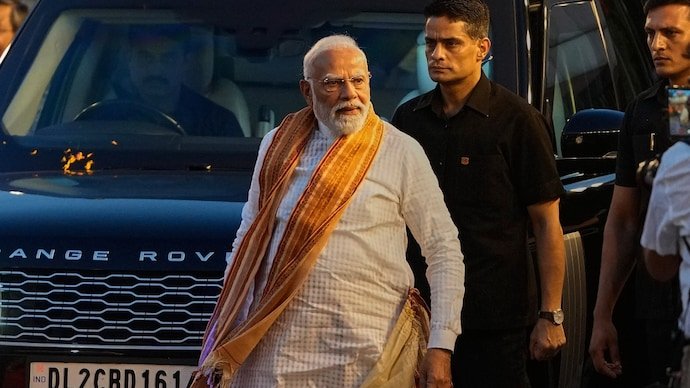
Prime Minister Narendra Modi remains the most preferred choice for India’s next prime minister, but the latest Mood of the Nation survey points to a political landscape that is beginning to look more competitive at the margins.
According to the August 2026 India Today-CVoter Mood of the Nation survey, 48.7% of respondents chose Modi as the person best suited to become prime minister. That keeps him comfortably ahead of Congress leader and Leader of the Opposition Rahul Gandhi, who received 27.1% support.
The more unexpected development is the arrival of Tamil Nadu Chief Minister and Tamilaga Vettri Kazhagam (TVK) chief Vijay in third place. The actor-turned-politician was selected by 9.2% of respondents, putting him ahead of several established national and regional political figures.
The numbers also contain a warning sign for the BJP. Modi’s 48.7% rating is down from 55% in the January 2026 edition of the survey, a decline of roughly six percentage points. It is also the first time since the August 2024 Mood of the Nation survey that his rating has fallen below 50%.
That does not amount to a collapse in his popularity. The gap between Modi and his nearest rival remains substantial. But the movement in the numbers matters because it comes as the ruling alliance faces a more mixed political picture in several areas, including projected Lok Sabha numbers, youth concerns and opposition gains.
Modi remains well ahead despite the decline
The most important takeaway from the August 2026 survey is still the scale of Modi’s lead.
Nearly half of respondents chose the prime minister as their preferred candidate for the country’s top political office. Rahul Gandhi, in second place, received 27.1%.
That leaves a gap of 21.6 percentage points between the two leading choices.
| Leader | Preferred as next PM | Position |
|---|---|---|
| Narendra Modi | 48.7% | 1st |
| Rahul Gandhi | 27.1% | 2nd |
| Vijay | 9.2% | 3rd |
| Mamata Banerjee | 2.0% | 4th |
| Akhilesh Yadav | 1.7% | 5th |
| Abhijit Dipke | 1.3% | 6th |
| Arvind Kejriwal | 1.2% | 7th |
The figures make one point particularly clear: no opposition leader has yet come close to matching Modi’s national preference rating in this survey.
At the same time, a fall from 55% to 48.7% is not insignificant. It suggests that while Modi continues to command the strongest individual preference, the level of support is not fixed.
Opinion polls are snapshots rather than guarantees of future election outcomes. The August survey therefore cannot establish who will win the 2029 Lok Sabha election or who will eventually become prime minister. What it can show is how respondents viewed the political leadership question when they were surveyed.
Why Modi’s rating matters more than the headline number
The change in Modi’s rating becomes more meaningful when viewed against the trajectory of previous Mood of the Nation surveys.
His support had remained above the 50% mark in the January 2026 edition, when 55% of respondents selected him. The August figure represents the first sub-50% rating since August 2024.
That does not necessarily mean voters have turned decisively against the prime minister. A six-point movement can reflect changing political circumstances, shifting public priorities, differences in the survey period or changes in the way voters assess competing leaders.
But it does suggest that Modi’s political position should not be interpreted solely through the lens of his previous high ratings.
The broader August MOTN findings provide additional context. The same survey projects the NDA to win 326 Lok Sabha seats if an election were held today, while the BJP is projected at 261 seats. The Congress is projected at 106 seats and the INDIA alliance at 185.
Those projections still put the NDA comfortably ahead, but the BJP’s projected tally is below the 272-seat halfway mark for the Lok Sabha, meaning the party would rely on allies to cross the majority threshold under that hypothetical projection.
Together, the findings point to an important distinction: Modi remains individually dominant in the preferred-prime-minister question, while the wider electoral picture shows more movement than his personal rating alone might suggest.
Rahul Gandhi holds second place
Rahul Gandhi remains the second-most preferred choice for prime minister, with 27.1% of respondents selecting him.
His August rating is almost unchanged from the 27% recorded in January. Unlike Modi’s result, therefore, Gandhi’s number has not experienced a major shift between the two latest editions.
His longer-term trajectory is more notable.
According to the survey history cited in the source material, Gandhi was preferred by only 6.8% of respondents as the next prime minister in 2022. His current 27.1% rating represents a substantial increase over that period.
That rise has occurred alongside an effort to reshape his political image.
Gandhi has increasingly focused on direct engagement with groups such as farmers and young voters, while his political communication has become more combative. His growing visibility on social media has also helped him reach audiences beyond traditional political campaigning.
Whether that translates into a broader national coalition remains a separate question. The survey shows that Gandhi has significantly narrowed the distance between himself and Modi compared with his own position several years ago, but he still trails the prime minister by more than 20 percentage points in the preferred-PM question.
Vijay’s surprise rise changes the conversation
The most eye-catching result of the August 2026 Mood of the Nation survey is Vijay’s third-place finish.
With 9.2% of respondents choosing him as their preferred next prime minister, Vijay has moved into a space normally occupied by politicians with much longer careers in electoral Politics.
That is particularly striking because his political career is still relatively young. The TVK founder entered politics in 2024 and has now emerged as Tamil Nadu’s chief minister. The latest survey indicates that his appeal is already extending beyond the question of state-level leadership.
Vijay’s third-place position also puts him ahead of several established political leaders.
TMC chief Mamata Banerjee received 2%, Samajwadi Party chief Akhilesh Yadav received 1.7%, Abhijit Dipke of the Cockroach Janta Party received 1.3%, and AAP national convenor Arvind Kejriwal received 1.2%.
The size of Vijay’s lead over those leaders is noteworthy, but it should not be interpreted as proof that he has already established a nationwide electoral organisation comparable with older political parties.
There is a difference between recognition and electoral strength. An opinion poll can capture growing national visibility without demonstrating that a politician has the organisational infrastructure, alliances and voter base needed to compete across India.
Vijay’s rise is about more than the PM question
The survey offers another indication that Vijay’s political profile is expanding.
When respondents were asked which current opposition leader was best suited to lead an opposition alliance, Vijay received 12.2%. Rahul Gandhi remained ahead at 29%, while Mamata Banerjee received 8.5%, Arvind Kejriwal 7.5% and Akhilesh Yadav 6.9%.
That result is significant because it suggests Vijay’s appeal is not confined to one hypothetical question about the prime minister’s office.
His political rise has also been accompanied by public discussion within the TVK about a larger national role. Party leaders have spoken about the possibility of a prime minister emerging from Tamil Nadu, although a national political ambition is very different from demonstrating nationwide electoral viability.
For now, the survey establishes one clear fact: Vijay has entered the national political conversation faster than many established politicians have managed to do.
What the numbers say about the opposition
The distribution of support below the top three is revealing.
Mamata Banerjee, one of India’s most prominent regional leaders and the head of the Trinamool Congress, is at 2%. Akhilesh Yadav follows at 1.7%, while Kejriwal is at 1.2%.
The relatively low individual ratings of these leaders point to a continuing problem for any opposition formation looking for a single national face.
Rahul Gandhi has a much stronger national preference rating than the other opposition figures in the survey, but he remains well behind Modi.
Vijay’s emergence complicates that picture further. His 9.2% rating is large enough to make him a significant name in the survey but still far below the two leading choices.
For opposition politics, the question is therefore not simply who can challenge Modi individually. It is also whether different political leaders can combine their regional strengths into a coherent national alternative.
The survey’s methodology matters
The August 2026 Mood of the Nation is a biannual survey commissioned by the India Today Group and conducted by CVoter.
The August edition directly surveyed 25,184 people between July 1 and August 25. The findings also incorporated another 91,795 interviews conducted during the previous six months as part of CVoter’s regular tracking.
That methodology is important when interpreting the figures.
The survey reflects responses gathered during a defined period. It is not a vote and should not be treated as a substitute for an election result. Political opinions can also change significantly before an actual election, particularly when campaigns, alliances, economic conditions and major national events reshape the political environment.
For that reason, the most useful way to read the survey is as an indicator of current political sentiment rather than a prediction of the 2029 election.
Could anti-incumbency be emerging?
The decline in Modi’s rating naturally raises the question of whether anti-incumbency is beginning to appear.
The survey itself does not prove that conclusion.
Anti-incumbency is a broad phenomenon that can include dissatisfaction with government performance, fatigue with a long-serving leader, economic concerns, local political issues or a desire for change. A single decline in a preferred-PM rating cannot identify which of those factors is responsible.
Still, the movement deserves attention because Modi has been India’s prime minister since 2014. The longer a government remains in office, the more voters have an opportunity to evaluate its record against their expectations.
That makes the distinction between personal popularity and government satisfaction increasingly important.
A leader can remain the most preferred candidate while losing some support at the same time. The August MOTN figures appear to illustrate precisely that situation: Modi’s lead remains large, but his individual rating has weakened compared with the previous survey.
Modi’s age adds another layer to the 2029 question
The 2029 general election introduces another question that the latest survey cannot answer: whether Modi will seek another term.
Modi, born in 1950, will be 79 during the 2029 election year.
The survey measures voter preference for the next prime minister, not whether individual leaders will contest the election. Consequently, the 48.7% figure should not be interpreted as a confirmation that Modi will seek another term.
That question will ultimately depend on political decisions that remain ahead.
For the BJP and the NDA, the issue of succession may eventually become more important as the 2029 election approaches. For the opposition, meanwhile, the challenge is to turn growing support for individual leaders into a credible national alternative.
What Vijay’s third place could mean for 2029
Vijay’s appearance among the top three creates a new variable in the longer-term political landscape.
His current 9.2% rating is not enough to suggest that he is on the verge of challenging Modi nationally. But it is high enough to indicate that his political identity has already travelled beyond Tamil Nadu in the public imagination.
The more difficult test will be whether that recognition survives the realities of governance.
Vijay now has to build a record in office, manage political expectations and establish an organisation capable of sustaining support. The transition from celebrity popularity to durable political support is not automatic.
His position in future surveys will therefore be worth watching. A sustained rise would suggest that his appeal is becoming politically deeper. A decline could indicate that the current number reflects the novelty surrounding his entry into government.
India’s political mood is more nuanced than the Modi number
The August 2026 Mood of the Nation survey is best understood as a story of continuity combined with change.
The continuity is straightforward: Narendra Modi remains India’s overwhelmingly preferred individual choice for prime minister, with 48.7% support. Rahul Gandhi is second at 27.1%, leaving a substantial gap between the two.
The change is visible in three places.
- Modi’s rating has fallen from 55% in January to 48.7% in August.
- Rahul Gandhi’s support has remained broadly stable while his longer-term rating has risen substantially.
- Vijay has entered the top three with 9.2%, giving India’s political conversation a new national figure.
There is another layer beneath the individual rankings. The broader MOTN findings show the NDA still projected to retain a majority if a Lok Sabha election were held today, but with the BJP itself falling below the halfway mark in the projection.
That combination matters. It suggests that the ruling side remains in a strong position while also facing a more competitive political environment than some previous surveys indicated.
What to watch next
The most important question is not whether Modi remains number one. He clearly does in this survey.
The bigger question is whether the movement below that headline number continues.
If Modi’s rating stabilises around the current level, the August decline could prove to be a temporary fluctuation. If it continues to fall in subsequent surveys, it would provide stronger evidence of changing voter sentiment.
Rahul Gandhi’s trajectory will also matter. His current 27.1% support puts him firmly in second place, but converting personal preference into an effective national challenge would require continued political expansion and a broader opposition strategy.
Then there is Vijay. His 9.2% debut makes him the most intriguing new name in the survey. Whether that number represents the beginning of a durable national political rise or simply the early impact of a high-profile new entrant will become clearer with time.
For now, the August 2026 MOTN survey does not show a dramatic rejection of Narendra Modi. It shows something subtler: Modi remains far ahead, but his once-over-50% preference rating has slipped, the opposition has a stronger second-place contender than it did several years ago, and a new political figure has suddenly entered the national race.
That makes the latest Mood of the Nation less a verdict on the 2029 election than an early snapshot of how India’s political competition is evolving.
For breaking news and live news updates, like us on Facebook or follow us on Twitter and Instagram. Read more on Latest India on thefoxdaily.com.





COMMENTS 0