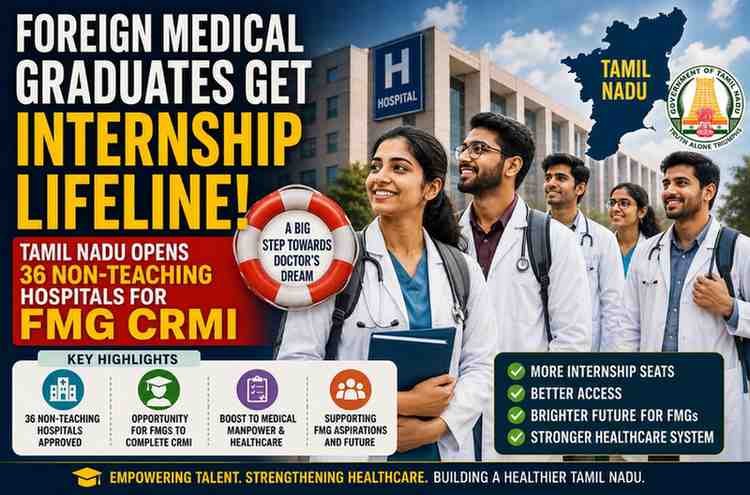
For hundreds of young doctors who spent years studying medicine abroad, the hardest part of becoming a licensed physician in India was never the classroom it was the waiting room. Now, Tamil Nadu has finally opened a door that many Foreign Medical Graduates (FMGs) had been knocking on for what felt like an eternity. The state has cleared the way for FMGs to complete their internship in 36 non-teaching hospitals, a decision that directly answers a demand that had been simmering for years among graduates who passed the Foreign Medical Graduate Examination (FMGE) but had nowhere to complete their mandatory Compulsory Rotating Medical Internship (CRMI).
Who does this affect? Hundreds of FMGs in Tamil Nadu who cleared the FMGE screening test but remained stuck without an internship posting. What changed? The Tamil Nadu Medical Council (TNMC) has now permitted internship training at 36 hospitals that are not attached to any medical college. When did this happen? The move comes in mid-2026, following months of public pressure, association appeals, and directives from the National Medical Commission (NMC). Where is this applicable? Across designated non-teaching government and private hospitals within Tamil Nadu. Why was it needed? Because the state’s medical colleges simply did not have enough internship seats to absorb the growing backlog of FMGs. How will it work? By allotting CRMI seats in these 36 hospitals under NMC-approved norms, alongside the existing college-based system.
This is not just a bureaucratic footnote. It is the resolution of a genuine human crisis one where fully qualified medical graduates were reportedly delivering food parcels and taking up odd jobs while waiting more than a year, sometimes close to two, for a seat that would let them legally begin practising medicine in the country they call home.
Understanding the Bottleneck: Why FMGs in Tamil Nadu Were Stuck
To understand why this decision matters, you need to understand the pipeline every Foreign Medical Graduate must pass through before they can hang up a stethoscope in an Indian clinic. An Indian citizen who studies MBBS abroad in countries like Russia, China, Georgia, the Philippines, or Ukraine must return home and clear the FMGE, a national screening exam considered one of the toughest licensing tests in the country. Passing the FMGE, however, is only half the battle. Every FMG must then complete a mandatory one-year CRMI inside an NMC-recognised Indian institution before they can obtain permanent medical registration and legally practise.
This is where the system had been quietly breaking down. Tamil Nadu, despite having one of India’s largest medical education ecosystems with dozens of recognised and approved medical colleges, was allotting FMGs almost exclusively to medical-college-attached teaching hospitals. The problem is that these seats are limited and shared with domestic MBBS graduates, creating a bottleneck that left FMGs waiting in a queue that barely moved.
Reports from FMG associations painted a grim picture earlier this year. Some graduates described waiting up to two years for an internship allotment, with only two or three candidates being placed each month despite hundreds remaining in line. The All FMGs Association (AFA) had publicly appealed to both the TNMC and the NMC, pointing out that non-teaching hospitals facilities not attached to a medical college but fully equipped to provide clinical training were sitting underutilised even though national guidelines explicitly permitted their use for FMG internships.
What Exactly Changed: The 36 Non-Teaching Hospital Decision
The latest development effectively closes that gap. By formally opening 36 non-teaching hospitals to CRMI training, Tamil Nadu has multiplied the number of institutions where FMGs can be posted, without needing new medical colleges to be built or new teaching capacity to be created overnight. Non-teaching hospitals are typically well-resourced district or government hospitals that handle high patient volumes and offer strong hands-on clinical exposure arguably even more intensive than what a slower-paced college ward might offer.
This mirrors a pattern seen at the national level too. The NMC itself has, over the past few years, approved several hundred non-teaching hospitals across India for CRMI purposes as a stopgap to manage the growing number of FMGE-qualified candidates. Tamil Nadu’s move essentially brings the state in line with a mechanism the national regulator had already sanctioned but which local implementation had been slow to adopt.
Timeline: How the FMG Internship Crisis Unfolded
| Period | Development |
|---|---|
| 2021 onwards | NMC’s Foreign Medical Graduate Licentiate Regulations formalise the requirement that FMGs who graduated after November 2021 complete their entire 12-month CRMI within India. |
| 2021–2023 | Pandemic and Russia-Ukraine war disruptions push a surge of returnee students into India, sharply increasing FMGE applicants and, in turn, demand for internship seats. |
| 2023–2025 | NMC issues a nationwide list of 650+ hospitals, including non-teaching institutions, approved for FMG internships, but state-level implementation remains inconsistent. |
| Early 2026 | FMG associations report severe delays in Tamil Nadu, with graduates waiting up to two years; some take up unrelated jobs to survive financially. |
| March 2026 | NMC’s Undergraduate Medical Education Board announces 43,250 additional CRMI slots nationally for 2026-27, with Tamil Nadu allotted a sizeable share. |
| Mid-2026 | Tamil Nadu formally permits FMG internships in 36 non-teaching hospitals, fulfilling a long-pending demand. |
The Bigger Picture: A Structural Mismatch in Indian Medical Education
It’s worth stepping back and asking why this problem exists at all. India produces roughly 1.29 lakh MBBS seats a year through its domestic medical colleges, yet more than 22 lakh students appear for the NEET-UG entrance exam annually. Nearly half of domestic seats sit in private colleges where fees can run into crores of rupees. That massive gap between aspiration and capacity is precisely what pushes thousands of Indian students abroad every year to pursue medicine at a fraction of the cost.
The irony is that this “abroad” pathway, meant to be a pressure release valve, simply relocates the bottleneck rather than removing it. Instead of competing for a college seat, these students now compete for an internship seat back home a queue that is, if anything, even tighter because it depends entirely on institutional capacity that colleges alone cannot provide. Opening non-teaching hospitals doesn’t just solve Tamil Nadu’s immediate backlog; it demonstrates a scalable model other states could copy without waiting for new medical colleges to be sanctioned, funded, and built a process that typically takes years.
Why This Matters: Real-World Impact on FMGs and the Healthcare System
The consequences of internship delays extend well beyond inconvenience. Consider the arithmetic: a typical MBBS course abroad already takes five to six years. Add the time needed to prepare for and clear the FMGE, and then a wait of twelve to twenty-four months for an internship seat, and a career that should logically wrap up in six to seven years stretches into eight, nine, or even ten years before a graduate earns the right to practise independently. For many families who have already stretched their finances to fund an overseas medical education, this extended limbo carries a real financial and emotional cost.
There’s also a public health angle that rarely gets enough attention. Tamil Nadu, like much of India, continues to grapple with uneven doctor-to-population ratios, particularly in semi-urban and rural pockets. Every FMG stuck waiting for an internship seat is, in effect, a trained medical professional sitting idle instead of contributing to patient care. Speeding up their absorption into the healthcare workforce provided quality and supervision standards are maintained is not just fair to the graduates; it is a rational use of scarce medical talent.
A Quiet Precedent With National Implications
Here’s an angle that’s easy to miss: Tamil Nadu’s decision is likely to become a reference point for other states currently under similar pressure. Reports from West Bengal earlier this year described dozens of FMGs left out of internship allotment rounds, and similar complaints have surfaced in other states with large numbers of returnee graduates. If Tamil Nadu’s non-teaching hospital model proves successful measured in shorter waiting times and steady throughput of interns expect FMG associations in other states to cite it directly in their own representations to state medical councils.
There’s also a fairness dimension worth flagging. A Supreme Court ruling earlier this year established that FMG interns must be paid the same stipend as their India-trained counterparts, closing a long-standing pay gap. Combined with expanded access to non-teaching hospitals, Tamil Nadu’s FMGs are now, on paper, moving closer to parity with domestically trained interns both in opportunity and in compensation. That’s a meaningful shift from a system that, until recently, treated foreign-trained doctors as a lower priority.
What FMGs Should Do Next
- Keep provisional registration documents, FMGE scorecards, and eligibility certificates updated and ready, since seat allotment typically moves quickly once new capacity opens.
- Track official notifications directly from the Tamil Nadu Medical Council rather than relying solely on informal groups, as hospital-wise seat distribution and application windows can change.
- Stay in touch with FMG associations, which have played a visible role in escalating this issue and are likely to continue monitoring implementation.
- Factor in that internship terms stipend, duty hours, facilities are expected to mirror those given to Indian MBBS interns at the same hospital.
Conclusion: A Step Forward, Not the Finish Line
Tamil Nadu’s decision to open 36 non-teaching hospitals for FMG internships is a genuinely significant moment for a group of graduates who have spent years navigating one of the most frustrating corners of India’s medical education system. It doesn’t erase the structural mismatch between the number of students pursuing medicine abroad and the country’s capacity to absorb them into the internship pipeline, but it does offer immediate, practical relief to a backlog that had left qualified doctors driving delivery bikes instead of treating patients.
The bigger test now lies in execution how quickly seats are actually allotted, whether stipend and training standards hold up to scrutiny, and whether other internship-starved states follow Tamil Nadu’s lead. If this model works as intended, it could well become the template that finally untangles India’s Foreign Medical Graduate internship crisis, one non-teaching hospital at a time.
For breaking news and live news updates, like us on Facebook or follow us on Twitter and Instagram. Read more on Latest Health on thefoxdaily.com.






COMMENTS 0