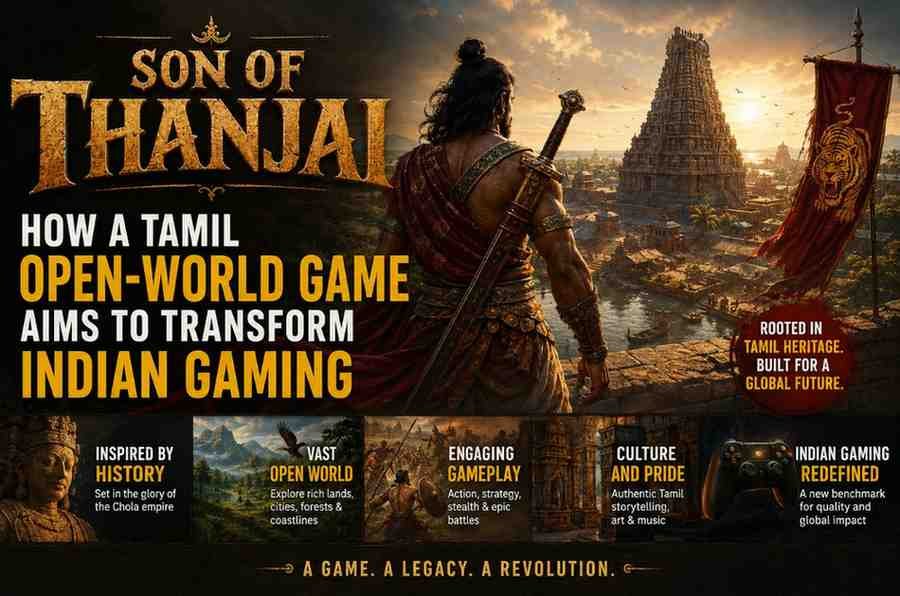
For decades, India’s Gaming industry has largely been known for mobile titles, outsourced development, and adaptations of global trends. But a new generation of creators is attempting something far more ambitious: building original games inspired by India’s own history, languages and cultural traditions.
Son of Thanjai, an upcoming historical open-world game from Ayelet Studio, is among the most closely watched examples of this shift. Developed with writer and lyricist Madhan Karky and led by Ayelet Studio head Abraham K, the project seeks to combine immersive gameplay with authentic Tamil heritage, creating an experience that resonates with local players while appealing to a global audience.
The game’s ambition extends beyond entertainment. It represents a broader movement within Indian game development one that believes local stories, when told with world-class production values, can travel far beyond regional borders.
Why ‘Son of Thanjai’ Is Generating Interest
The international gaming industry has increasingly embraced stories rooted in specific cultures. Successful titles inspired by Japanese folklore, Norse mythology, Chinese legends, and European medieval history have demonstrated that authenticity often creates stronger global appeal rather than limiting it.
Son of Thanjai follows this philosophy by drawing inspiration from Tamil history and culture instead of imitating familiar Western fantasy settings.
Rather than presenting India as a backdrop, the game places its heritage at the centre of the narrative.
What Is an Open-World Historical Game?
Open-world games allow players to explore expansive environments with greater freedom instead of following a strictly linear path. Players can interact with characters, complete quests, discover hidden locations and experience stories at their own pace.
When combined with historical settings, this format enables players to engage with architecture, traditions, landscapes and social life in ways that feel immersive rather than instructional.
For developers, however, this freedom also demands significantly greater world-building, technical expertise and historical research.
The Significance of Thanjavur in Tamil History
The title Son of Thanjai immediately evokes Thanjavur (Tanjore), one of Tamil Nadu‘s most historically significant cities. Known for its artistic traditions, temple architecture, literature, music and contributions to South Indian civilisation, Thanjavur has long served as a cultural centre.
Its legacy provides rich material for storytelling, allowing developers to draw from history without relying solely on fictional fantasy worlds.
Using such a setting also offers international players an opportunity to experience a part of Indian history that has rarely appeared in mainstream video games.
Building Authenticity Without Becoming a History Lesson
One of the biggest creative challenges in historical game development is balancing authenticity with entertainment.
Players expect engaging gameplay, compelling characters and meaningful exploration. At the same time, developers seeking cultural authenticity must carefully research language, architecture, costumes, music, traditions and historical context.
The goal is not to create a textbook but to build a believable world where history enhances immersion rather than interrupting it.
The Challenge of Creating a Rooted Tamil Game for Global Players
Madhan Karky and Abraham K have highlighted the importance of creating a game that remains deeply connected to Tamil identity while remaining accessible to players unfamiliar with the culture.
This balance is one of the defining challenges facing culturally inspired games.
Too much localization may confuse international audiences, while excessive simplification risks losing the authenticity that makes the project unique.
Successful cultural storytelling often finds universal human themes courage, family, conflict, ambition and discovery—within distinctly local settings.
| Creative Goal | Development Challenge |
|---|---|
| Historical Authenticity | Balancing accuracy with gameplay |
| Tamil Cultural Identity | Appealing to international audiences |
| Open-World Exploration | Building detailed environments |
| Storytelling | Making history emotionally engaging |
| Global Reach | Competing with major international studios |
Why Indian Gaming Needs Original Stories
India is one of the world’s largest gaming markets by player numbers, yet relatively few globally recognized premium games originate from Indian studios.
Many developers have traditionally focused on mobile gaming or outsourced projects due to financial constraints and market realities.
Original narrative-driven games like Son of Thanjai represent an important step toward establishing India’s identity as a creator not merely a consumer of globally competitive gaming experiences.
The Rise of Cultural Storytelling in Video Games
Modern players increasingly seek authentic worlds that introduce them to unfamiliar cultures. This trend has encouraged studios around the world to explore indigenous traditions, historical civilizations and regional folklore.
For Indian developers, this creates an opportunity to showcase the country’s extraordinary cultural diversity through interactive storytelling.
Unlike films or books, video games allow audiences to actively participate in these worlds, making cultural experiences more immersive.
Technology Is Raising Expectations
Today’s gamers expect visually rich environments, intelligent artificial intelligence, realistic animation, cinematic storytelling and seamless exploration.
Meeting these expectations requires advanced game engines, skilled artists, programmers, writers, historians, sound designers and quality assurance teams.
Developing a large-scale open-world game is therefore one of the most resource-intensive forms of digital entertainment.
For emerging Indian studios, achieving this level of quality represents both a creative and technical milestone.
Language as a Creative Strength
One of the distinctive aspects of Son of Thanjai is its embrace of Tamil language and identity rather than treating them as obstacles.
Increasingly, audiences appreciate multilingual storytelling when supported by thoughtful localization through subtitles, voice acting and contextual storytelling.
Rather than reducing cultural specificity, preserving linguistic authenticity often enhances immersion.
The Economic Opportunity for Indian Game Development
The Indian gaming industry has expanded rapidly over the past decade, driven by smartphones, faster internet connectivity and a growing community of players.
However, premium PC and console games developed entirely in India remain relatively rare.
Projects like Son of Thanjai could encourage greater investment in domestic studios, specialized training, digital art, animation and interactive storytelling.
A successful original title also has the potential to inspire future developers to explore India’s own historical narratives.
The Bigger Picture: Games as Cultural Ambassadors
Films have long introduced international audiences to different cultures, but video games offer an even deeper level of engagement because players actively explore rather than simply observe.
A carefully researched historical game can generate curiosity about architecture, literature, music, traditions and historical events, encouraging players to learn beyond the game itself.
In this way, games increasingly function as modern cultural ambassadors.
| Traditional Historical Learning | Historical Gaming Experience |
|---|---|
| Reading textbooks | Interactive exploration |
| Passive observation | Player-driven discovery |
| Fixed narrative | Immersive storytelling |
| Historical facts | Emotional engagement with history |
| Limited visualization | Detailed digital environments |
What Success Could Mean for Indian Gaming
If Son of Thanjai succeeds both creatively and commercially, its impact may extend beyond a single title.
It could demonstrate that Indian history, regional languages and cultural narratives possess global commercial potential when combined with modern game design and high production values.
This may encourage developers across the country to move beyond imitation and invest in original intellectual property rooted in India’s diverse traditions.
Such a shift would strengthen both creative independence and international recognition for Indian studios.
Conclusion
Son of Thanjai represents more than an ambitious open-world historical game—it symbolizes a changing vision for Indian game development. By embracing Tamil culture rather than borrowing familiar international settings, the project challenges the long-held assumption that global success requires abandoning local identity.
For creators like Madhan Karky and Abraham K, the goal is not simply to tell a Tamil story but to demonstrate that authentic regional narratives can resonate with players anywhere in the world.
As India’s gaming industry continues to mature, projects like Son of Thanjai may mark the beginning of a new era one where the country’s rich history, languages and traditions become powerful foundations for globally celebrated interactive experiences.
For breaking news and live news updates, like us on Facebook or follow us on Twitter and Instagram. Read more on Latest Lifestyle on thefoxdaily.com.






COMMENTS 0