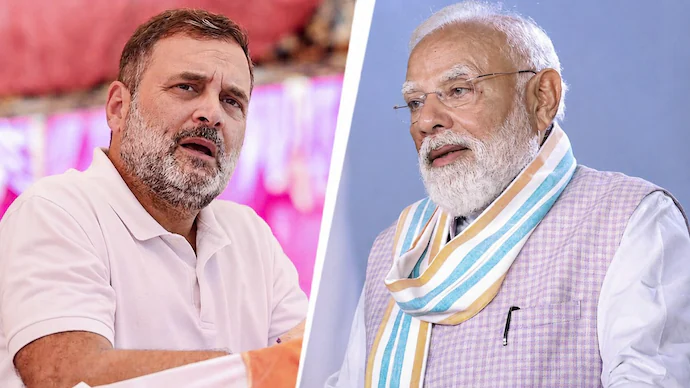
Congress leader Rahul Gandhi has hit back at Prime Minister Narendra Modi over his criticism of industrialists for failing to create enough jobs and increase employee salaries despite benefiting from government tax concessions. Turning the Prime Minister’s remarks against corporate leaders into a political attack, Gandhi argued that the comments exposed the shortcomings of the government’s economic policies and its relationship with large businesses.
In a post on X on Friday, the Leader of Opposition in the Lok Sabha said Modi’s criticism was effectively an admission of his own government’s failure to ensure that tax benefits and policy support translated into employment opportunities and better wages. Gandhi also accused the government of allowing major businesses to gain control over key sectors while small traders and micro, small and medium enterprises (MSMEs) struggled to survive.
Rahul Gandhi Says PM Modi’s Criticism of Industrialists Is an Admission of Policy Failure
Gandhi responded to the Prime Minister’s remarks at the centenary celebrations of the Federation of Indian Chambers of Commerce and Industry (FICCI) in Delhi. Modi had questioned whether companies had done enough for employees after receiving benefits from the government’s economic and tax-related measures.
Reacting to the criticism, Gandhi said the Prime Minister was blaming industrialists for outcomes that his own government should be accountable for. In his post, he wrote that Modi’s comments were not accusations against business leaders but a confession about the government’s approach to the economy.
“Yesterday, Modi ji was taunting industrialists: ‘We cut taxes, yet you neither raised wages nor created jobs.’ Modi ji, these aren’t accusations against them, they’re your own confession,” Gandhi wrote in Hindi.
He then turned to the Prime Minister’s remarks about the appetite of industrialists, arguing that the government had provided major business groups with access to valuable economic opportunities and assets without demonstrating that these benefits had generated enough employment.
“You say, ‘They’re so hungry they can’t even fill their stomachs.’ Well said. The whole country knows whose hunger this is. Airports, ports, mines, forests, electricity, coal, roads – all handed over to them. How many jobs did they create?” he said.
The Congress leader’s argument centred on the distinction between business growth and broad-based economic development. While large companies can expand their operations and increase their market presence, Gandhi questioned whether the resulting economic gains were reaching workers, smaller enterprises and ordinary households.
Modi Questions Why Tax Benefits Have Not Led to More Jobs and Higher Salaries
The political exchange began after Modi addressed corporate leaders at FICCI’s centenary celebrations. The Prime Minister highlighted the government’s efforts to improve the business environment and reduce the tax burden on companies, but challenged industrialists to explain why these measures had not resulted in stronger employment and wage growth.
Modi referred to the reduction in the corporate tax rate from 30 per cent in 2014 to 22 per cent in 2019. He also pointed to the government’s tax relief under the new personal income tax regime, under which eligible taxpayers with annual incomes of up to Rs 12 lakh can receive a rebate that brings their tax liability to zero, subject to the applicable conditions.
However, the Prime Minister questioned whether companies had responded to these measures by hiring more employees or increasing salaries. His criticism suggested that tax concessions and improvements in the ease of doing business should be accompanied by a greater contribution from the corporate sector to employment and household incomes.
Addressing the industrialists, Modi said: “Mujhe maloom hai taali nahi bajaoge. Achhi tarah jaanta hoon kyunki aapki bhookh itni hai, kitna hi khilao, pet bharta nahi hai.”
In English, he said he knew business leaders would not applaud because their appetite was so large that no matter how much they received, it was never enough.
He also directly questioned the audience about employment and wages, asking whether companies had increased employee salaries or expanded their workforce after benefiting from government measures.
“Have you increased the salaries of your employees? Have you increased the number of people you employ? No. Your attitude is, ‘Modi ji, you do it. We will just watch’,” the Prime Minister said.
Modi’s remarks were notable because they placed responsibility on corporate India to convert favourable business policies into tangible economic benefits for employees. Rather than limiting his address to the government’s achievements in improving the business environment, he challenged industrialists over their contribution to job creation and wage growth.
Gandhi Accuses Government of Weakening Small Traders and MSMEs
Gandhi broadened his response beyond the Prime Minister’s comments at FICCI, bringing demonetisation and the implementation of the Goods and Services Tax (GST) into the debate. He accused the government of damaging small traders and MSMEs through policies that, in his view, placed a disproportionate burden on smaller businesses.
Small enterprises play an important role in India’s employment ecosystem, operating across manufacturing, retail, services and local supply chains. Many have limited access to affordable credit and fewer financial resources than large corporations, making them particularly sensitive to disruptions in demand, compliance costs and working-capital requirements.
Gandhi argued that the government’s economic approach had made it harder for these businesses to compete while allowing larger companies to strengthen their positions in important sectors.
He also linked the issue to market concentration, warning that excessive dominance by a small number of companies could weaken competition and affect consumers.
“Monopoly doesn’t create jobs. It drives up prices and eliminates competition. ‘You do it, we’ll see?’ Modi ji, you and your friends did the looting – the country saw it, and is still seeing it,” he said.
These allegations reflect the Congress party’s broader criticism of the government’s economic policies and its claims that economic opportunities have become increasingly concentrated among large corporate groups. The government and its supporters have generally defended their approach by pointing to infrastructure investment, tax reforms, manufacturing initiatives and efforts to improve the ease of doing business.
Why the Debate Over Corporate Tax Cuts and Employment Matters
The exchange highlights a larger economic question: whether lower taxes and a more favourable business environment automatically translate into higher wages and more jobs.
Corporate tax reductions can improve the financial position of companies by lowering the amount of profit they pay in taxes. Businesses may use the additional resources to invest in new facilities, expand production, upgrade technology, repay debt or strengthen their balance sheets. However, these decisions do not automatically guarantee that companies will hire more workers or increase salaries.
Employment growth depends on several factors, including consumer demand, business confidence, investment plans, access to finance, technology adoption and the overall state of the economy. Companies may increase production without proportionately expanding their workforce, particularly when automation and productivity improvements reduce the need for additional labour.
Wage growth also depends on the availability of skilled workers, labour-market conditions, profitability and competition for employees. Even when companies benefit from tax reductions, the gains may not be distributed equally among shareholders, workers and consumers.
This is why Modi’s challenge to industrialists and Gandhi’s criticism of the government address different sides of the same economic debate. The Prime Minister has questioned whether corporate India is doing enough with the benefits it receives, while Gandhi has argued that the government itself must answer for the structure of economic opportunities and the distribution of growth.
Rahul Gandhi Mocks PM Modi Over Industrialists’ Reaction
Gandhi also used the Prime Minister’s comments about the lack of applause from the business audience to deliver another political jab. Modi had indicated that he expected industrialists not to applaud his remarks, suggesting that corporate leaders were unwilling to acknowledge the government’s support.
Gandhi mocked the Prime Minister for appearing dissatisfied with the audience’s reaction and suggested that he seek applause from his remaining supporters instead.
“Get your applause and your thali-banging from whatever followers you have left,” he wrote on X.
The remark added a personal and political dimension to an exchange that had begun with questions about corporate responsibility, taxation and employment. It also reflected the increasingly confrontational rhetoric between the ruling BJP and the Congress over economic policy and the influence of large business groups.
Corporate India Faces Questions From Both the Government and Opposition
The political significance of the exchange lies in the fact that Modi and Gandhi have approached the same issue from sharply different perspectives. The Prime Minister has challenged industrialists to demonstrate that government concessions are producing wider benefits for employees and the economy. Gandhi, meanwhile, has argued that the government cannot distance itself from the consequences of its own economic decisions.
For businesses, the debate raises questions about how corporate tax relief, investment incentives and regulatory reforms should translate into measurable outcomes such as employment, wage increases and stronger domestic supply chains. For workers, the central concern is whether economic growth is improving household incomes and creating stable employment opportunities.
Small traders and MSMEs are also central to the argument because their ability to compete affects the diversity of India’s business ecosystem. A market dominated by a limited number of large companies may create challenges for smaller enterprises, although the extent of those effects depends on individual sectors, competition and market conditions.
Neither the Prime Minister’s criticism nor Gandhi’s accusations, by themselves, establish whether corporate tax concessions have failed or whether large businesses have received unfair advantages. Assessing those claims requires examining employment trends, wage growth, investment, competition and the distribution of economic gains.
Nevertheless, the exchange has brought an important issue into the political spotlight: the responsibility of both governments and corporations to ensure that economic growth delivers benefits beyond company balance sheets. As the debate over jobs, salaries and business concentration continues, the performance of India’s corporate sector and the effectiveness of government policies are likely to remain major points of political contention.
For breaking news and live news updates, like us on Facebook or follow us on Twitter and Instagram. Read more on Latest India on thefoxdaily.com.






COMMENTS 0