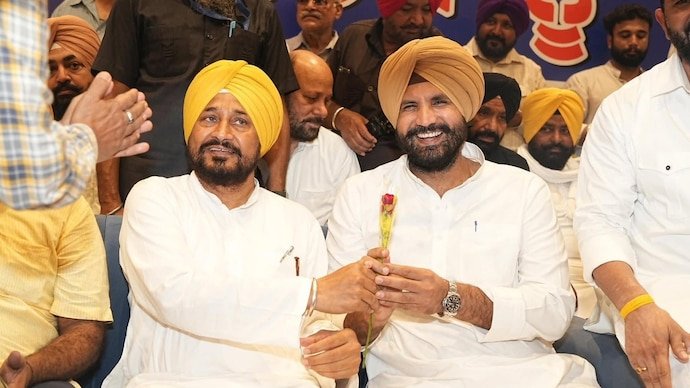
The Punjab congress is once again at a crucial turning point. With less than a year and a half before the 2027 Punjab Assembly Elections, the party’s central leadership is conducting an extensive review of its state unit amid growing concerns over factionalism, declining grassroots influence, and the challenge posed by the ruling Aam Aadmi Party (AAP).
The debate is not merely about replacing a state president or reshuffling organisational posts. It is about determining the future direction of one of Congress’s most important state units. Punjab remains one of the few states where Congress continues to possess a substantial political base, experienced leadership, and the potential to stage a comeback. However, repeated internal conflicts have often undermined that potential.
As senior leaders deliberate on the future of Punjab Congress, the decisions taken in the coming months could shape not only the party’s prospects in 2027 but also its broader revival strategy in northern India.
Why Punjab Matters So Much for Congress
Punjab has historically been one of Congress’s strongest states. The party has governed the state multiple times and continues to maintain a significant support base among urban voters, sections of farmers, Dalits, and traditional Congress loyalists.
However, the political landscape has changed dramatically over the last decade.
The rise of AAP disrupted the traditional Congress-versus-Akali Dal political structure. The 2022 assembly election resulted in a landslide victory for AAP, while Congress suffered one of its worst defeats despite being the incumbent government.
That defeat exposed several structural weaknesses:
- Persistent factional infighting
- Leadership instability
- Lack of organisational discipline
- Confusion over chief ministerial faces
- Weak coordination between state and central leadership
With AAP now seeking re-election in 2027, Congress cannot afford to repeat those mistakes.
The High Command’s Unusual Level of Attention
Recent developments indicate that the Congress high command is treating Punjab as a priority state.
Rahul Gandhi, Congress president Mallikarjun Kharge, and Punjab in-charge Bhupesh Baghel have held multiple consultations with state leaders. The appointment of a three-member observers’ panel reflects the seriousness of the exercise.
The committee has reportedly interacted with a broad cross-section of leaders, including MPs, MLAs, former ministers, district presidents, and veteran party workers.
This approach suggests that Congress is trying to avoid the mistakes of previous organisational decisions that were often made based on factional lobbying rather than grassroots feedback.
The observers’ report is expected to provide recommendations on:
- State leadership structure
- Election preparation strategy
- District-level organisation
- Candidate selection mechanisms
- Representation of different communities
The Raja Warring Question
At the centre of the debate lies Punjab Congress president Raja Amarinder Singh Warring.
Warring was appointed to energise the organisation after the 2022 electoral defeat. His supporters argue that he inherited a fractured party and has worked to rebuild organisational networks across the state.
However, critics point to recent local body election results as evidence that the party has not achieved the desired momentum under his leadership.
The setback in Gidderbaha, considered one of Warring’s political strongholds, has strengthened voices demanding a leadership review.
The challenge for Congress is that replacing a state president close to elections can create fresh instability, while retaining him could disappoint leaders WHO believe change is necessary.
This is precisely why the high command faces a difficult balancing act.
Charanjit Singh Channi’s Growing Influence
Former Chief Minister Charanjit Singh Channi remains one of the most significant figures in Punjab Congress.
His supporters believe he continues to enjoy considerable popularity among sections of Dalit voters and grassroots workers.
Several factors strengthen Channi’s position:
- His experience as Chief Minister
- His appeal among Scheduled Caste communities
- Improved local electoral performance in some areas
- His visibility at the national level
Yet Channi’s candidacy for a larger organisational role is not without complications.
Congress projected him as Punjab’s first Dalit Chief Minister before the 2022 Assembly election. Despite the symbolic significance of that decision, the party suffered a crushing defeat.
Many within Congress therefore question whether relying once again on personality-centric Politics is the right approach.
The Dalit-Jatt Sikh Balancing Challenge
Perhaps the most sensitive issue confronting Congress is social representation.
Punjab has one of the highest proportions of Scheduled Caste populations among Indian states. Dalit voters play a decisive role in dozens of constituencies.
At the same time, Jatt Sikhs continue to dominate much of the state’s political leadership.
Currently, both key Congress positions are held by Jatt Sikh leaders:
| Position | Leader | Community Background |
|---|---|---|
| Punjab Congress President | Raja Warring | Jatt Sikh |
| Leader of Opposition | Pratap Singh Bajwa | Jatt Sikh |
This has intensified demands from Dalit leaders for greater representation.
Political observers believe Congress must carefully balance social representation without triggering new factional tensions.
A leadership formula that includes stronger Dalit participation could potentially help the party reconnect with a voter segment that has increasingly shifted toward AAP.
How AAP Changed Punjab Politics
One reason Congress is reassessing its strategy is the transformation of Punjab’s political Environment since AAP’s rise.
Traditional Congress strengths no longer guarantee electoral success.
AAP’s emergence introduced a different political model focused on:
- Governance-based campaigning
- Anti-establishment messaging
- Welfare delivery
- Centralised leadership structure
- Digital voter outreach
Congress often finds itself fighting multiple battles simultaneously—against AAP externally and against internal rivalries internally.
Unless organisational unity improves, defeating a relatively disciplined political opponent will remain difficult.
The Lessons From Congress’s 2022 Defeat
The 2022 Punjab election offers several lessons that continue to shape current discussions.
Before the election, Congress experienced prolonged public disputes among senior leaders. Leadership changes, chief ministerial controversies, and factional conflicts dominated headlines.
While voters expected Congress to highlight governance achievements, much of the campaign became focused on internal disagreements.
The result was a dramatic erosion of public confidence.
Many party strategists now believe that organisational stability matters as much as electoral messaging.
This explains why the high command is investing considerable effort in evaluating the state unit nearly two years before polling.
Potential Leadership Scenarios Before 2027
Several possible outcomes are being discussed within political circles.
Scenario 1: Status Quo
Congress retains Raja Warring while strengthening the organisational structure around him.
Advantages:
- Avoids disruption
- Provides continuity
- Allows focus on election preparation
Risks:
- Dissatisfied factions may continue internal pressure
- Momentum for change may be lost
Scenario 2: Leadership Change
A new state president is appointed before the election.
Advantages:
- Fresh energy
- Signals accountability
- Potentially unites dissatisfied groups
Risks:
- New factional disputes emerge
- Transition period consumes valuable time
Scenario 3: Collective Leadership Model
Congress adopts a broader power-sharing arrangement involving leaders from different communities and factions.
Advantages:
- Greater representation
- Reduces concentration of power
- Improves internal inclusion
Risks:
- Decision-making becomes slower
- Conflicting power centres may emerge
The Bigger Challenge: Rebuilding Trust With Voters
Leadership decisions alone will not guarantee electoral success.
The larger challenge for Congress is rebuilding voter trust.
Punjab’s electorate is increasingly demanding practical solutions to issues such as:
- Agricultural sustainability
- Youth unemployment
- Drug abuse concerns
- Industrial growth
- State finances
- Rural development
Whichever leadership structure emerges must present a credible alternative vision for governance.
Voters are likely to evaluate parties less on internal organisational appointments and more on whether they can address everyday concerns.
A Comparison With Other Congress Revival Efforts
Punjab’s situation resembles challenges Congress has faced in several states.
Successful revivals in the past have generally shared three characteristics:
- Clear leadership
- Organisational discipline
- Unified messaging
States where Congress remained trapped in factional battles often struggled to convert voter dissatisfaction into electoral gains.
This is why Punjab is increasingly being viewed as a test case for the party’s broader revival strategy.
What the Observers’ Report Could Reveal
The upcoming report is expected to provide a detailed assessment of grassroots sentiment within the organisation.
Beyond recommending names for leadership roles, the report could identify structural weaknesses that have prevented Congress from functioning as a cohesive electoral machine.
If implemented effectively, its recommendations may help the party establish a clearer roadmap toward 2027.
However, implementation will ultimately matter more than diagnosis.
Future Outlook: A Defining Moment for Punjab Congress
The Punjab Congress faces one of its most important strategic decisions since its defeat in 2022.
The debate over leadership is ultimately a debate about the party’s future identity, organisational culture, and electoral strategy. Whether Congress chooses continuity or change, the decision must address deeper challenges involving factionalism, representation, and voter confidence.
The coming weeks could determine whether the party enters the 2027 election united and focused or continues to grapple with internal uncertainty.
One thing is clear: Punjab remains one of Congress’s best opportunities for a major electoral comeback. But converting that opportunity into victory will require more than leadership changes. It will demand organisational discipline, social coalition-building, a compelling vision for governance, and above all, unity at a time when every political advantage matters.
As the observers submit their findings and the high command weighs its options, Punjab Congress stands at a crossroads that could shape not only the state’s political future but also the trajectory of the party’s national revival efforts.
For breaking news and live news updates, like us on Facebook or follow us on Twitter and Instagram. Read more on Latest India on thefoxdaily.com.






COMMENTS 0